
Open the valve on a compressed-air reservoir and the jet grows stronger as the pressure outside falls. Eventually something peculiar happens: reducing the downstream pressure further no longer increases the mass of gas escaping per second. The flow has reached a sonic bottleneck. A narrow throat has become a remarkably predictable flow regulator.
This phenomenon, called choked flow, helps explain how rocket nozzles set their mass flow and why their flared exit can accelerate gas even though an ordinary widening pipe slows it. It also matters when sizing gas feed systems, laboratory jets and pressure-relief equipment.
What reaches its limit?
Imagine a large reservoir of air feeding a smooth converging nozzle. The reservoir is nearly motionless, so its pressure and temperature are approximately the stagnation values p₀ and T₀. The passage narrows to an area A*. Outside, a separate chamber imposes the back pressure pb. All pressures here are absolute.
For a steady one-dimensional stream, mass conservation reads
ṁ = ρVA
where ṁ is mass flow (kg/s), ρ is density (kg/m³), V is speed (m/s), and A is passage area (m²). An incompressible intuition suggests that a larger pressure difference always means more speed and therefore more flow. Gas density, however, falls as the gas accelerates. The nozzle must accommodate both changes.
The speed of sound a is the speed at which small pressure disturbances travel relative to the local gas. Define Mach number M = V/a. Once the throat reaches M = 1, disturbances from farther downstream can no longer travel upstream through that sonic section in the steady flow. Further lowering back pressure cannot tell the reservoir to supply a greater mass flow through the same ideal throat. The gas can still expand and accelerate after the throat; the bottleneck remains.
The area equation reverses its sign
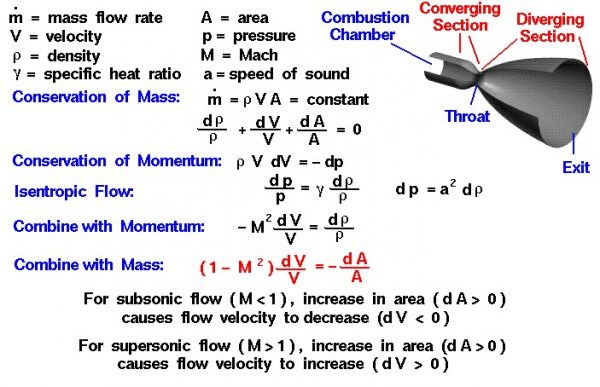
The surprising geometry follows from combining mass conservation with the inviscid momentum equation and the isentropic relation between pressure and density. For a smooth, steady, quasi-one-dimensional flow without heat transfer or shocks:
(1 − M²) dV/V = −dA/A
Below Mach one, the coefficient on the left is positive. Narrowing the passage (dA < 0) accelerates the gas. Above Mach one, that coefficient is negative: widening the passage accelerates the gas. In supersonic expansion, density decreases sufficiently rapidly that speed must rise even as the flow area grows.
This is why a converging-diverging, or de Laval, nozzle has its narrowest section between two regions. A properly choked throat can feed a supersonic expansion in the divergent part. But a flared nozzle does not guarantee supersonic flow. Depending on back pressure, its divergent section can carry subsonic flow, a shock, or an overexpanded jet.
Calculate the maximum flow
For a calorically perfect ideal gas, with constant heat-capacity ratio γ and specific gas constant R, the isentropic mass-flow expression is
ṁ = (Ap₀/√T₀) √(γ/R) M [1 + (γ−1)M²/2]−(γ+1)/[2(γ−1)].
At fixed stagnation conditions and area, the Mach-dependent factor reaches its maximum at M = 1. The resulting throat capacity is
ṁ* = (A*p₀/√T₀) √(γ/R) [2/(γ+1)](γ+1)/[2(γ−1)].
Here A* denotes the sonic throat area, not multiplication. The units reduce to kg/s: area times pressure divided by the square root of temperature, multiplied by the gas-property factor.
Take an illustrative air reservoir at p₀ = 300 kPa absolute and T₀ = 300 K, with a 10 mm² throat. Approximate air as γ = 1.4 and R = 287 J/(kg K). Substitution gives ṁ* ≈ 0.0070 kg/s, or about 7.0 grams per second. This is an ideal capacity, not a measured discharge rate. Boundary layers, contraction and other losses can lower the actual value.
The ideal static-to-stagnation pressure ratio at a sonic section is
p*/p₀ = [2/(γ+1)]γ/(γ−1) ≈ 0.528 for air.
Thus the sonic throat static pressure in this example is about 158 kPa absolute. For a simple converging nozzle discharging directly into a chamber, the ideal choking threshold corresponds to a back pressure near this value. For a converging-diverging nozzle, the relationship between back pressure, exit pressure, shock position and throat choking requires the full nozzle solution. Applying 0.528 blindly to its exit pressure would be a mistake.
Why lowering back pressure can still matter
Mass flow may plateau while the downstream jet changes dramatically. A lower external pressure can allow additional expansion, greater exit speed, or a different shock pattern. In a rocket engine, thrust depends on momentum flux and exit pressure:
F = ṁVe + (pe − pa)Ae
for a stationary rocket with negligible inlet momentum. Here e indicates exit conditions and pa is ambient pressure. Even with nearly constant ṁ, changes in ambient pressure alter pressure thrust and potentially the internal expansion pattern. A choked throat fixes the ideal mass-flow capacity for given upstream stagnation conditions; it does not fix thrust.
NASA’s mass-flow derivation shows the maximum at Mach one, while its nozzle design explanation derives the reversal in the area-velocity relation. These are idealized governing relations. Real hot rocket gases can have temperature-dependent specific heats, changing chemical composition, viscous losses and shocks. Engineers use more detailed thermochemistry and nozzle calculations where those effects matter.
A small simulation worth trying
Proposed calculation, not an experiment already performed. Hold p₀ = 300 kPa, T₀ = 300 K, γ = 1.4 and A = 10 mm². Evaluate the general mass-flow equation above for M from 0.05 to 2.0, then plot ṁ against M. The curve should peak at M = 1 near 7 g/s. Mark the subsonic and supersonic branches. This is a plot of the local ideal mass-flow function at fixed area and stagnation state; it is not a prediction that a given physical nozzle traverses all Mach numbers when back pressure changes.
For a second calculation, vary T₀ while keeping p₀ and A fixed. The choked mass flow scales as 1/√T₀. Raising the reservoir temperature from 300 K to 600 K reduces the ideal flow capacity by a factor of √2 if γ and R remain constant. Raising the upstream stagnation pressure instead increases that capacity linearly. The counterintuitive consequence is useful: a hotter reservoir can deliver less mass per second through the same sonic throat even though the emerging gas has more energy per unit mass.
The engineering decision follows directly. Size a throat from required mass flow and upstream thermodynamic state, then choose the divergent geometry for the desired expansion and operating pressure range. The throat and exit solve different problems, and neither can be designed sensibly from velocity alone.
For related Alkemata engineering, see how rocket engines cool their walls with fuel. Cooling and choking interact through the chamber conditions, but address distinct limits on engine design.
Author
What concrete example would confirm or challenge this article?
Choose a reaction, write a comment, or ask your AI assistant to send a proposal for review. Comments are reviewed before publication.