
A bathroom can sit unused for weeks and look perfectly clean, yet the first person who opens the door notices a drain smell. Pouring a glass of water into the basin may make it disappear. That small intervention works because the bend beneath the sink is not primarily a place for debris to collect. It is a liquid valve with no moving parts.
A P-trap holds a plug of water between the room and the drainage system. Wastewater can spill over its outlet, but air from the pipe must first push that retained water out of the way. The trap therefore behaves as a small hydrostatic pressure barrier. Its strength can be estimated, its failures have distinct causes, and its reliability depends on a second piece of plumbing that is mostly out of sight: the vent.
A liquid door
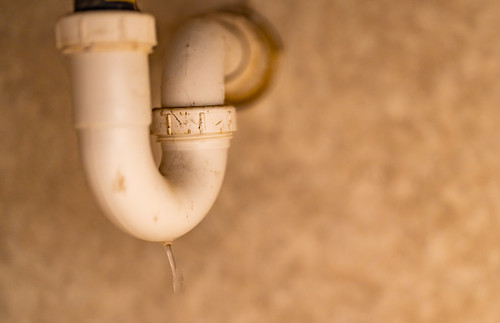
Look at the trap in profile. Water entering from the basin descends into the low bend and rises towards the outlet. When its level reaches the outlet weir, additional water flows away, but some remains in the bend. The vertical depth between the standing surface and the point at which the seal would be lost is the trap seal.
To cross that barrier, a pressure difference must displace the water. The relationship is the same one used in a simple manometer: Δp ≈ ρgΔh. The pressure difference Δp is proportional to the density of the liquid ρ, gravitational acceleration g, and the difference in water level Δh. With water, a 25-millimetre difference corresponds to roughly 245 pascals. A pressure that seems tiny on an engineering gauge can therefore move a visible fraction of a shallow seal.
This is why plumbing codes specify both the seal and the pressure conditions around it. The 2024 International Residential Code, for example, specifies trap seals between 51 and 102 millimetres and requires protection against siphonage and back pressure. Exact rules differ by jurisdiction, but the physical question is universal: will enough water remain between the two air spaces?
Why a drain needs an air route
A drainage stack does not carry water alone. It carries water and air, often in rapidly changing patterns. A discharged basin or toilet can send a slug or film of water down a pipe, entraining air and creating short pressure changes. Negative pressure on the drain side can pull water from a trap; positive pressure can push it towards the room. The National Institute of Standards and Technology described building drainage as an unsteady, three-phase flow involving air, water and solids—not simply water sliding down an empty tube—in its review of water supply and drainage in buildings.
The vent system gives that displaced air a route. The International Code Council’s explanation of venting says the system is designed to prevent pressure from exceeding 249 pascals, or one inch of water column, on either side of the trap. In other words, the vent protects a water barrier by keeping ordinary pressure disturbances below a controlled fraction of its depth.
A gurgle is therefore useful evidence: air and water are rearranging. It is not, by itself, a diagnosis. The cause might be a local blockage, poor venting, an unsuitable pipe layout or something farther downstream. The sound says to investigate the pressure path, not merely to pour in a stronger cleaner.
Four ways the boundary fails
The water seal is elegant, cheap and passive, but it is not permanent.
Evaporation can empty a trap in a rarely used shower, floor drain or guest basin. Both the residential code and the World Health Organization’s guidance on plumbing treat maintaining water seals as part of sanitary drainage. Where a fixture cannot be used regularly, building systems may need a trap-seal protection device rather than relying on memory.
Siphonage occurs when flowing water and falling pressure draw the seal towards the drain. The geometry and vent connection determine whether the trap refills or is stripped. Back pressure does the reverse, pressing drainage air and water towards the fixture. Finally, leakage can lower the seal without any pressure event at all; moisture at a joint or beneath the bend is evidence to address, not part of normal operation.
The strongest objection to calling a trap a “valve” is that it cannot actively close or report its own failure. That objection is correct. A trap is dependable only as part of a system: sound joints retain water, regular use replenishes it, suitable geometry resists self-siphonage, and venting limits pressure. The simple component works because the surrounding design keeps it inside a narrow operating range.
Make the pressure visible
A clean tabletop model can turn the mechanism into a measurement. Use a length of transparent flexible tube, bend it into a U and secure it upright. Add coloured water until both sides contain a shallow column, then tape a ruler beside the tube and mark the initial levels. Keep the model entirely separate from household plumbing.
Connect a clean squeeze bottle or large syringe to one end—never use your mouth—and apply pressure slowly. One surface falls while the other rises. Measure the vertical difference between them and estimate the pressure with Δp ≈ ρgΔh. Ten millimetres of water is about 98 pascals; 25 millimetres is about 245 pascals. Release the pressure and watch the levels return.
Next, reshape one side so that it turns down like a trap outlet. Add water slowly from the “fixture” side. Once it reaches the outlet weir, water spills away while a seal remains in the bend. Apply too much pressure and the liquid boundary is pushed past the weir: the model has made failure visible. A useful record is a small table of applied level difference, estimated pressure and whether the seal recovered.
This is a proposed demonstration, not a substitute for testing a building’s drains. Do not attach experimental tubing to a waste pipe, inhale from a drain, dismantle unfamiliar fittings or mix drain chemicals. Real drainage faults can involve shared stacks and hidden blockages; persistent odour, repeated gurgling, slow flow or visible leakage warrants a qualified local plumber.
A better first question
If an odour appears at an infrequently used fixture, adding clean water is a low-risk first observation: if the smell stops and stays away, evaporation is a plausible explanation. If it returns quickly, or appears together with gurgling, leakage or slow drainage, the more useful question is not “what can dissolve this?” but “what removed the water boundary?”
That question changes the response. It directs attention from a bottle of chemicals to seal depth, use, joints, airflow and responsibility for the shared system. A P-trap is a modest piece of engineering, but it offers a general lesson: a passive barrier remains trustworthy only when the pressures around it are designed as carefully as the barrier itself.
Author
What concrete example would confirm or challenge this article?
Choose a reaction, write a comment, or ask your AI assistant to send a proposal for review. Comments are reviewed before publication.