
You turn a radiator valve from 5 to 2 and touch the metal a minute later. It is still hot. The obvious conclusion is that the control has ignored you. Yet the dial may already have moved the valve towards closed while the radiator continues releasing heat stored in its water and steel.
The number on a thermostatic radiator valve is not a power level, and the head is not a tap that directly meters a fixed amount of hot water. It is a small, self-powered temperature controller. It senses the air around itself, compares that condition with a mechanical setpoint and continuously nudges a separate valve. Understanding that chain makes the dial more useful—and makes faults easier to describe without guessing.
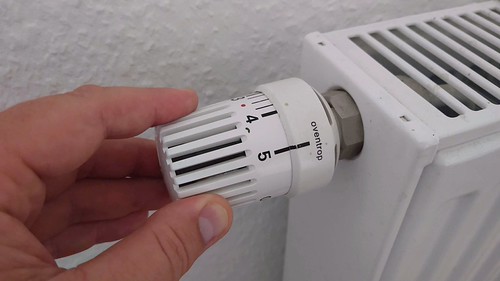
A thermostat that needs no electricity
A mechanical thermostatic radiator valve, usually shortened to TRV, has two functional parts. The visible head contains the temperature-sensitive mechanism and the setting dial. Beneath it, the metal valve body contains a spring-loaded spindle, cone and seat that regulate the water passage.
Inside the head is a sealed bellows or capsule charged with a material that changes volume or pressure with temperature. Designs use gas, liquid or wax. As the air around the head warms, the element expands and pushes a piston against the valve pin. The cone moves towards its seat, reducing the flow of hot water. As the local air cools, the element contracts and the valve spring allows the passage to open again. Danfoss describes this as modulating control: the valve makes small adjustments rather than simply alternating between fully open and fully closed.
Turning the numbered head changes the balance between the sensing element and a setting spring. It therefore changes the air-temperature condition at which the head begins to throttle the flow. It does not tell the radiator to run at 40 or 80 per cent of maximum output. The Energy Saving Trust notes that the numbers do not correspond to the same temperatures on every model: lower generally means a cooler room, higher a warmer one.
This also explains why the head can turn while the valve beneath it remains stuck. The rotating plastic part adjusts the controller; it is not necessarily screwed directly to the water-blocking cone. A moving dial proves that the dial moves. It does not prove that the sensing element can push the pin through its working range, that the pin returns under spring force or that the cone seals against its seat.
Three temperatures move on different clocks
After a setting change, three temperatures matter. The air around the head changes first or last depending on draughts, curtains and the radiator’s position. The incoming water temperature depends on the boiler or heat network. The radiator surface sits between them, warmed by flowing water and cooled by convection and radiation into the room.
If the valve closes, hot water already inside the radiator does not vanish. Its energy must pass into the metal and then into the room. The top near the inlet may remain hottest while the lower or return side cools sooner. A hand on one patch gives only a momentary, qualitative reading; it cannot distinguish reduced flow from no change in flow.
The opposite misunderstanding happens when a room is cold. Setting the dial to its maximum does not usually make the radiator heat the room faster than a lower setting that already leaves the valve fully open. Once the cone is clear of the seat, the available heat is limited by water temperature, system flow, radiator area and the room’s heat loss. The dial determines when throttling begins, not the maximum capacity of the heating system. That wider capacity question is why the coldest room can set the heat-pump test.
The sensor measures its corner, not the room
A TRV is local in a very literal sense. It senses the air immediately around the head. Danfoss warns that heat from nearby pipework can make an integral sensor register a higher temperature than the rest of the room; its documentation recommends a horizontal orientation where possible, or a remote sensor when the location is unsuitable. Caleffi likewise advises placing the operator away from the heat emitter rather than above it.
A curtain, radiator cover or piece of furniture can therefore create a warm pocket around the controller. The valve may throttle while the occupied part of the room is still cool. Cold air leaking from a nearby opening can cause the reverse. The controller is not irrational: it is acting on a poor sample.
This is the strongest limit of the elegant passive mechanism. It needs no battery, network or central service, and it gives each room a degree of control. But it cannot know occupancy, forecast weather, measure a distant seating area or explain why the requested temperature was not reached. Its simplicity preserves autonomy and long service, while constraining what it can perceive.
Read the response before touching the plumbing
A safe household experiment can separate normal thermal delay from a control problem without removing the head or adjusting the return-side lockshield.
- Choose a time when the heating system is steadily supplying hot water and the room is already warm. Keep doors, windows and curtains in the same position.
- Place a room thermometer about a metre from the radiator, away from direct sun and the radiator plume. Mark three repeatable surface points: near the inlet at the top, the middle, and near the lower return side.
- Record room and surface temperatures. Lower the TRV by several settings, then record the same points every five minutes for half an hour. Use a contact thermometer if available. An infrared thermometer is convenient, but shiny paint or changing angle can distort readings, so keep the spot and geometry consistent.
- On another comparable heating cycle, repeat with the valve left high. Compare the shapes of the curves rather than demanding one universal cooling time.
If the lowered setting produces an earlier fall near the inlet and a growing temperature difference across the radiator, the controller is probably reducing flow even though the metal remains warm. If both trials remain nearly identical while the room is clearly above the chosen setpoint, the observation is useful evidence—but not a complete diagnosis. System pressure, valve type, flow direction, another room controller and the valve insert can all matter.
Stop at measurement if a valve leaks, a fitting must be loosened or the system would need draining. Those steps can release hot pressurised water and belong with a qualified heating professional. The useful next action is to bring the response curve: room temperature, three surface points, settings and times. “It stays hot” is a symptom. A curve shows whether heat is merely leaving slowly or hot water is still arriving.
Author
What concrete example would confirm or challenge this article?
Choose a reaction, write a comment, or ask your AI assistant to send a proposal for review. Comments are reviewed before publication.