
You pack for a trip, pick a USB-C cable from a drawer and discover that it charges your phone but barely sustains your laptop. Another cable charges the laptop yet will not send an image to a monitor. The plugs fit. Nothing looks broken. The temptation is to blame the computer, the charger or the supposedly universal standard.
The more useful explanation is that USB-C is a connector shape, not a promise of one capability. Power, data speed and video are separate questions, and the working result depends on the device, the source and the cable finding a mode that all three support. That invisible negotiation makes the connector flexible. It also transfers a diagnosis problem to the person holding a drawer full of anonymous black leads.
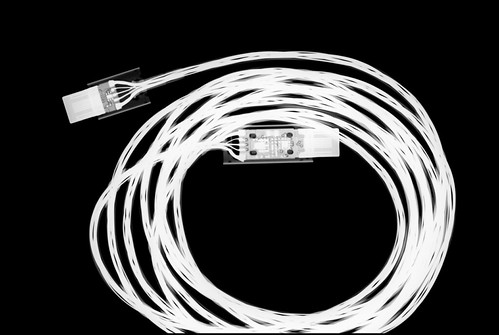
Three participants, one outcome
Start with a simple mental model. A charging connection has a source, usually a power adaptor; a sink, such as a phone or laptop; and a cable between them. The available power is not whatever number is largest on the packaging. It is a compatible offer accepted by all relevant parts of the path.
USB Power Delivery makes this explicit. In the basic exchange described by the USB Implementers Forum, the source announces its capabilities, the sink requests one of them, and the source accepts before signalling that the new power state is ready. Until that exchange succeeds, the system stays within a safer, more limited condition. A 100-watt charger therefore cannot force 100 watts into a device, and a laptop cannot demand a mode the charger did not offer.
The cable can impose a further ceiling. Ordinary USB-C cables may carry up to 3 amperes; cables intended for higher current identify their capability electronically. This is one role of the small e-marker chip hidden in many full-featured or higher-current cables. The current USB Type-C specification defines the cable and connector system, while USB Power Delivery 3.1 extended supported power as high as 240 watts using new voltage levels and appropriately rated cables. “Up to” is essential: the standard makes those modes possible; it does not give every port, charger or cable all of them.
Power and data travel on different maps
A cable that charges well can still be a poor data cable. Some USB-C cables implement USB 2.0 data, whose headline rate is 480 megabits per second, while others support much faster USB generations. Some connections can carry a display signal through an alternate mode; others cannot. The oval plug does not reveal which signal wires are present or which modes the devices at both ends implement.
This separation is deliberate. A short cable for a high-performance dock has different signal-integrity demands from a long, flexible lead intended mainly for charging. Adding the conductors, shielding, electronics and testing needed for every possible capability would raise cost and thickness even where the capability is unnecessary. Backward compatibility also lets new equipment work, at reduced performance, with simpler cables.
The counterargument to “USB-C is confusing” is therefore strong: negotiation prevents a powerful supply from blindly applying the wrong voltage, and a shared connector lets a modest cable serve many ordinary jobs. The complexity buys safety, reuse and gradual evolution. The failure lies less in negotiation itself than in hiding its result and selling visually identical cables without durable, legible information.
Labels are improving, but drawers remember the past
USB-IF’s current certification rules address part of the problem. USB-C-to-USB-C cables submitted through its compliance programme must carry a 60-watt or 240-watt power marking. Certified cables above basic USB 2.0 also need an appropriate data-rate marking; the organisation gives the example of a cable labelled 20 Gbps and 60 W. Its cable guidance is careful to say that not all cables have the same capabilities and that a capable cable cannot add functions missing from the connected products.
These rules do not retroactively label every cable already in a home, office or online marketplace. Nor does the presence of USB-C mean that every product exposes the same diagnostic information. A laptop may say “slow charger”, a monitor may simply remain dark, and a phone may show a lightning symbol without saying which power contract was reached.
European common-charger rules make the port more consistent without abolishing these capability differences. The European Commission states that the requirements have applied to listed handheld devices since 28 December 2024 and to laptops since 28 April 2026. They require USB-C, harmonised fast-charging technology where applicable, and clearer information about required power. The policy should reduce unnecessary chargers, but its own consumer guidance still asks buyers to compare a device’s requirements with a charger’s capabilities. A common socket is the foundation of interoperability, not proof of identical performance.
A cable drawer can become a small inventory
The practical experiment needs no destructive testing. Choose the devices that reveal useful differences: a laptop that reports charging power, an external monitor or dock, and a storage device capable of faster transfers. Use one known-good charger and test each USB-C cable in turn. Record only observable results: whether the laptop charges normally or reports reduced power; whether the monitor displays; and whether the storage connection falls back to a slow mode. Do not infer a precise rating from a single successful test, because the device or charger may be the limiting part.
Give each cable a small removable label based on verified documentation or conservative test results: “phone charge”, “laptop charge”, “display”, or a manufacturer-stated wattage and data rate. Keep an “unknown” category rather than converting uncertainty into a claim. A simple table with cable colour, length, printed markings and confirmed uses is enough. If a cable or connector becomes hot, damaged or intermittent, stop using it; a household experiment is not a compliance or electrical-safety test.
Then try the more revealing change: for one month, return every cable to its labelled place after use. Count how often somebody still reaches for the wrong one and whether the household buys a duplicate. The aim is not to turn a drawer into a laboratory. It is to restore legibility to a system whose intelligence is otherwise hidden inside chips and protocol messages.
USB-C succeeds when people can reuse equipment without memorising a family tree of connectors. Its next human-centred step is equally mundane: let the plug remain universal, but make the negotiated capability visible. Until devices do that reliably, a few honest labels can turn “this cable sometimes works” into knowledge that a household can share.
Author
What concrete example would confirm or challenge this article?
Choose a reaction, write a comment, or ask your AI assistant to send a proposal for review. Comments are reviewed before publication.