A public funding record can answer a surprisingly concrete question: who was named in a decision, for what kind of project, and for how much? It can also leave important questions unanswered. A project cost is not necessarily a grant paid out. A decision is not evidence that the project succeeded. We built parts of Alkemata around that tension: make public records easier to explore while keeping their limits visible.

Example one: following money into digital media
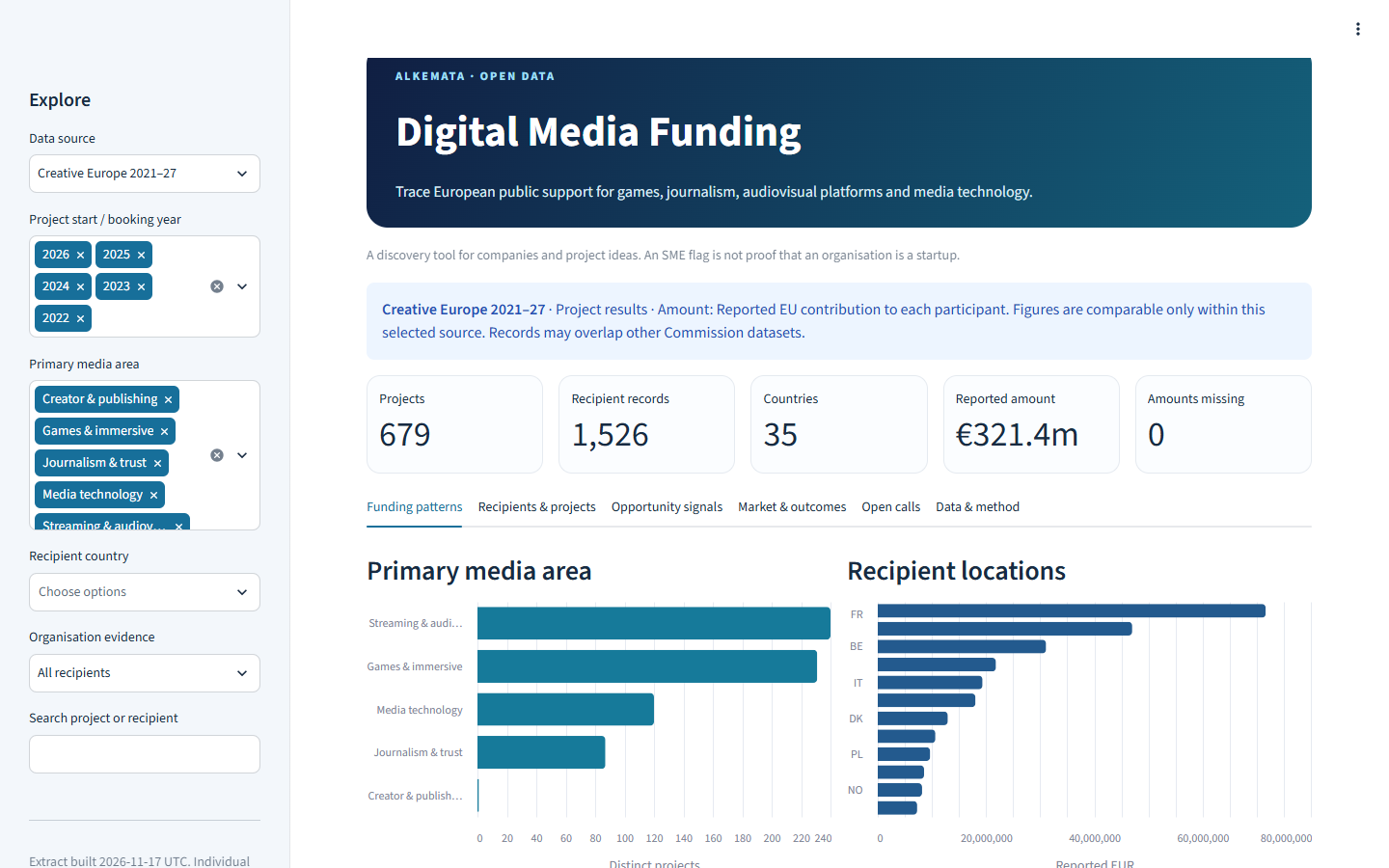
Suppose you want to know what public support reaches games, audiovisual work or other digital media. At media.alkemata.com, you can explore published decisions and awards from European, national and regional sources. The source views include Creative Europe project results, CORDIS research projects, the Commission’s Financial Transparency System, and selected German and UK funding bodies. A separate market view uses broad sector statistics rather than treating a recipient’s grant as its revenue.
That separation matters. A Creative Europe participant contribution, a regional funding decision and a Financial Transparency System commitment describe different things. Some may refer to the same underlying award. Adding them into one impressive total would tell a misleading story. The app keeps sources apart, labels what each amount means, and links back to the publisher. Its figures can help you find a project or a pattern worth investigating; they cannot, on their own, tell you whether a studio became profitable or whether a film found an audience.
Example two: examining public spending in NRW
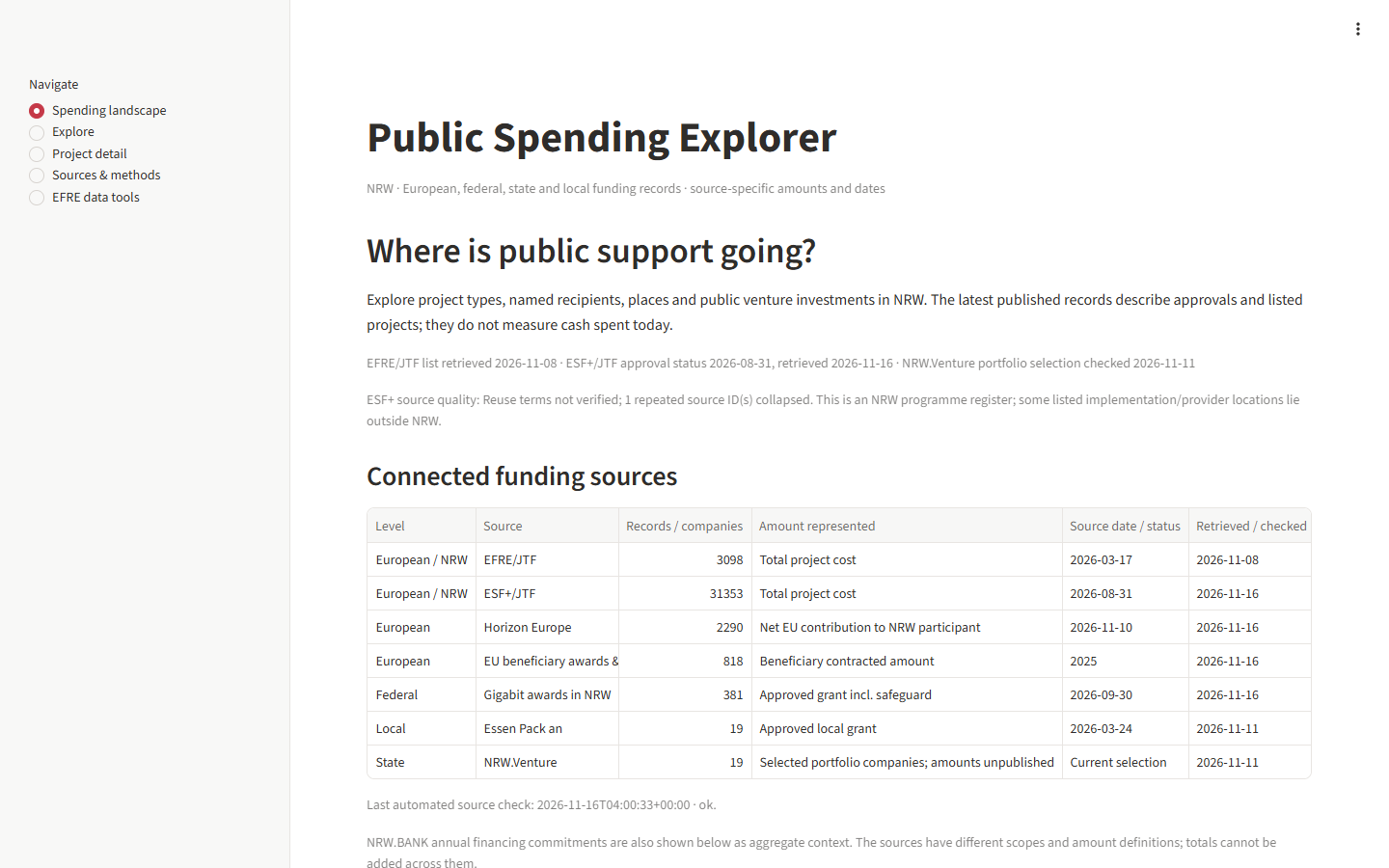
At funding.alkemata.com, the question widens: what do published funding records show about projects and recipients in North Rhine-Westphalia? One starting point is the state’s EFRE/JTF list of approved projects. You can move from an NRW-wide view to a source location such as Essen, inspect individual records, and return to the official data.
The list gives a project description, a location label, total project cost and an EU cofinancing rate. It does not state an actual payment or demonstrate an outcome. The location may be a city or district, and for a project without one fixed site it may refer to the beneficiary instead. The explorer therefore does not turn that label into a precise project address or calculate a supposedly paid EU amount from cost and rate. Other sources, including European research data, federal awards and a reviewed local Essen grant list, remain visibly distinct because their financial fields mean different things.
What happens between a source and a screen?
Open data is only the beginning. We first identify the publisher, the licence, the publication date and the meaning of each field. An importer checks the file’s structure and values, keeps a dated copy with a checksum, and records how source fields become searchable records. If a refresh fails validation, the last verified snapshot remains available instead of silently replacing it with broken data. The public apps read those prepared records; visitors cannot rewrite the source data by using a filter.
Then we make the questions practical: search for a place or organisation, narrow a topic, inspect a record, and follow its link back to the original publisher. The interface should also say when a field is absent, when a number is a cost rather than a payment, and when sources may overlap. Those notes are part of the answer, not small print.
What we hope this makes possible
Our goal is to give curious readers a reliable starting point for exploring decisions that affect places and industries. A journalist might find a project to follow up. A developer might notice a useful dataset. A resident might ask what a local programme actually funded. A researcher might spot a gap between a funding announcement and the evidence needed to judge its results.
We are not trying to turn every public record into a verdict on success. We want to make the source, the transformation and the unanswered question visible together. Try the media explorer or the NRW spending explorer, and tell us where an explanation is missing or a source deserves a closer look. That is how the platform should improve: one checkable question at a time.
Author
What concrete example would confirm or challenge this article?
Choose a reaction, write a comment, or ask your AI assistant to send a proposal for review. Comments are reviewed before publication.