
Drop a strong magnet through a vertical copper pipe and it may take many seconds to emerge. The magnet never touches the wall. Copper is not ferromagnetic, and the pipe has no power supply. Its own motion generates the currents that slow it down.
Eddy-current braking converts motion into electrical current and then into heat. The mechanism is useful in contact-free damping, but its force depends on speed, field geometry, electrical conductivity and the paths available to induced currents.
The tube becomes a stack of shorted coils
Imagine dividing the tube into thin conducting rings. As a magnet approaches each ring, magnetic flux through it changes. The change reverses as the magnet passes. Faraday’s law gives the induced electromotive force, EMF = −dΦ/dt, where flux Φ is measured in webers and EMF in volts. Since each ring forms a closed circuit, the EMF drives current. Lenz’s law determines its direction: the current opposes the change that produced it.
Below the descending magnet, induced currents tend to repel it upward. Above it, currents tend to attract it upward. The two regions therefore brake the same motion. A stationary magnet inside a stationary copper tube induces no sustained current and produces no such braking force.
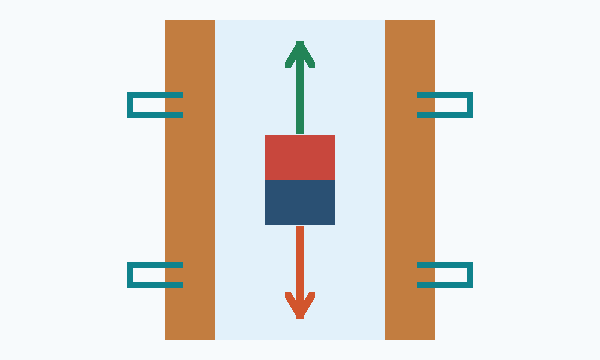
Why drag grows with speed
At modest speeds, the magnetic flux changes faster when the magnet moves faster. Faraday’s law makes the induced voltage proportional to speed. When resistance dominates inductive effects, current scales with speed too. A useful approximate drag law is Fdrag = −bv, where downward velocity v is in m/s and b is a positive coefficient in N·s/m.
For mass M and gravitational acceleration g, the equation becomes M dv/dt = Mg − bv. From rest, v(t) = (Mg/b)[1 − exp(−bt/M)]. The predicted terminal speed is vt = Mg/b and the time constant is τ = M/b. The linear model applies to a particular low-speed regime; it is not a universal law for every brake.
Consider an illustrative calculation with a 20 g magnet and an independently measured damping coefficient of 1.0 N·s/m. Its weight is 0.196 N, the predicted terminal speed is 0.196 m/s, and the time constant is 0.020 s. This example does not predict b from tube dimensions. A short tube can have substantial entrance and exit effects, so its overall transit time may not reveal terminal speed.
Where the energy goes
At terminal speed, the magnet’s kinetic energy stops increasing. Gravitational power Mg v is converted primarily to resistive heating in the tube. In the illustrative case, 0.196 N × 0.196 m/s ≈ 0.038 W. The tube may not feel warm because the heat is spread over a relatively large mass.
This energy balance also offers a way to derive the drag coefficient. Each induced current loop dissipates I²R. Integrate the heating over the tube, equate it to mechanical power bv², and solve for b. In the idealized limit of a point magnetic dipole centered in a long, thin-walled conducting tube, the scaling is b ∝ σwμ₀²md²/a⁴. Here σ is electrical conductivity (S/m), w wall thickness (m), μ₀ vacuum permeability (H/m), md magnetic dipole moment (A·m²), and a tube radius (m).
The radius dependence is striking. Increasing a by 20%, while holding other parameters fixed, cuts this idealized b by a factor of 1.2⁴ ≈ 2.07. That makes clearance a sensitive design parameter. A real finite cylindrical magnet close to the wall needs a more faithful model: the point-dipole approximation can be poor.
The hidden cost of a contact-free brake
The linear drag law breaks down when induced fields significantly modify the applied field, or magnetic diffusion and inductive effects matter. Real tubes have ends, nonzero wall thickness, temperature-dependent conductivity and finite clearance. At higher speeds, braking force need not keep growing linearly. Heat removal and thermal expansion can become important in industrial installations.
There is also a useful counterexample to the simple idea that more metal always gives stronger braking. A lengthwise slit in the tube interrupts the easiest circumferential current paths and can substantially weaken the effect, even if nearly all the copper remains. The geometry of the circuit matters as much as the presence of conductor.
Most importantly, an eddy-current brake provides little or no holding force at rest. It cannot replace a parking brake. It is a dissipative device, so energy removed from motion becomes heat rather than being recovered as electricity in an external circuit.
The COMSOL falling-magnet model describes a more detailed axisymmetric electromagnetic treatment. For published quantitative and experimental analyses, see Levin, da Silveira and Rizzato (2006) and Irvine and colleagues (2014). The latter specifically addresses the field of a finite cylindrical magnet and compares analytical predictions with observations.
Try interrupting the current paths
Proposed experiment, not performed: Release the same small magnet through equal-length copper and plastic tubes with comparable bores, using a secure vertical support and a soft landing. Film the descent and extract position versus time. If a safely deburred longitudinally slotted copper tube is available, repeat with it. Record magnet dimensions, tube bore, wall thickness, release height and orientation.
Expect the intact copper tube to slow the magnet much more than plastic. The slotted tube tests the electrical-circuit explanation: disrupting closed paths should reduce the braking. Use the slope of position against time to identify a possible velocity plateau; a single transit-time measurement is insufficient to prove terminal motion. Avoid placing strong magnets near vulnerable electronics or medical implants.
Alkemata’s Coriolis flowmeter article describes another way motion reveals a physical quantity, using phase differences in a vibrating tube. Here the reverse question is interesting: could a measured falling speed reveal the tube’s conductivity? It could, provided the magnet’s field and the tube geometry were independently characterized well enough to distinguish conductivity from the other factors controlling drag.
Author
What concrete example would confirm or challenge this article?
Choose a reaction, write a comment, or ask your AI assistant to send a proposal for review. Comments are reviewed before publication.