
Consider a resident deciding whether to walk to the library, a clinic or a bus stop. The map says the destination is 700 metres away. What the map does not show is whether there is somewhere usable to sit halfway, whether that seat has arms to help them stand again, or whether yesterday’s rain has made it unusable. A short distance for one person can become a closed route for another.
A public bench is therefore more than street furniture. In the right place, it can extend a person’s practical walking range and make shops, transport and public life reachable without a car or companion. The important unit is not the individual bench but the chain of reliable resting points along a journey. One long gap can break that chain.
A route has an energy budget
Street design often treats walking distance as geometry: measure the metres between origin and destination, then check gradients, crossings and pavement width. Those matter, but a person’s usable range can also depend on how long they can remain standing or moving before pain, breathlessness, fatigue or loss of balance requires a pause.
A resting point changes the journey by dividing one continuous effort into shorter stages. It does not reset every limitation, and a person who uses a wheelchair may need clear space rather than a seat. Yet for many older people and people with mobility impairments, the possibility of sitting changes whether a trip feels manageable at all. Active Travel England’s current guidance describes benches as supporting longer walking distances and suggests less than 50 metres between resting points on an active-travel route where possible.
The precise interval is not a universal biological threshold. Terrain, weather, health, crowding and the purpose of the trip all matter. The deeper design principle is continuity. If seats occur every 40 metres except for one exposed 180-metre stretch, counting the average spacing conceals the route’s most difficult point.
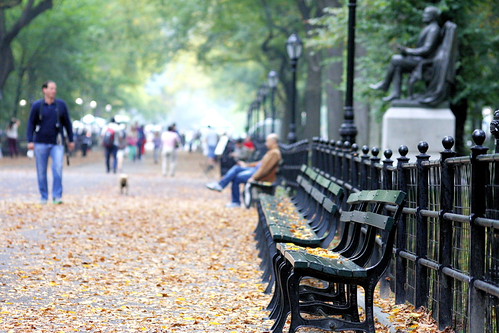
Availability is not the same as usability
A dot on a municipal asset map may represent a bench, but it does not prove that the bench works for the person who needs it. Seat height affects the effort required to sit and stand. A backrest can support someone who cannot rest safely on a narrow perch. Armrests may provide leverage, while adjacent clear space lets a wheelchair user pause beside a companion rather than in the pedestrian flow.
The UK Department for Transport’s Inclusive Mobility guidance recommends a mixture of seating styles and heights in waiting areas, with most seats at 470–480 millimetres, some armrests and space among the seating for wheelchair users. It also warns that seating must not obstruct pedestrian movement and should contrast visually with its surroundings.
These details reveal a design tension. A bench can enable one person while narrowing the path for another. An armrest can help someone rise, but a rigid division of every place can prevent people with different body sizes or transfer needs from using it comfortably. Shade is welcome in heat; a dark, isolated location may feel unsafe. Durability matters to maintenance teams, but a metal surface that becomes painfully hot or cold may be technically intact and practically unusable.
This is why procurement by catalogue is insufficient. City of York Council’s accessible-seating review combined a site audit, consultation with disabled people and trials of two bench designs. Respondents identified details that specifications can miss, including sharp armrests and bars that pressed into thighs. The council’s framework also recommends publishing seat locations and features so people can plan journeys.
The strongest objection: streets are not waiting rooms
The serious counterargument is that public space is limited. Benches cost money to install, clean and repair. Poorly placed furniture can impede wheelchairs, pushchairs and people using long canes. Some streets need loading space, trees, cycle parking or wider clear paths more urgently. A fixed spacing rule can produce clutter without creating a coherent journey.
That objection is right about objects and wrong about the goal. The aim should not be to maximise the number of benches. It should be to make important routes usable by more people. Sometimes the correct intervention is a conventional seat; elsewhere it may be a low wall designed for resting, a perch at a bus stop, a movable seasonal seat or no furniture where the footway is too narrow. The route test must include obstruction, transfer space, visibility, shelter and maintenance, not merely presence.
There is also a distribution question. Attractive seating tends to be obvious in parks, shopping districts and redeveloped centres. The journeys that determine independence may be less photogenic: from sheltered housing to a pharmacy, from a bus stop to a health centre, or up a slope between a station and a neighbourhood. If investment follows footfall alone, people who already walk most easily will dominate the evidence.
A one-route rest audit
A useful local experiment can begin with one ordinary journey. Choose a route of roughly 500 metres to one kilometre that connects homes with a public destination such as a bus stop, library, clinic or shopping street. Do not test it on behalf of everyone. Invite people with different mobility needs to define what counts as usable for them, and avoid asking anyone to exceed a safe walking distance.
Walk or wheel the route in both directions and record each potential resting point. Note the distance to the next one; whether the approach is level and unobstructed; seat height; back and arm support; adjacent wheelchair space; shade or shelter; surface condition; lighting; and whether the point is actually available at the time of the visit. Photograph locations only without identifiable people, or use a simple sketch.
Then map the gaps rather than awarding the route a single score. Identify the longest distance without a usable rest, the section with the steepest demand and any point whose failure would make the next stage unreachable. Repeat once after rain or at a different time of day. A bench that collects water, disappears behind café furniture or feels inaccessible after dark is not equally reliable.
The output should be small enough to act on: one map, three priority gaps and one proposed trial. A council or community group could borrow a temporary accessible seat for several weeks, publish its location and ask people whether it changes a real journey. Measure use, obstruction complaints, maintenance effort and whether people report reaching the destination more independently. If the trial fails, move or redesign the seat before buying permanent furniture.
Design the chain, not the object
A bench cannot repair a broken pavement, shorten a dangerous crossing or substitute for dependable public transport. Nor should sitting in public require a person to explain a diagnosis. The case for resting points is simpler: public space should acknowledge that bodies have different ranges and that a journey can be made possible by a modest place to pause.
This complements Alkemata’s earlier examination of how one broken lift can close an entire accessible journey. In both cases, access is a network property. The route is only as usable as the weakest essential link, and official inventories matter less than current, lived reliability.
The next decision is not whether a city needs “more benches” in the abstract. It is which important journey is currently just beyond someone’s reach, where the chain breaks, and what small, reversible change would let that person continue under their own power.
Author
What concrete example would confirm or challenge this article?
Choose a reaction, write a comment, or ask your AI assistant to send a proposal for review. Comments are reviewed before publication.