
The last bus has gone, but the walk home remains. At one corner, a lamp illuminates the carriageway while the pavement turns behind a hedge. A bedroom window catches the light. The same fitting is serving several people badly in different ways: the person walking wants to see the next stretch of path; the resident wants darkness indoors.
This is a design problem before it is an argument about brightness. A council deciding whether to dim its street lights should not ask only how much electricity it can save, or assume that maximum output is the safest setting. It should specify what people need to do after dark, where light helps them do it, and what evidence would justify changing the arrangement.
The worthwhile possibility is more discriminating public infrastructure: light directed towards useful tasks, at suitable times, with residents able to challenge the result. The danger is that an adjustable system merely makes a poorly explained budget cut easier to execute.
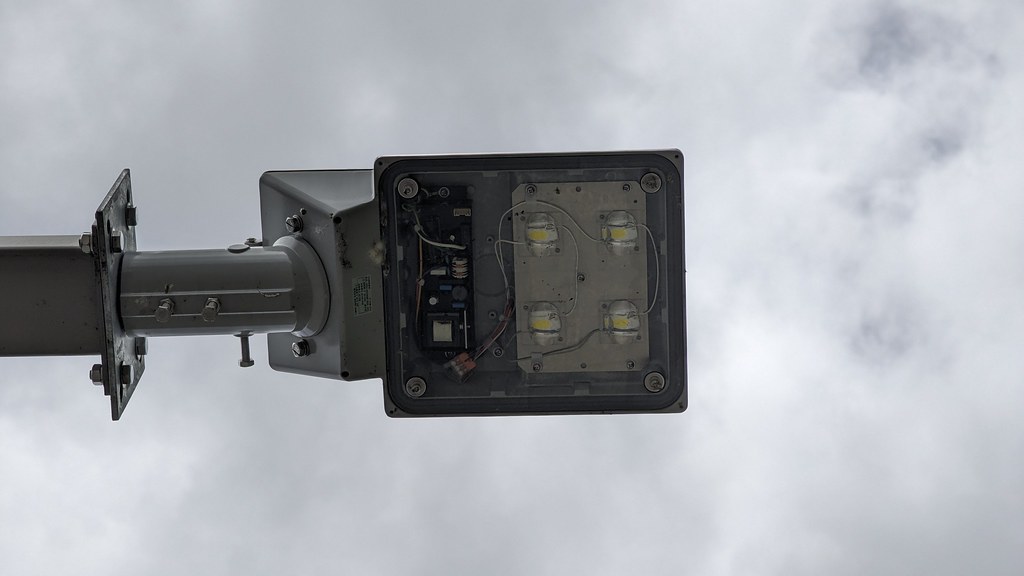
The intervention is not simply “less light”
A lamp can be replaced, aimed, shielded, dimmed or switched off for part of the night. These are different interventions. A replacement changes the source; shielding changes where its light goes; a timer changes when it is available. Treating all of them as one upgrade hides the decisions that matter to the person below.
The joint DarkSky–Illuminating Engineering Society principles for responsible outdoor lighting offer a useful starting point. They call for a clear purpose, targeted illumination, no more light than necessary, controls that match its availability to need, and warmer-coloured light where possible. Shielding and careful aiming limit spill beyond the intended area; timers and motion detectors can limit unnecessary operating hours.
These are design principles, not a universal prescription for a particular road. They suggest separating questions that are too often bundled together. Does this crossing need illumination throughout the night? Does light need to reach that window? Is the proposed change a lower output, a different distribution or complete darkness during certain hours?
An engineering assessment must answer those questions for the actual site. A public decision must also explain whose needs have been counted. A quiet road is not necessarily an unused road: a single early-shift worker may depend on it.
Two findings that should remain in tension
A study published on 28 July 2015 examined lighting changes across 62 local authorities in England and Wales. Its observational analysis used collision records from 2000–2013 and crime records from 2010–2013. It found little evidence that switching off, part-night lighting, dimming or conversion to white light had harmful effects on those outcomes overall.
That is meaningful evidence against assuming that every reduction inevitably causes harm. It is not proof that any street can safely lose its lamps. The authorities had selected their interventions; this was not random allocation. Crime data lacked offence times, preventing a specifically night-time crime analysis, and results varied between police-force areas. The researchers also lacked direct measurements of how many journeys people made. A stable incident count cannot by itself establish that people retained the same freedom to travel.
The serious counterargument is that additional lighting can help. In a New York public-housing experiment conducted in 2016, temporary light towers were allocated through a randomised design in developments selected for elevated crime and perceived lighting need. The participating University of Chicago Crime Lab reports a 36 per cent reduction in serious “index” crimes occurring outdoors at night in developments receiving new lighting.
That result should stop an energy-saving argument from becoming an ideology of darkness. But adding temporary towers in selected housing developments is not the reverse of modestly dimming an existing road-lighting system. The interventions, places and comparisons differ. Neither finding supplies a brightness setting for the street outside your home.
What the dashboard leaves out
A council can reasonably want lower operating costs and less unnecessary illumination. It must also keep public space usable. The difficulty is that the easiest things to report are not necessarily the things residents most need to know.
An electricity total can describe consumption without describing whether someone stopped walking to an evening class. A count of complaints can miss people who do not know which organisation owns a lamp, cannot use the reporting website, or assume that complaining will achieve nothing. Conversely, a strongly worded objection does not establish that a proposed setting is dangerous.
The answer is neither to dismiss experience nor to treat every preference as a technical specification. Separate the evidence. Professional measurements and risk assessments address lighting performance. Incident records address recorded harms. Conversations with affected people reveal tasks, discomfort and avoided journeys that need investigation. Each answers a different question.
This is related to the distinction Alkemata explored in route-level accessibility: equipment statistics are not the same as the capability people are trying to use. For lighting, however, the challenge is not simply whether an asset works. It is whether its chosen operating rule is defensible.
Responsibility should remain visible. The authority proposing a change should name the decision-maker, explain the assessment and offer a route to correction that does not require a smartphone. Residents can contribute knowledge without becoming unpaid substitutes for maintenance staff or lighting engineers.
Test a decision, not a slogan
A useful first project would be a public lighting brief for one small area before any settings change. Choose a place with a specific tension, such as unwanted spill into homes alongside a late-night walking connection. Ask the responsible authority to describe the present arrangement and propose alternatives, including maintenance or better targeting rather than only reduced output.
Bring together people who use the place at different times, including disabled residents and shift workers, and compensate structured participation where possible. Ask what each person must be able to see or do. Record disagreement rather than averaging it into a satisfaction score. Nobody should be asked to walk somewhere they consider unsafe to prove their concern.
If a professionally assessed trial is appropriate, publish its boundaries, duration, operating schedule and review date in advance. State the conditions that would pause it, who can restore the previous arrangement and how urgent faults will be handled. Residents must not alter lamps themselves.
Compare the proposed arrangement with the baseline using the same questions and, where feasible, similar times and conditions. Record weather and other changes. Report electricity use alongside unresolved visibility problems, unwanted spill and volunteered accounts of changed behaviour. Avoid identifiable movement tracking. A short local trial cannot establish an effect on rare crimes or collisions; those require larger, longer evaluation. It can reveal a bad assumption and improve a design.
The immediate next step is modest: request the lighting schedule and assessment for one contested location, then write a one-page account of what the light is meant to enable. Before arguing for brighter or darker streets, make that public purpose explicit. The setting worth defending is the one whose benefits, burdens and remaining uncertainties can be explained to the people who live beneath it.
Author
What did this make you think?
Choose a reaction or write a comment. Comments are reviewed before publication.