
The polished component is on the test stand. It reaches the promised field, capacity or power density. The photograph is persuasive because the achievement is concentrated in one object. The less photogenic question begins when that object must be bolted, soldered, sealed, cooled, powered and serviced as part of a machine.
Frontier engineering often fails at the joint because the joint is where different materials, teams and assumptions meet. It must transfer load without damaging either side, conduct heat or current without becoming a bottleneck, tolerate manufacturing variation and remain inspectable after assembly. The component may define what is physically possible. The interface often decides whether that possibility becomes dependable equipment.
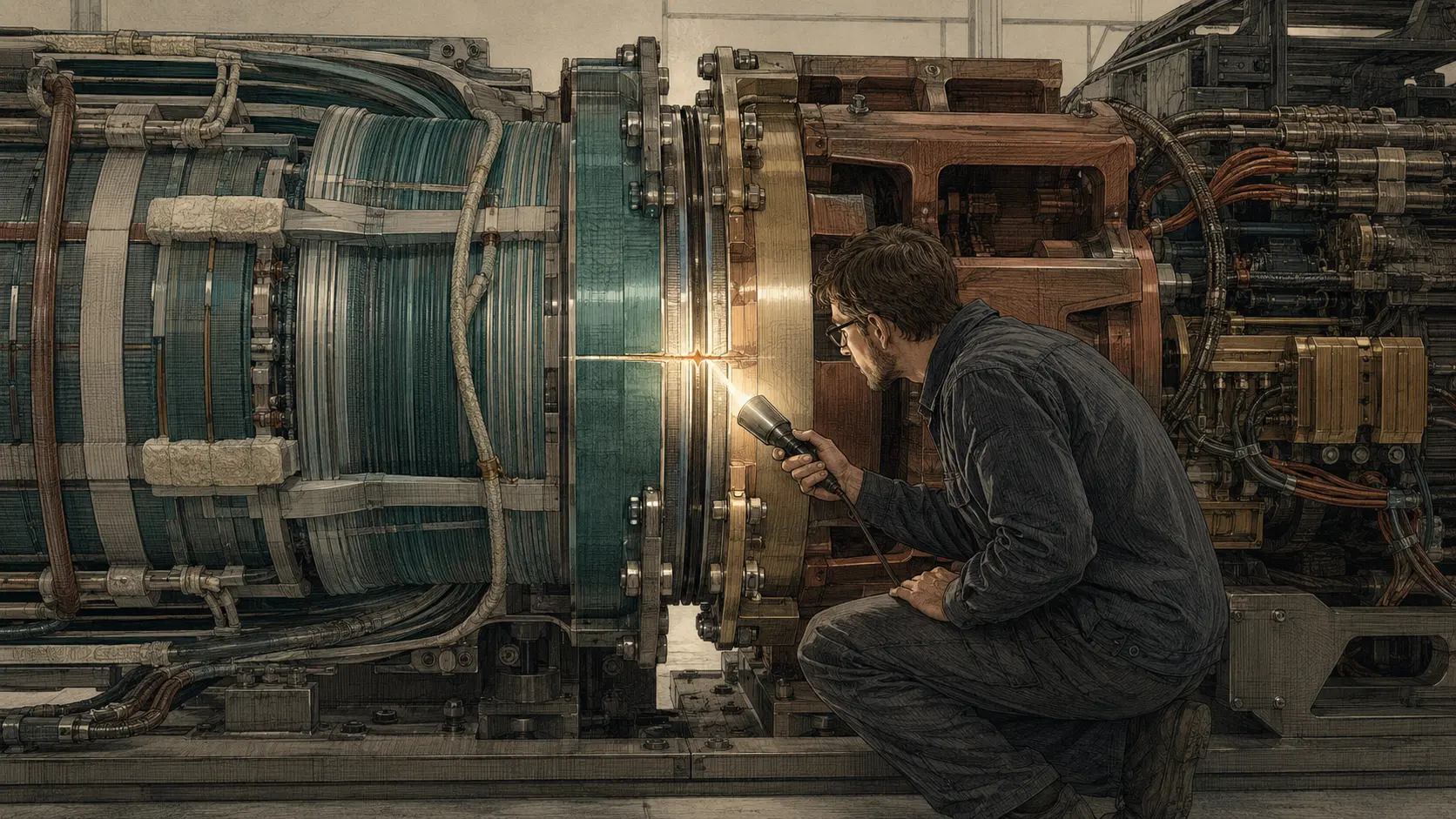
Where mismatches become concentrated
A joint is rarely a neutral line between identical things. Copper meets ceramic. A rigid housing meets a compliant seal. A semiconductor package meets a circuit board. Each side expands by a different amount as temperature changes, carries load through a different geometry and ages through a different mechanism.
The resulting stress is local. A large structure may move by a fraction of a millimetre, yet that movement can be concentrated in a thin solder layer or at the edge of a bonded surface. A joint that passes a static strength test may then fatigue through thousands of smaller thermal or mechanical cycles. NASA’s technical record on solder-joint fatigue in spacecraft electronics describes differential thermal expansion as a leading cause of failure and treats reliability as a system problem linking the mission environment, packaging design and qualification tests.
This is the first reason interfaces deserve disproportionate attention: they translate global motion into local strain. The second is variation. Flatness, surface finish, alignment, contact pressure, contamination and adhesive thickness can all change the behaviour of nominally identical connections. A record-performing component is a maximum. A production joint is a distribution.
The superconducting joint that adds resistance
High-temperature superconductors make the paradox unusually clear. REBCO tape can carry immense current with essentially no resistance while superconducting, but practical magnets need connections between conductors. Those joints are not perfectly superconducting. At tens of kiloamperes, even nanohms create heat that must be removed at cryogenic temperature.
For compact fusion, a demountable joint offers something valuable in return: access. Sections of a toroidal-field magnet could be opened so that irradiated components inside the machine can be replaced. The ARC conceptual design used this possibility to connect high-field magnets with a maintainable reactor architecture. But opening a current path creates requirements for repeatable alignment, contact pressure, electrical resistance, cooling and inspection every time it is reassembled.
This is why the earlier Alkemata deep dive, The Joint That Could Decide Compact Fusion, treated the connection as more than an electrical detail. A lower-resistance permanent joint may make the magnet easier to operate but the reactor harder to maintain. A demountable joint may improve access while adding heat and another uncertain step to every major outage. The “best” joint exists only in relation to the whole maintenance strategy.
A battery depends on an interface it creates itself
In a lithium-ion battery, one of the most important interfaces is not simply manufactured and left alone. Reactions between an electrode and the electrolyte form a thin solid-electrolyte interphase. A stable interphase can pass lithium ions while limiting continued electrolyte decomposition. It is a protective boundary produced by the cell’s own chemistry.
Silicon anodes show what happens when the material breakthrough and the interface cannot be separated. Silicon can store substantially more lithium per mass than graphite, but it also changes volume strongly during cycling. The US National Renewable Energy Laboratory’s Silicon Electrolyte Interface Stabilization programme documented cracking associated with silicon expansion and contraction. Fresh surface then becomes exposed, the interphase reforms and usable lithium and electrolyte can be consumed.
The lesson is not that silicon “fails”. It is that capacity measured in the active material does not directly become durable cell capacity. Particle geometry, binder, electrolyte and interphase chemistry determine whether the material can repeat the cycle. The boundary is part of the device.
The interface can also be an organisational seam
The most sobering joint example is the Space Shuttle Challenger’s right solid-rocket motor field joint. The Presidential Commission’s technical conclusion identified destruction of the joint’s seals as the direct cause of the loss. The geometry allowed the joint to rotate under pressure, affecting the ability of the O-rings to seal; low temperature further reduced their responsiveness.
The Commission also found severe failures in the decision process before launch. That connection matters. The physical interface sat between motor segments, but the risk also sat between contractor data, engineering analysis, management judgement and launch authority. Evidence about erosion and temperature sensitivity existed without being converted into an effective constraint on the system.
This pattern recurs in less catastrophic forms. A connector is supplied by one team, installed by another and diagnosed by a third. The electrical group specifies contact resistance; structures owns the preload; thermal engineers need a heat path; maintainers need tool access. When responsibility is divided by component while the failure mechanism crosses components, the interface can become everybody’s assumption and nobody’s owned object.
Why breakthroughs still deserve the headline
The strongest counterargument is that this focus can become a conservative reflex. Without a higher-field superconductor, higher-capacity electrode or faster semiconductor, there is no frontier system to integrate. Interfaces can often be improved through established engineering once the valuable component exists. Demanding power-plant reliability from an early material demonstration would suppress useful ambition and confuse exploration with deployment.
That objection is right. Component performance changes the feasible design space, sometimes by orders of magnitude. Early researchers should be allowed to demonstrate one property without solving manufacturing, maintenance and economics at once. A proof of principle is not dishonest because it is incomplete.
The correction is to report the boundary accurately. A component record shows that one constraint has moved. It should also make the new bottleneck visible. If a magnet reaches a higher field, the next questions concern conductor length, joints, protection and structural loads. If an electrode stores more charge, the next questions concern swelling, interfaces, cycle life and cell manufacture. Bold framing is useful when it points towards the engineering work that the breakthrough has enabled.
Designing the joint as a first-class component
A credible interface programme begins before detailed component designs are frozen. It specifies which loads cross the boundary, how tolerances accumulate and how properties change with temperature, radiation, humidity or time. It tests realistic assemblies across cycles rather than relying only on ideal coupons. It measures distributions and failure rates, not just the best specimen.
Diagnostics must be designed with the joint. A connection buried behind shielding may be electrically excellent but operationally opaque. Sensors need to distinguish a developing local defect from ordinary variation. Inspection must have a decision attached: continue operation, reduce load, repair locally or replace a larger module. Data without an actionable threshold does not give operators control.
Repair access changes the design again. Fasteners need space for tools. Surfaces must survive cleaning and remating. A replaceable module needs connectors that can be disconnected without damaging its neighbours. The spare part requires drawings, process records and test equipment years after the original specialists have moved on. Repairability is therefore a geometry, documentation and staffing property as much as a material one.
Ownership should follow the failure mechanism. Someone must be responsible for the performance of the complete interface across electrical, mechanical, thermal and operational boundaries. That does not remove specialist teams; it creates a place where their constraints are reconciled and where anomalous evidence cannot be dismissed as belonging to another subsystem.
The capability preserved by a good joint
For the person operating or maintaining an advanced machine, a well-designed joint preserves a simple capability: localise a problem and recover from it. The alternative is a system in which a microscopic defect disables an enormous asset, while diagnosis requires disassembling half the machine and repair depends on the people who built the prototype.
This is not an argument for making every interface demountable or adding sensors everywhere. Each added connection creates new cost and failure modes. The decision is which boundaries deserve access, monitoring and replaceability because their degradation is plausible and their consequences are large.
If you value engineering analysis that follows breakthroughs into manufacture, maintenance and human use, subscribe to Alkemata for future viewpoints and deep dives.
Frontier engineering should keep celebrating exceptional components. It should become equally precise about the ordinary joints asked to make them useful. The remaining question after the next record is not merely whether the component can perform again. It is whether the interfaces can be manufactured within tolerance, diagnosed before damage and repaired by people who were not present for the demonstration.
