
A joint in a compact fusion magnet may have to carry more than 40,000 amperes while sitting near 20 kelvin, resisting enormous mechanical forces and adding almost no electrical resistance. If its resistance is one nanohm, a current of 40.5 kiloamperes produces about 1.64 watts of heat at the joint. That sounds trivial at room temperature. Deep inside a cryogenic magnet, where every watt must be removed by refrigeration, it is an engineering load.
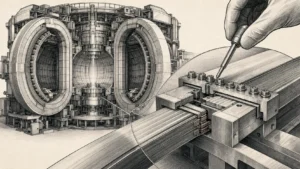
This is the less spectacular side of high-field fusion. Rare-earth barium copper oxide, usually shortened to REBCO, has made magnetic fields above 20 tesla credible in large prototype coils. Higher field can support a smaller plasma for a given class of performance, bringing compact fusion machines into the realm of serious engineering. But a power plant will not be made from a record field. It will be made from kilometres of conductor, hundreds of interfaces, cooling channels, structures, sensors and maintenance procedures that work together repeatedly.
The central question is therefore shifting. REBCO has shown that very high field is possible. The harder test is whether high-field magnets can be manufactured, protected, exposed to a fusion environment, opened for maintenance and returned to service economically. The joint is where many of those demands meet.
Why a stronger field changes the machine
A tokamak confines an extremely hot plasma with magnetic fields. In simplified comparisons between otherwise similar designs, fusion power density is often described as increasing approximately with the fourth power of magnetic field. The exact scaling depends on the assumptions used, so it is not a universal law of reactors. It does explain why magnet performance has such leverage: a moderate increase in field can change the size, structure and cost of the whole machine.
Conventional low-temperature superconductors remain formidable materials, but their useful current density falls as magnetic field rises. REBCO is different. It is a ceramic superconducting layer deposited on a flexible metal tape, surrounded by stabilising and protective materials. Although called a high-temperature superconductor, it still operates at cryogenic temperatures. Its advantage for fusion is that it can carry substantial current in magnetic fields and temperatures where established superconductors become more constrained.
That advantage enabled a representative-scale toroidal-field model coil built by MIT and Commonwealth Fusion Systems. In a peer-reviewed account of the programme, the researchers report a peak field of 20.1 tesla on the conductor at a terminal current of 40.5 kiloamperes. The coil was roughly three metres across and subjected its structure to loads relevant to a compact tokamak magnet. This was not a fusion power plant, but neither was it a small material coupon. It was an integrated magnet prototype designed to retire several risks at once.
That distinction matters. A sample of REBCO tape demonstrates a material property. A cable shows that many tapes can share a large current. A model coil tests winding, structure, cooling, joints and protection in combination. A power-plant magnet must add industrial manufacture, radiation tolerance, maintainability and dependable operation over years. Progress at one level does not automatically prove the next.
A tape is not yet a magnet
A REBCO tape is thin and anisotropic: its performance depends on the direction of the magnetic field relative to its surface. A practical conductor must arrange many tapes so that current is distributed reliably, heat has a route into coolant, mechanical loads reach the structure and a local defect does not destroy the cable.
The VIPER cable programme addressed this translation from tape to high-current conductor. Its authors reported thousands of mechanical cycles, multiple cryogenic cycles and repeated quench-like transients, together with demountable electrical joints and fibre-optic temperature sensing. Those are meaningful component results. They do not establish the lifetime of a reactor magnet, but they show why the conductor must be judged as a mechanical, thermal and diagnostic system rather than as a bundle of superconducting tape.
Every interface introduces another set of variables. Tape surfaces must make uniform electrical contact. Copper stabilisers must share current if part of the superconductor becomes resistive. Steel structures must restrain the magnetic forces without overstressing a brittle ceramic layer. Cooling paths must remove heat without creating unacceptable pressure drop. Sensors must detect a dangerous local change early enough for the protection system to respond.
The joint concentrates these variables into a short length. It has to be electrically quiet, mechanically strong, thermally connected, reproducible in manufacture and accessible enough to inspect or replace. Optimising only one of those properties can make another worse. More contact pressure may reduce resistance but complicate assembly. More copper can spread current and heat but adds volume and changes mechanical behaviour. A solder may produce a stable interface at low temperature while imposing limits on fabrication or repair.
The nanohm problem
Electrical resistance becomes heat according to the familiar relation P = I²R. The current is squared, so fusion-magnet currents make very small resistances consequential. In the MIT model coil, fifteen internal pancake-to-pancake joints operated between 0.5 and 2.0 nanohms at 20 kelvin and in fields up to 12 tesla. At 40.5 kiloamperes, a one-nanohm joint dissipates about 1.64 watts; fifteen such joints would produce roughly 25 watts at their operating temperature before other heat loads are counted.
A cryogenic plant must consume much more than 25 watts of room-temperature electrical power to remove 25 watts near 20 kelvin. The exact penalty depends on the refrigeration system and its operating point, but the direction is unavoidable. A resistance that looks excellent on a laboratory meter can become a persistent operating cost when multiplied across a magnet set and years of operation.
Average resistance is not enough. A joint can have an acceptable total value while current is distributed unevenly among its tapes. One overloaded path may heat locally, lose superconductivity and damage neighbouring layers before the terminal voltage looks alarming. The useful evidence is therefore a distribution: resistance across production joints, current sharing within them, behaviour after thermal and mechanical cycling, and performance after disassembly and reconnection.
Experiments by the UK Atomic Energy Authority on soldered REBCO joints measured samples from room temperature to 4.2 kelvin and in fields up to 12 tesla. The work found that copper and silver layers could reduce heating and reported reproducibility better than ten per cent below the superconducting transition temperature for one solder system. The authors estimated that such joints could add only a few per cent to cryogenic cost. That is encouraging component evidence, but the cost result is model-dependent and does not yet describe a complete reactor’s maintenance history.
Internal connections and a magnet that opens
Not all joints serve the same purpose. The model coil used internal connections between stacked winding pancakes. A demountable toroidal-field magnet asks for something more ambitious: selected sections of the whole coil can be electrically and mechanically separated so that large components inside the machine can be removed.
The attraction is practical. A fusion plant’s first wall, blanket and vacuum vessel sit close to the plasma, where heat and neutrons gradually limit component life. In a conventional closed toroidal-field coil, replacing those components can require difficult movement through restricted openings. A demountable magnet could create a much larger maintenance route.
The ARC conceptual design used this idea to propose a compact machine with demountable REBCO toroidal-field coils. It described a reactor-scale architecture and analysed how removable magnets might enable vacuum-vessel replacement. It did not demonstrate repeated remote opening, inspection and reconnection of full-size irradiated joints. The design is valuable precisely because it exposes the next questions; it should not be mistaken for evidence that those questions are settled.
A demountable interface must return to a known condition after maintenance. Its mating surfaces may have changed through oxidation, irradiation, wear or microscopic damage. Bolts or clamps must reproduce contact pressure. Alignment errors must not transfer excessive load into the conductor. Inspection has to reveal defects that matter, not merely defects that are visible. In a plant, much of this work may need to be done remotely because components near the plasma can become activated.
This turns a magnet feature into a maintenance system. The relevant measure is not simply whether one joint can be opened. It is how long the outage takes, how often reconnection succeeds first time, which measurements certify the result, what happens when a joint fails inspection and whether a damaged section can be repaired without replacing an entire coil.
Protection when heat does not announce itself
When a region of a superconductor becomes resistive, engineers call the transition a quench. In many established superconducting magnets, the normal zone propagates far enough and fast enough to create a detectable voltage. REBCO can behave differently: a resistive zone may spread slowly, allowing a small area to become dangerously hot before a large terminal signal appears.
That makes local knowledge important. Fibre-optic sensing can track temperature or strain along a conductor. Hall sensors can infer how current moves among cable elements. Research on current-distribution monitoring in REBCO cable terminations shows how changes near a joint might reveal a developing fault that ordinary terminal measurements would miss. The method is promising, but a reactor will need sensors, algorithms and wiring that remain dependable in high fields, at low temperature and under radiation.
The model coil also explored a no-insulation winding approach. Turns were able to exchange current through controlled transverse paths, so current could move around a local resistive region. In an intentional open-circuit test, the coil showed passive self-protecting behaviour. This is a real integrated-prototype result. It is not a universal guarantee. Current redistribution changes charging dynamics, creates its own local heating patterns and makes the magnet’s internal state harder to infer. Protection becomes partly a problem of modelling where the current actually is.
A plant-scale protection case must cover more than the clean failure used in a planned test. It must include sensor faults, imperfect joints, coolant interruptions, power-supply faults and combinations that occur during maintenance or ramping. It must also define what happens after protection succeeds. A magnet that survives but requires months of diagnosis or an inaccessible repair is not operationally resilient.
Radiation changes the lifetime question
A fusion magnet is shielded from the plasma, but shielding cannot remove every neutron. Radiation can create defects in the REBCO layer and alter metals, insulation and sensors. Results from room-temperature irradiation followed by later testing do not fully reproduce a conductor carrying current while cold.
A 2026 study reported the first in-situ measurements of REBCO during cryogenic irradiation with fusion-spectrum neutrons. At 40 kelvin, the researchers observed a gradual decline in critical current with accumulated fluence, followed by recovery after room-temperature annealing. The onset occurred earlier than some previous ex-situ estimates suggested. This is important evidence, but it is not yet a reactor lifetime: the tested fluence, temperature, stress state and sample construction must be connected cautiously to a complete conductor and shielding design.
The result sharpens rather than closes the question. A magnet may tolerate some performance loss if it starts with margin. Warming it for annealing may restore material performance, but a reactor cannot assume that a laboratory recovery procedure will be economical or harmless to every other component. Joints also contain solders, copper, substrates and contact surfaces whose combined radiation response may differ from that of the superconducting layer.
Qualification therefore needs irradiation while cold and energised, followed by mechanical and electrical cycling of representative joints and cables. It also needs credible shielding models tied to measurements from the eventual machine. Otherwise a projected lifetime is a chain of extrapolations, each reasonable on its own but uncertain in combination.
From one excellent coil to an industrial magnet set
A prototype is allowed to receive exceptional attention. Technicians can select material, document each operation and diagnose unusual behaviour with the engineers who designed it. A power programme needs repeatability across many coils and replacement parts, including work performed years later by a broader workforce.
This changes the evidence that matters. A record field is a maximum. Manufacturing readiness is a distribution. Engineers need to know the spread in tape performance across long production lengths, the fraction of joints that meet specification without rework, the time required for assembly, the failure rate after many cycles and the sensitivity to ordinary process variation. Supply capacity, quality assurance and repair documentation become part of magnet performance.
Commonwealth Fusion Systems reported in January 2026 that it had delivered the first of eighteen full D-shaped toroidal-field magnets for SPARC from its manufacturing facility. That is a company report about a major production milestone, not independent evidence of power-plant reliability. Its significance is that high-field REBCO engineering is moving from a single model coil towards repeated large-magnet manufacture, where yield, consistency and integration can begin to be measured.
The same lesson can be seen in the history of large fusion projects. Alkemata’s account of the engineers behind ITER shows how system integration and accumulated practical knowledge shape machines whose headline physics is only one part of the work. Compactness does not remove that burden. It rearranges it, often putting more demand on materials and interfaces.
The strongest case against focusing on the joint
There is a fair objection to making the joint the protagonist. Without REBCO’s high-field capability, there is no compact high-field magnet to connect. Better superconducting tape, higher-performance cable and stronger structural materials may deliver larger gains than another incremental reduction in contact resistance. Some designs can also avoid large demountable joints, accepting harder maintenance in exchange for a simpler electrical circuit.
That counterargument is correct as far as it goes. Component breakthroughs alter the feasible design space, and “the interface is everything” would be as misleading as “the field record is everything”. The reason to concentrate on joints is not that they replace plasma physics or superconducting materials. It is that they reveal whether a promising component can become a serviceable system.
A joint exposes trade-offs that a peak-field number hides. A lower-resistance permanent connection may obstruct maintenance. An easily opened connection may add heat, volume or mechanical uncertainty. More sensors may improve protection while adding penetrations and failure points. A heavily shielded magnet may last longer while making the reactor larger. These are system choices, not defects awaiting one clever material.
What power-plant readiness would look like
The decisive programme is less likely to be another isolated record than a connected body of evidence. It would show low and uniform resistance across statistically meaningful production batches, at full current, field and temperature. It would demonstrate many thermal, electromagnetic and mechanical cycles, including repeated disassembly and reconnection. It would expose representative conductor and joint assemblies to fusion-relevant neutron spectra while cold, then test their remaining margins.
It would also integrate protection rather than treating it as an accessory. Local sensing, current-distribution models and energy-dump strategies would have to detect realistic faults without producing so many false alarms that operators learn to distrust them. Maintenance demonstrations would use the tooling, access constraints and remote procedures expected in the plant. Cost models would include cryogenic electricity, rejected joints, inspection time, spares, outage duration and the possibility of repair.
None of this diminishes the achievement of a 20-tesla-class model coil. It defines what that achievement has made possible to ask. The machine becomes credible not when every uncertainty disappears, but when its remaining risks can be measured, assigned and reduced through repeatable tests.
For the people who may one day operate a fusion plant, agency takes a practical form: the ability to know the condition of the magnet, isolate a fault, open the machine, replace a limited part and verify that it is safe to restart. A compact reactor that produces impressive plasma performance but cannot be inspected or restored on a useful timescale would offer little operational control.
If you value engineering stories that connect material breakthroughs to the systems people must actually build and maintain, you can subscribe to Alkemata for future deep dives.
The remaining decision is architectural as much as material. Fusion developers must choose how much electrical and mechanical complexity to accept in exchange for field strength and access. The next persuasive evidence will not be one perfect joint. It will be proof that thousands of ordinary interfaces, made and remade under realistic conditions, can keep a compact fusion machine both powerful and repairable.