
Advanced physics is difficult for reasons that go far beyond the complexity of its equations. A student must connect mathematical techniques, physical intuition, experimental evidence, historical models and conventions that vary between textbooks. A concept introduced in quantum mechanics may depend on linear algebra learned years earlier. A plasma-physics paper may assume familiarity with fluid mechanics, electromagnetism, kinetic theory and numerical simulation—all within a few pages.
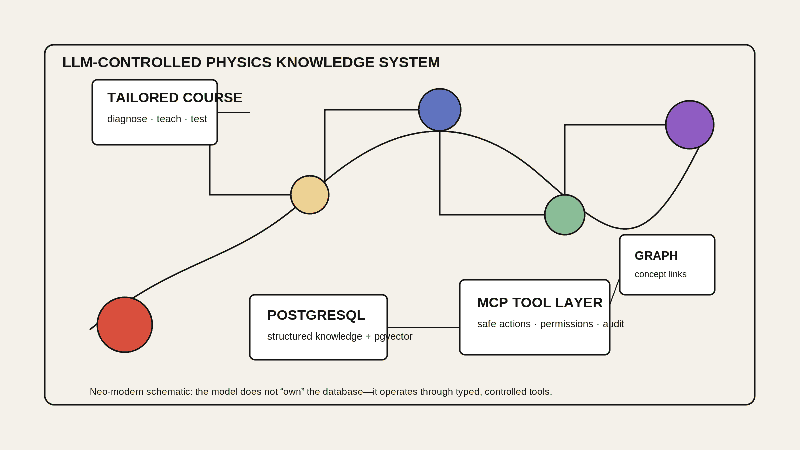
Large language models, or LLMs, cannot replace textbooks, lecturers or careful mathematical work. They can, however, provide something that conventional learning resources rarely offer: a course that continuously adapts to the learner and a knowledge system that grows alongside them.
Used carefully, an LLM can act as a tutor, course designer, discussion partner, exercise generator and interface to a personal physics knowledge database.
1. Why advanced physics needs a different learning approach
A conventional course follows a fixed sequence. Every student receives approximately the same lectures, exercises and examinations. This structure works well for establishing a common foundation, but it becomes less effective when learners have different backgrounds.
Consider three people trying to understand quantum field theory:
- A mathematician may be comfortable with Hilbert spaces but unfamiliar with scattering experiments.
- An electrical engineer may understand Fourier transforms and waves but need help with relativistic notation.
- A physicist returning to the subject after 15 years may remember the concepts but no longer manipulate the equations fluently.
A standard textbook cannot reorganize itself around these differences. An LLM can.
The first step is not to ask the model simply to “teach quantum field theory.” The learner should provide a profile: previous courses, mathematical confidence, available study time, objectives and preferred balance between theory, computation and experimentation.
I have a PhD-level background in classical plasma physics but limited knowledge of quantum field theory. I remember linear algebra and Fourier analysis, but I need to revise special relativity and operator methods. I can study four hours per week for six months. My goal is to understand research papers on quantum plasmas rather than to pass an examination.
From this information, the model can propose a structured learning path rather than a generic list of topics.
2. Creating a tailored physics course
A useful LLM-generated course should be organized as a dependency graph, not merely as a weekly list. Each advanced topic should be connected to the concepts required to understand it.
A course on general relativity might include the following chain:
- Index notation and tensor algebra
- Curvilinear coordinates
- Differential geometry
- Geodesics and covariant derivatives
- Curvature tensors
- Einstein’s field equations
- Schwarzschild geometry
- Gravitational waves and cosmology
Before starting a new module, the LLM can conduct a short diagnostic assessment. It might ask the learner to transform a vector between coordinate systems, explain the equivalence principle or calculate a Christoffel symbol in a simple metric.
The results determine what happens next. If the learner understands tensor notation but struggles with geometric interpretation, the course can reduce repetitive algebra and introduce more visual and conceptual exercises. If the opposite is true, it can add computational drills.
The course therefore evolves according to demonstrated understanding rather than elapsed time.
A practical adaptive lesson
Suppose a learner is studying the quantum harmonic oscillator. A traditional course may proceed directly from the Schrödinger equation to ladder operators.
An adaptive LLM-based lesson could instead follow this process.
Diagnostic question: Why must the energy of a bound harmonic oscillator be quantized?
The learner answers that quantization occurs because “particles can only occupy discrete orbits.”
The answer reveals a conceptual confusion with the Bohr model. The LLM can then temporarily interrupt the planned lesson and explain that quantization emerges from the boundary and normalizability conditions imposed on the wavefunction, not from predetermined classical orbits.
It might then offer three representations:
- a differential-equation derivation;
- an algebraic derivation using creation and annihilation operators;
- a numerical demonstration showing which trial energies produce normalizable solutions.
Afterward, it can ask the learner to compare the three approaches. The purpose is not merely to reach the correct energy spectrum, but to understand why different mathematical representations describe the same physical system.
3. Moving between intuition, mathematics and computation
One of the most useful roles of an LLM is translation—not between human languages, but between forms of scientific understanding.
Explain Landau damping first physically, then mathematically, and finally as a numerical experiment I could implement in Python.
The model can respond at three levels.
At the intuitive level, it can describe particles moving slightly faster or slower than a plasma wave and exchanging energy with it.
At the mathematical level, it can guide the learner through the linearized Vlasov equation, the velocity-space integral and the treatment of the pole through analytic continuation.
At the computational level, it can help construct a simple simulation, define observables and explain how to distinguish genuine collisionless damping from numerical diffusion.
This movement between representations is essential in advanced physics. A learner may be able to reproduce a derivation without understanding the physical mechanism, or understand the mechanism without being able to formalize it. The LLM can identify and target the missing connection.
4. Generating exercises that respond to mistakes
Static problem sets are limited. Once an answer has been read, the exercise loses much of its diagnostic value. An LLM can generate new problems that test the same concept with altered assumptions.
Suppose a student incorrectly applies energy conservation to a time-dependent Hamiltonian. Instead of merely correcting the answer, the model can create a sequence of related questions:
- Show that the expectation value of energy is conserved for a time-independent Hamiltonian.
- Identify the additional term that appears when the Hamiltonian depends explicitly on time.
- Analyze a spin in a time-dependent magnetic field.
- Explain the difference between conservation of probability and conservation of energy.
- Construct an example in which the state evolves while the energy expectation remains constant.
The model can also vary the type of activity. It can ask for a calculation, a conceptual explanation, an error analysis, a dimensional argument or a piece of code.
Do not give me the solution immediately. Ask one question at a time, identify the first step at which my reasoning becomes invalid, and give me only the smallest hint needed to continue.
This transforms the LLM from an answer generator into a guided problem-solving partner.
5. Using an LLM as a Socratic tutor
Advanced physics is often learned most effectively through dialogue. The learner attempts an explanation, discovers contradictions and gradually refines the model.
For example, the learner might state:
An electron interferes with itself because it physically travels through both slits.
A good tutor should not simply label this statement right or wrong. It could ask:
- What experimental observation would distinguish “travelling through both slits” from “having amplitudes associated with both paths”?
- How does the explanation change when a path detector is installed?
- Is the wavefunction being interpreted as a physical wave, a probability amplitude or information about the system?
- Which parts of your statement are experimentally testable, and which depend on an interpretation of quantum mechanics?
The dialogue makes hidden assumptions visible. This is especially valuable in areas where familiar language—particle, wave, vacuum, observation, force or information—can conceal precise technical meanings.
6. Building a personal physics knowledge database
Creating a tailored course solves only part of the problem. Advanced learners also need a reliable way to store and retrieve what they have learned.
Ordinary notes often become a collection of disconnected documents. A knowledge database should instead preserve relationships among concepts, equations, assumptions, derivations, papers and unresolved questions.
A useful entry might contain:
- the concept or result;
- a concise explanation in the learner’s own words;
- the central equations;
- definitions of every symbol;
- assumptions and validity conditions;
- links to prerequisite concepts;
- a derivation or proof;
- one worked example;
- common misconceptions;
- references to textbooks or papers;
- the learner’s confidence level;
- questions that remain open.
For example, an entry on the magnetohydrodynamic approximation could link to the Vlasov equation, fluid moments, quasineutrality, collision frequencies, Debye length and characteristic time scales.
The most important information may not be the final MHD equations, but the conditions under which they can legitimately be used.
7. From notes to a connected knowledge graph
The LLM can help transform notes into a knowledge graph. Instead of treating each note as an isolated page, the system records relationships such as:
- “requires understanding of”;
- “is an approximation of”;
- “is valid when”;
- “contradicts under these assumptions”;
- “is experimentally measured by”;
- “is numerically solved using”;
- “is analogous to”;
- “is derived from.”
Imagine that the learner adds notes about Debye shielding. The model could suggest connections to the Poisson–Boltzmann equation, collective effects, plasma frequency, quasineutrality and screening in condensed-matter physics.
Your notes use quasineutrality in the MHD section, but your database does not yet explain why quasineutrality may hold at scales much larger than the Debye length. Would you like to create a bridging note?
This is more than automatic summarization. It is an attempt to reveal gaps in the learner’s conceptual network.
8. Retrieving knowledge through questions
Once the database becomes large, keyword search is insufficient. The learner may not remember the exact terminology used in an earlier note.
A semantic search system can retrieve material according to meaning. The learner could ask:
Where in my notes did I encounter a mathematical mechanism similar to phase mixing?
The system might return entries on Landau damping, filamentation in velocity space, inviscid damping and dephasing in coupled oscillators.
An LLM can then synthesize the retrieved material:
These examples share a common structure: information moves toward increasingly fine scales in an internal coordinate or phase variable. Macroscopic observables decay even though the underlying microscopic dynamics may remain reversible.
Crucially, this answer should be linked back to the source notes. The LLM should not present an unsupported synthesis without showing which documents, equations or passages it used.
9. A practical technical architecture
A personal physics learning system does not require a single monolithic application. It can be built from several components.
The content layer
The learner stores textbook notes, handwritten derivations converted to digital form, lecture summaries, research papers, code notebooks and exercise solutions.
Documents should retain metadata such as author, date, topic, source and reliability.
The retrieval layer
The documents are divided into meaningful sections and converted into numerical embeddings. These are stored in a vector database.
When the learner asks a question, the system retrieves semantically relevant passages. A conventional text-search engine can be used alongside semantic search to find exact equations, symbols and terminology.
The reasoning layer
The LLM receives the question together with the retrieved passages. It explains, compares or reorganizes the information while citing the underlying sources.
This approach is commonly called retrieval-augmented generation. Its main benefit is that the model works with the learner’s actual materials instead of relying only on its general training.
The learner-model layer
A separate record tracks:
- concepts studied;
- exercises attempted;
- recurring errors;
- confidence assessments;
- prerequisite gaps;
- dates of previous reviews;
- preferred explanation styles.
The course generator can use this information to choose the next lesson and schedule revisions.
The verification layer
Physics answers should be checked using tools appropriate to the problem:
- symbolic algebra for derivations;
- numerical computation for limiting cases;
- unit checking for dimensional consistency;
- plotting for qualitative behaviour;
- direct consultation of source material for definitions and claims.
The LLM coordinates these tools but should not be treated as the final authority.
10. Example: learning general relativity through a personal database
Consider a learner studying the Schwarzschild metric.
During the first lesson, the LLM explains the meaning of the metric and asks the learner to identify the time and radial components. The learner then calculates the proper time for a stationary observer.
The system stores:
- the derivation;
- the learner’s explanation of gravitational time dilation;
- a mistake involving coordinate time and proper time;
- a link to the equivalence principle;
- a future review question.
Several weeks later, while studying black-hole horizons, the learner asks:
Why does the Schwarzschild time coordinate behave badly at the event horizon?
The system retrieves the earlier note and recognizes that the learner previously confused coordinate singularities with physical singularities. Instead of giving a generic explanation, it explicitly reconnects the new lesson to that prior difficulty.
It can compare curvature invariants at the event horizon and at the central singularity, then introduce Eddington–Finkelstein or Kruskal–Szekeres coordinates.
The course is personalized not merely because it covers a chosen topic, but because it remembers how the individual learner has understood and misunderstood that topic.
11. Example: reading a difficult research paper
LLMs can also help bridge the gap between coursework and research literature.
Suppose a learner wants to understand a paper about turbulence in magnetized plasmas. The model can first extract:
- the main scientific question;
- the physical regime;
- the governing equations;
- approximations;
- dimensionless parameters;
- numerical method;
- principal results;
- limitations.
It can then compare this structure with the learner’s database and identify missing prerequisites:
The paper assumes familiarity with critical balance, anisotropic cascades and gyrokinetic ordering. Your notes cover anisotropic turbulence but not gyrokinetic ordering. I suggest reviewing that approximation before Section 3.
The LLM can create a short preparatory module, followed by questions that require the learner to predict the paper’s results before reading them.
Afterward, it can help store the paper not as a passive summary but as an active knowledge object:
- What did the paper establish?
- Which assumptions were essential?
- Which conclusion remains uncertain?
- How does it differ from previous models?
- What experiment or simulation could test it?
- What does the learner still not understand?
12. Preventing the illusion of understanding
The greatest danger of an LLM tutor is that fluent explanations can create a false sense of mastery. Reading a clear answer is not equivalent to being able to derive, apply or criticize it.
A robust learning process should therefore include regular closed-book activities:
- explain the concept without assistance;
- reproduce the derivation from a blank page;
- solve a new problem;
- estimate the result before calculating;
- identify the assumptions;
- test limiting cases;
- write a small simulation;
- criticize an intentionally flawed solution.
The LLM should frequently ask the learner to generate an answer before showing one.
It can also maintain separate confidence measures:
- “I recognize this concept.”
- “I can explain it.”
- “I can derive it.”
- “I can apply it to a new problem.”
- “I can identify when it is not applicable.”
These are very different levels of knowledge.
13. Hallucinations and mathematical errors
LLMs may invent references, omit conditions, change notation midway through a derivation or produce an argument that sounds convincing but is mathematically invalid.
Several rules reduce this risk.
First, the model should be asked to distinguish clearly between sourced information, derivation and speculation.
Second, long derivations should be divided into checkable steps.
Third, the learner should request dimensional analysis and tests of special cases.
Fourth, claims about a research paper should be grounded in the actual paper rather than in the model’s memory.
Fifth, important equations should be checked using symbolic or numerical tools where possible.
For each major conclusion, state the assumptions used, test one limiting case and identify the step most likely to contain an error.
The LLM’s confidence should never be confused with correctness. Its role is to accelerate understanding and support verification—not to eliminate verification.
14. A weekly learning workflow
A practical weekly routine could be organized as follows.
At the beginning of the week, the LLM selects a topic based on the course plan, prerequisite graph and previous mistakes.
The learner completes a short diagnostic exercise. The model then generates a lesson containing a conceptual explanation, a mathematical derivation and a computational or experimental example.
During problem solving, the learner uses the LLM only for hints. Completed solutions are compared with alternative approaches.
At the end of the session, the learner writes a short explanation in their own words. The model identifies ambiguities but does not silently replace the text with a polished version.
The final notes, equations, errors and open questions are added to the knowledge database.
Several days later, the system generates a retrieval exercise based on previous material. The review schedule depends on demonstrated recall rather than on a fixed calendar alone.
This creates a loop:
diagnose → learn → apply → explain → store → connect → retrieve → revise
15. The future: from conversational assistants to scientific learning environments
The most powerful educational use of LLMs will not be a chat window that instantly answers questions. It will be an integrated scientific learning environment.
Such a system could combine:
- a dynamic curriculum;
- a map of conceptual dependencies;
- interactive simulations;
- symbolic and numerical tools;
- a database of personal notes;
- research-paper retrieval;
- automatic exercise generation;
- spaced repetition;
- records of misconceptions;
- collaborative discussion with teachers and peers.
The learner would remain responsible for setting goals, performing calculations, evaluating evidence and deciding what they believe. The LLM would help manage the complexity surrounding those activities.
Advanced physics cannot be reduced to generated explanations. It requires patience, mathematical discipline, repeated failure and contact with real scientific problems. But an LLM can make this difficult path more navigable.
It can show where a concept comes from, connect it with knowledge acquired years earlier, generate an exercise at exactly the right level and recover a forgotten note when it becomes relevant again.
The central promise is therefore not effortless learning. It is continuity: a course that adapts as the learner develops and a knowledge database that gradually becomes a structured representation of how that learner understands physics.
Continue exploring
- For the database and retrieval architecture behind this approach, read How to Build an LLM-Controlled Knowledge Database for Learning Advanced Physics.
- For a shorter perspective on the learning method, read The Infinite Tutor.
