
Seven atoms approach a barrier. Classical physics says they should stop. Quantum mechanics offers a stranger option: they cross it together — while also remaining on the other side.
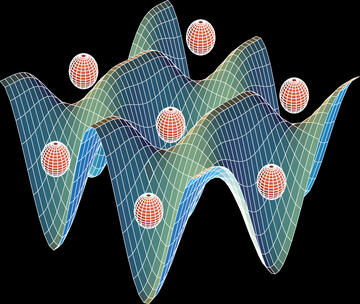
A quantum object heavier than a single atom
In a result highlighted by Nature Physics on 6 July, researchers have pushed quantum tunnelling into a striking new regime. They cooled rubidium-87 atoms to extraordinarily low temperatures, arranged them in a laser-made “optical lattice” and bound clusters of up to seven atoms together.
The seven-atom cluster had a total mass of about 608 atomic mass units. Yet it did not behave like seven independent particles slipping across one after another. The atoms tunnelled collectively, as a single composite quantum object, through a barrier about 320 nanometres wide.
That is the quantum equivalent of watching seven tightly linked climbers disappear into a mountain and reappear together on the other side — without ever climbing over the summit.
The barrier that is not quite a barrier
Quantum tunnelling is one of the clearest ways in which the microscopic world refuses to follow everyday intuition. A particle is described by a wave, and that wave can extend into — and sometimes through — a region that classical physics declares forbidden.
The effect is routine for electrons. It powers scanning tunnelling microscopes, contributes to radioactive decay and appears in several quantum technologies. But tunnelling normally becomes brutally less likely as an object grows heavier. Add mass, and the wave-like route through the barrier rapidly fades.
The team’s trick was not simply to push a heavier lump through. They engineered the interactions between the atoms so carefully that the cluster could use a coordinated, higher-order tunnelling process. In the right regime, increasing the number of atoms did not crush the tunnelling rate as quickly as standard intuition would suggest.
Enter Schrödinger’s cat — in two neighbouring wells
The most dramatic moment came partway through the tunnelling cycle. The cluster entered a spatial superposition: all seven atoms were on the left and all seven were on the right, until a measurement forced a definite outcome.
This is often called a Schrödinger-cat state. No actual cat was involved, and the object remains microscopic. The name refers to the famous thought experiment in which a cat becomes entangled with a quantum event and is described as both alive and dead before observation.
Here, the two alternatives were less theatrical but experimentally cleaner: the complete atomic cluster occupying one microscopic well or the neighbouring one. Crucially, the researchers measured the occupation statistics and found that the atoms predominantly moved as an indivisible group rather than leaking across in random fragments.
Why physicists are excited
The experiment sits on one of physics’ most fascinating fault lines. Quantum mechanics works spectacularly well for atoms and particles. General relativity describes gravity and the large-scale Universe. Yet the two theories still resist a complete union.
One possible route toward that boundary is to create increasingly massive objects in well-controlled spatial superpositions. If an object is genuinely in two places at once, what gravitational field does it produce? Can gravity preserve quantum coherence, destroy it or even generate entanglement? Today’s seven-atom cluster cannot answer those questions, but it offers a platform that might be scaled and refined.
There is also a more immediate payoff: precision measurement. A cat state containing several correlated atoms can accumulate phase faster than independent atoms. The researchers used the superposition to detect extremely small energy differences between neighbouring wells, with hertz-level precision and sensitivity beyond the usual standard quantum limit.
A giant leap — measured on a microscopic ruler
It is worth keeping the scale in perspective. A mass of 608 atomic units is enormous for this particular type of coherent centre-of-mass tunnelling, but it is still roughly a trillion trillion times lighter than a house cat. The superposition was separated by hundreds of nanometres, and its coherence remained fragile.
Scaling to much larger clusters will mean fighting particle losses, environmental noise and the simple fact that a larger quantum system offers the outside world more ways to disturb it. The result is not evidence for quantum gravity, nor proof that macroscopic objects can be placed into arbitrarily large superpositions.
But it changes the engineering question. Instead of asking whether mass must inevitably kill tunnelling, physicists can now ask how cleverly designed interactions might keep collective quantum motion alive.
Seven atoms have crossed a barrier together. The distance was only 320 nanometres — yet conceptually, the step may point toward one of the widest gaps in modern physics.
Sources and further reading
- Simon Haine, “When atoms tunnel as one,” Nature Physics, 6 July 2026
- Han Zhang et al., “Scalable generation of massive Schrödinger cat states via quantum tunnelling,” Nature Physics
- Open preprint and technical details on arXiv
- NIST background on laser cooling and optical lattices
Continue exploring
Explore how AI can support the study of difficult scientific ideas in From Textbook to Personal Research Tutor, or browse more articles in Science & Engineering.
