
An AI answer can look unusually solid. It may name a paper, link to an official page, show a calculation and explain each step in calm technical language. None of those features, alone, establishes that the answer is correct.
Verifiability is not a style. It is a property of the route from a claim to something outside the answer that another person can inspect, repeat or challenge. A useful answer does not merely ask for trust; it reduces the work needed to discover where trust would be misplaced.
The central question is therefore not “Does this sound reliable?” but “What could a reader do to test it?” The stronger the consequence of being wrong, the further that test should go.
Five different promises
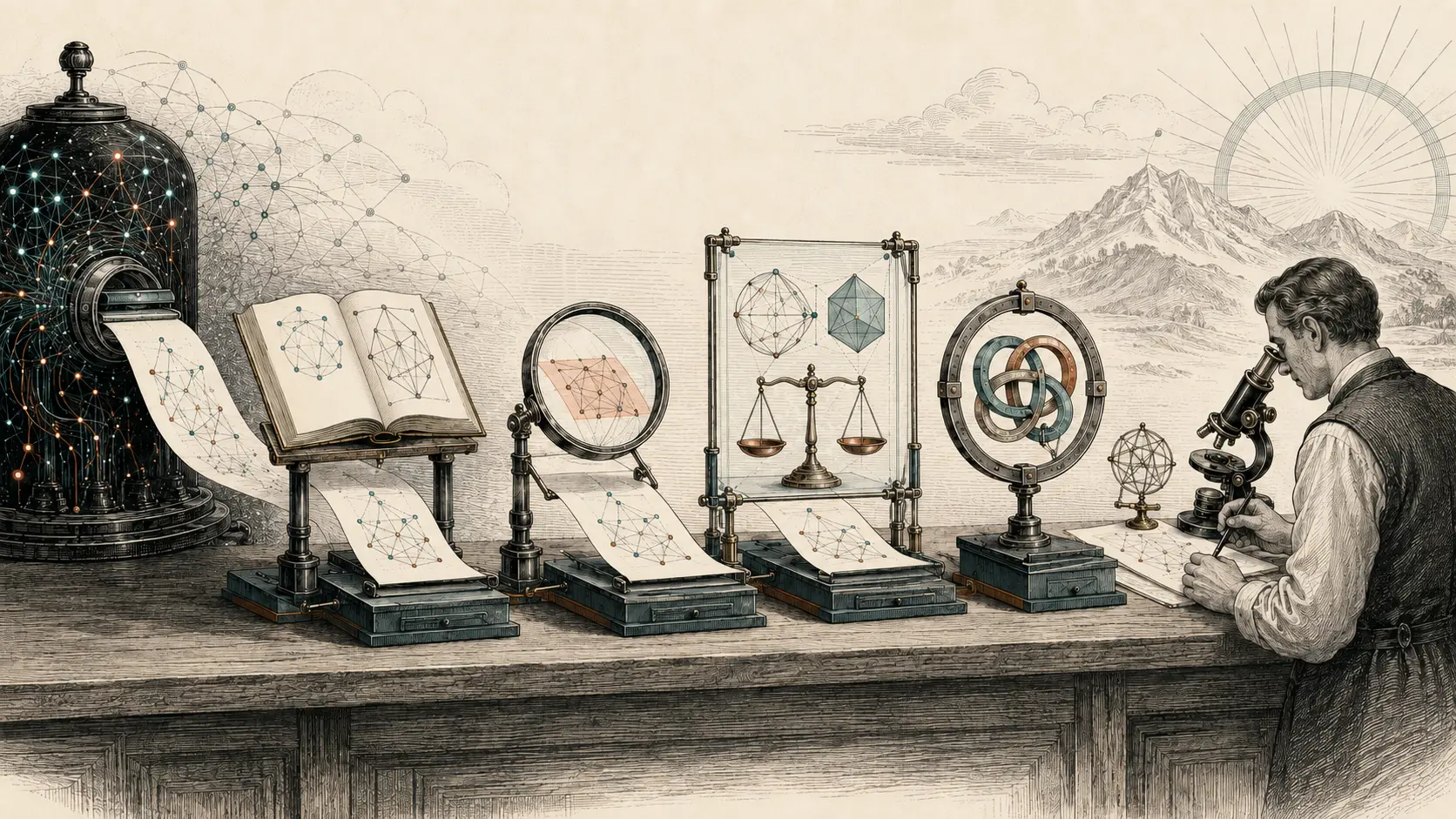
A citation promises that a source exists. Evidence promises that the source contains material that actually supports the nearby claim. Provenance records where an item came from and what happened to it. Reproducibility means another person can repeat a procedure with sufficiently specified inputs and obtain the same result, within stated tolerances. Independent confirmation asks whether a separate source, method or observer reaches a compatible conclusion.
These promises reinforce one another, but they are not substitutes. A real paper can be cited for a proposition it never makes. A passage can support a proposition even though the underlying study is weak. A complete record of how an answer was generated can prove its history without proving its truth. A calculation can be perfectly reproducible while starting from the wrong assumptions. Two answers generated by the same model from the same faulty source are repetition, not independent confirmation.
This distinction matters because language models generate plausible continuations. NIST calls the confident production of erroneous or false content “confabulation” and, in its Generative AI Risk Management Framework profile, explicitly recommends reviewing and verifying sources and citations in system outputs. Fluency can help people understand an answer; it cannot validate the answer’s connection to the world.
Retrieval helps, but does not finish the job
Retrieval-augmented generation gives a model an external collection to search. The retriever converts a question into a representation, finds documents or passages judged similar, and places selected text into the model’s context. The model then generates an answer using that context alongside knowledge encoded in its parameters.
The original 2020 retrieval-augmented generation paper described this combination as parametric memory plus an explicit, non-parametric memory. It improved performance on the tasks studied and made external knowledge easier to update. The mechanism also creates an inspectable intermediate object: the retrieved passage.
That object is valuable only if the interface shows it. A bare link forces the reader to hunt through a long document. A useful citation opens the exact page or passage, preserves enough context to avoid quotation mining, and sits beside the claim it is meant to support. The reader should be able to ask three separate questions: is this the claimed source, does this passage entail the claim, and is the source itself appropriate evidence?
Retrieval can fail before generation begins. The right document may be absent from the collection, described with different vocabulary, ranked below a superficially similar result or split into fragments that lose a qualification. Generation can then add a stronger conclusion than the passage warrants. A citation may be authentic, relevant to the topic and still fail to support the sentence attached to it.
Show the objects that can be checked
For a factual answer, the checkable object is often a supporting passage with its title, author or issuing body, publication date and stable location. For a calculation, it is the expression used, the numerical inputs, their units, the substitutions and the output. For code, it is the source, environment, dependencies, test data and observed result. For a comparison, it is the common definition and time period applied to each side.
Structured intermediate steps are useful when they expose these objects. They need not reveal a model’s private internal reasoning. A compact record can state the claim being tested, the evidence selected, the assumptions introduced, the calculation performed and the uncertainty left unresolved. This lets a reviewer find the break without reconstructing the entire answer.
An audit log extends the idea from one answer to an operational system. It can record the model and system version, the user request, the retrieval query, documents returned, tool calls, timestamps, transformations and final output. Such a log supports incident investigation and repeatability. It does not magically make confidential prompts safe to store, and it needs access controls, retention rules and redaction. More logging can improve accountability while creating a new privacy and security liability.
Provenance is similarly precise and limited. The C2PA standard, designed primarily for digital media and documents, uses cryptographically bound Content Credentials to record origin and modifications. Its own technical explainer stresses that valid provenance does not make a value judgement about whether recorded content is true. It can show that a statement came from a particular signed workflow and was not altered afterwards; it cannot show that the statement was correct when created.
A concrete verification path
Suppose an AI assistant says that lowering the supply temperature of a district-heating network reduces pipe losses and improves heat-pump efficiency. At the first level, the answer is merely plausible. At the next, it links to an engineering source. A stronger answer identifies the passages describing heat loss and temperature lift, then states the physical mechanism: heat transfer to the soil grows with the temperature difference, while a heat pump generally needs more work for a larger lift.
The answer becomes reproducible if it supplies the assumed pipe temperatures, ambient condition, loss model and heat-pump performance data so another analyst can repeat the comparison. It becomes more robust when measured network data or a second engineering method produces a compatible result. Even then, the conclusion remains conditional: a real project still depends on insulation, flow, building requirements, electricity and operating control.
The same ladder changes shape by domain. A mathematical answer should survive algebraic checking, dimensions, limiting cases and substitution back into the original problem. Software should run against tests, including failure cases, in a specified environment. A legal answer needs the current authoritative text, jurisdiction, date and relevant decision rather than a generic summary. A medical claim needs appropriate clinical evidence and professional judgement for the person and context concerned. Domain expertise decides what counts as an adequate independent check.
The compact verification ladder
A practical ladder can be expressed in prose. Begin by locating the claim. Ask for a source, then open it. Find the exact supporting material and check that it entails the claim without a missing condition. Reperform any calculation or executable step from stated inputs. Inspect provenance and the record of tools or transformations. Finally, seek confirmation that does not merely repeat the same model, source or pipeline. Stop at the level proportionate to the stakes, but know where you stopped.
This ladder also clarifies human responsibility. The AI can lower verification cost by retrieving passages, exposing assumptions, formatting calculations and preserving an audit trail. The user still decides whether the selected evidence is authoritative, whether uncertainty is acceptable and whether the result may be acted upon. Verification is a capability shared between interface, system and person, not a disclaimer appended to generated text.
If you value explanations that make their claims easier to test, you can subscribe to Alkemata for future articles on human-centred AI and engineering.
Continue exploring
How to Build an LLM-Controlled Knowledge Database for Learning Advanced Physics examines how a structured knowledge system can preserve sources, relationships and uncertainty instead of treating every generated response as an endpoint.
The unresolved design question is not whether an AI can attach more citations. It is whether the system can expose the smallest set of evidence, assumptions and repeatable operations that lets a reader find an error before the answer changes a decision.
