
A draft judgment can look finished before the judging has begun. The chronology is tidy, the authorities sound familiar and the conclusion arrives in confident prose. Yet one cited case may not support the proposition attributed to it, one disputed fact may have been treated as agreed, and one plausible sentence may quietly bridge a gap that the evidence does not cross.
That is the proper boundary for judicial AI. A system may organise a record, retrieve possible authorities, compare submissions or challenge a draft. It must not supply the reasoning that makes a coercive decision legitimate. The judge must own the chain from evidence, through law, to outcome.
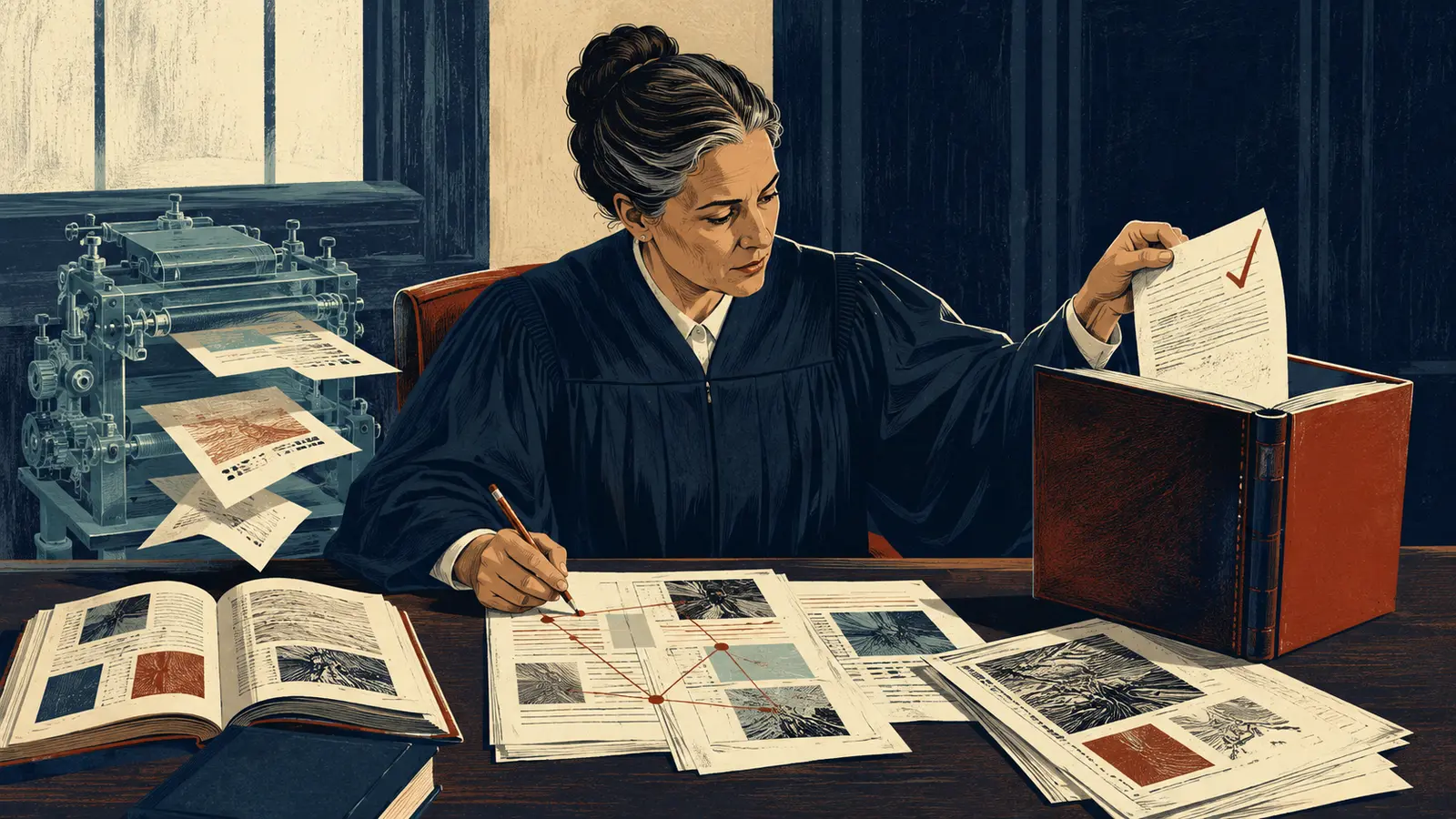
Reasons are more than fluent explanation
A judgment is not authoritative because its prose is polished. Its reasons must show which issues had to be decided, what evidence was accepted or rejected, which legal rules governed the dispute, and how applying those rules produced the result. That chain lets the parties understand why they won or lost, permits an appellate court to examine the decision and disciplines the judge’s own thinking.
Generative AI is unusually good at the visible surface of that work. It can produce a recognisable judicial form, compress a long submission and make an argument appear coherent. But it generates language by estimating plausible continuations. Plausibility is not authentication. A fluent paragraph can contain a fictitious authority, an outdated rule or a factual inference that no witness established.
The current judicial guidance for England and Wales, updated in October 2025, therefore warns about hallucinations and bias and states that judicial office holders remain personally responsible for material produced in their name. The point is not that a judge must type every word. It is that authorship means responsibility for the reasoning, not merely approval of its final wording.
Where assistance can be real
Used carefully, AI can reduce clerical friction without displacing judgment. It can propose a chronology linked to the record, identify where the parties disagree, compare submissions, or organise candidate evidence and authorities. It can test whether a draft has answered an argument, surface an inconsistency or suggest a clearer expression of a conclusion already reached.
These tasks are useful because they leave a verifiable object behind. A date can be checked against an exhibit. A quotation can be opened in the judgment from which it came. An omitted submission can be found in the filed document. The Consultative Council of European Judges’ 2023 opinion on assistive technology makes the same institutional distinction: technology should support rather than supersede judges, while ultimate responsibility remains human.
The safest architecture is retrieval before generation. The tool should search authenticated judgments and legislation, return supporting passages and stable references, and separate sourced material from generated language. Even then, the judge or a responsible member of the judicial team must open the original, confirm its jurisdiction and current status, read the context and check every quotation.
The case record needs equivalent discipline. A summary should point to the relevant page, recording or exhibit. Disputed assertions should remain visibly disputed. Missing material should appear as a gap, not be smoothed into a narrative. A useful system exposes uncertainty and provenance; a dangerous one hides them behind a single polished answer.
The first draft can become an anchor
The most important risk may arise before any factual error is noticed. A complete draft gives the judge an initial frame: these are the important facts, this is the governing question, and this is the natural result. Later review can become editing within that frame. A technically optional recommendation may exert practical pressure simply because rejecting it requires more mental work than accepting it.
That suggests a different order of operations. Before seeing generated prose, the judge should identify the material issues, provisional findings and unresolved questions from the record and authenticated law. AI can then be used as a challenger: Which submission has not been answered? What evidence cuts against this finding? Does the proposed rule fit the cited authority? The judge compares the response with the sources rather than comparing one attractive paragraph with another.
The Council of Europe’s December 2025 guidelines on generative AI for courts place generative systems in preparatory and auxiliary roles, say that legal reasoning and assessment of evidence must not be delegated, and warn against automation bias. They also say suggestions should not be binding and judges should not have to justify departing from them. Those are design requirements, not merely professional aspirations. A court system should not present a model’s conclusion as the default, rank judges by agreement with it or make opting out cumbersome.
Confidentiality cannot be added later
Court files can contain medical records, addresses, allegations, commercially sensitive documents and material subject to reporting or access restrictions. Placing them in a public chatbot can disclose information beyond the court’s control. The England and Wales guidance expressly cautions judges not to enter private information into public AI tools.
An approved judicial system needs controlled access, encryption, retention limits, reliable deletion, incident reporting and clear rules about whether inputs or outputs are used to train any model. It must record which source set and system version produced a material output. That record is operational provenance, not an invitation to expose a judge’s private deliberations. The distinction matters: courts need to audit the machinery while preserving the protected space in which a judge evaluates the case.
The parties cannot answer a hidden influence
Judicial reasoning is also adversarial. If a tool introduces a legal authority, factual proposition or decisive line of analysis that neither party addressed, the court cannot quietly import it into the judgment. Depending on the procedural context, the parties may need notice and a fair opportunity to respond. The 2023 European judicial opinion says technology used in individual proceedings should be capable of scrutiny by the parties, consistently with due notice, adversarial process and judicial accountability.
This does not require disclosure of every spelling correction or routine search. It does require a policy for material use: when AI affects an issue, authority, factual synthesis or proposed reason on which the outcome may turn, the source and the role of the tool should be traceable, and procedural fairness should determine what the parties are told. Otherwise assistance becomes an invisible participant that one side cannot test.
But judges already rely on other people
The strongest counterargument is practical. Judges have long worked with clerks, researchers, standard directions and earlier judgments. They do not personally originate every phrase. If a judge checks and adopts an AI-assisted draft, why treat it differently?
The answer is not that human assistance is infallible. It is that human collaborators occupy roles with duties, supervision and the ability to explain how a proposition was reached. A generative model has no professional obligation to the parties and no understanding of the consequences. Its errors can be convincing precisely because the system is optimised to produce plausible language. That difference calls for stronger source authentication, logging and interface design, not a blanket ban on useful tools.
Nor should “human in the loop” become a ceremonial signature. Meaningful ownership requires enough time, competence and authority to reject the draft; direct access to the complete record and authentic law; and a workflow that makes disagreement easier to express than passive acceptance. A court that uses AI to accelerate drafting while increasing caseload until real review becomes impossible has substituted automation in practice, whatever its policy says.
The boundary is reconstruction
A workable rule is demanding but clear. The judge should be able to reconstruct every material step without trusting the model: where the fact came from, why it was accepted, what legal proposition applies, where that proposition is authoritatively stated, how the parties were able to address it and why the conclusion follows. If that reconstruction cannot be made, the generated passage is not ready to become a judicial reason.
Courts can test this boundary empirically. They can audit whether citations resolve to authentic sources, whether summaries preserve disputed status, whether judges detect planted errors, whether materially new points are disclosed to parties and whether time saved in drafting is actually available for review. The evidence needed is not a demonstration that a model can imitate a judgment. It is proof that the surrounding institution preserves careful, independent adjudication under real workload.
If you value analysis of where human responsibility should sit inside public technology, you can subscribe to Alkemata for the next article in this series.
The remaining decision for each court is therefore not whether AI may touch judicial work. It is which functions can be verified from authoritative sources, which uses must be visible to the parties, and which act—the construction of reasons connecting evidence, law and outcome—must never be reduced to accepting a machine’s plausible draft.
