
A designer trying to make a protective pad faces an awkward compromise. It must bend around a curved surface, resist a local impact and remain comfortable when its wearer moves. Choosing a softer polymer helps with flexibility, but material chemistry is only part of the design. Another option is to change the geometry inside the pad so that it responds to a pull in an unexpected way.
Most familiar materials get thinner or narrower when stretched. A rubber band makes the effect obvious. An auxetic structure can do the reverse: pull it in one direction and it expands in the perpendicular direction too. The trick need not involve an exotic substance. It can come from ordinary solid pieces arranged to rotate rather than merely stretch.
That is a striking engineering idea: an apparent material property can be programmed by the shape of empty space.
Explore: why pulling usually makes things narrower
When a strip is stretched along its length, it usually contracts across its width. Engineers describe this coupling with Poisson’s ratio, conventionally written as ν = -εtransverse / εaxial for small strains. Here ε is the fractional change in length, such as 0.01 for a one-per-cent increase. The minus sign makes the ratio positive for the usual combination of lengthening and narrowing.
For a simple illustration, suppose two strips are each initially 100 mm wide and are stretched by 10% along their length. If the first has a Poisson’s ratio of +0.3, a small-strain approximation predicts a width reduction of about 3%, to 97 mm. If the second has an effective ratio of -0.5, it instead widens by about 5%, to 105 mm. These are illustrative linearised estimates, not universal predictions at 10% strain; real structures can change their response as they deform.
The sign matters because it tells us whether a local pull tends to close or open the structure sideways. But a negative ratio does not mean that the material creates energy, expands under every kind of force or is automatically stronger. It describes a particular relationship between deformations under specified loading conditions.
In 1987, Roderic Lakes reported foam structures with a negative Poisson’s ratio. The central insight was structural: changing the architecture of the foam’s cells could reverse the usual lateral response. Later researchers developed more explicit geometric mechanisms, including a particularly elegant arrangement of rotating squares.
Understand: let the squares turn instead of stretching
Imagine a sheet made from many rigid square tiles, each connected to its neighbours at corner hinges. Adjacent tiles are tilted in opposite directions. The tiles cannot significantly change shape, but the joints let them rotate. Pull the sheet and the alternating squares turn, opening the spaces between them. Crucially, that opening increases the sheet’s extent in both the direction of pulling and the perpendicular direction.
This is not the same as pulling on a net of elastic strings. The important motion is a coordinated rotation of units whose edges remain approximately fixed in length. In their 2000 rotating-squares model, Joseph Grima and Kenneth Evans showed that the ideal geometry can have a Poisson’s ratio of -1. Their original three-page paper gives the underlying construction.
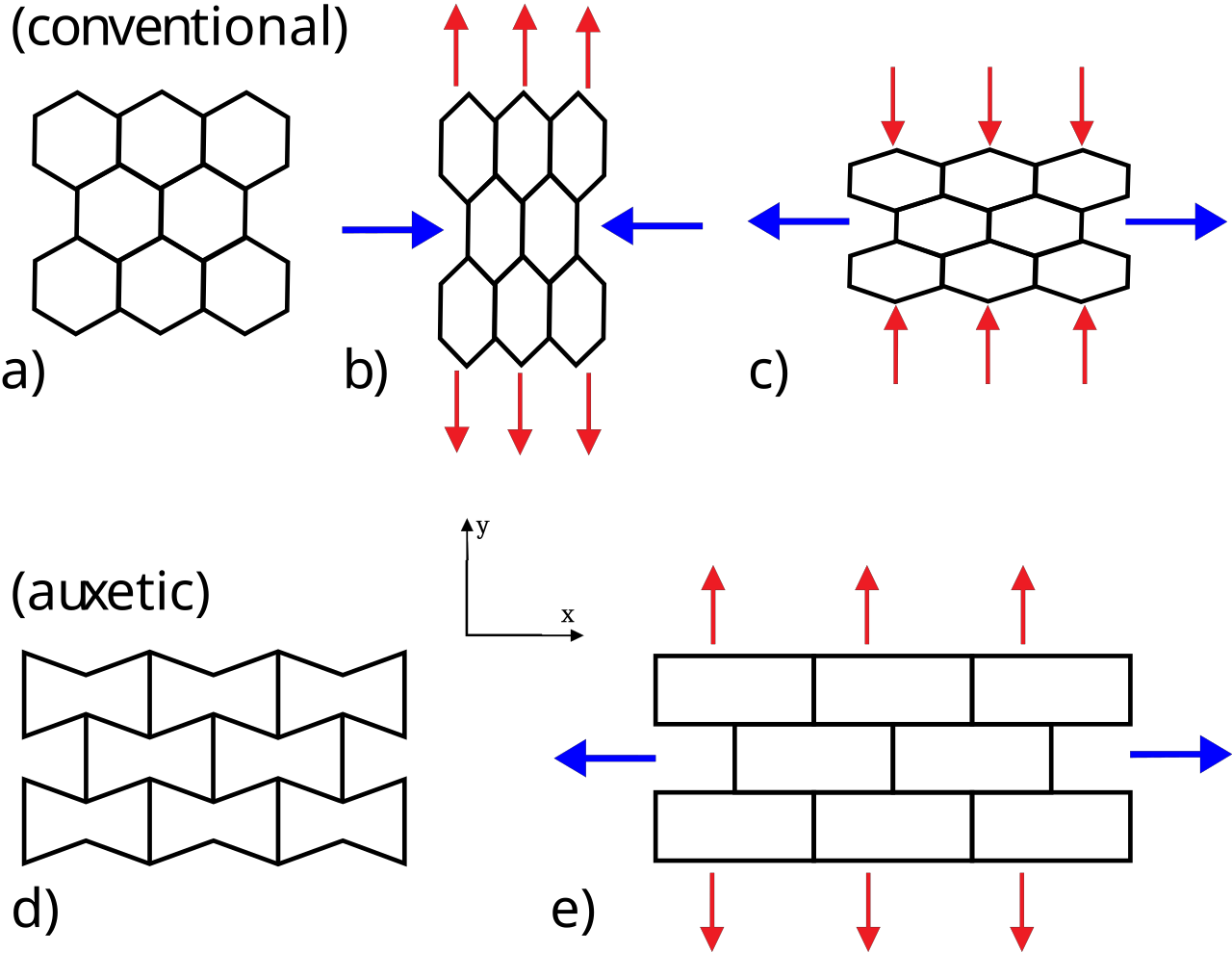
The illustration compares the visible response of conventional and auxetic materials under a pull. It does not depict the rotating-square mechanism itself: in that idealised mechanism, the individual tiles remain the same size while their angles change, opening gaps and increasing the spacing of tile centres in both directions.
The small derivation that makes the trick visible
Take a square tile with side length a, rotated through an angle θ between 0 and 45 degrees. In the alternating checkerboard arrangement, the distance between neighbouring tile centres along either axis is L(θ) = a[cos(θ) + sin(θ)]. The geometry gives the same spacing in both directions: Lx = Ly = L.
As the tiles rotate from 10 degrees to 35 degrees, the spacing changes from about 1.158a to 1.393a, an increase of roughly 20% along each axis. Because the fractional changes in horizontal and vertical dimensions are equal, dεy = dεx. Hence, for the ideal mechanism, ν = -dεy/dεx = -1.
The result is not an unexplained negative constant inserted into a constitutive law. It follows from the simple fact that the mechanism preserves the lattice’s aspect ratio while allowing its scale to change. One geometric degree of freedom controls two macroscopic dimensions. This is a useful example of a mechanical metamaterial: its effective response is governed as much by architecture as by the substance from which it is made.
There is an important qualification. Real hinges bend, tiles deform, joints have finite thickness and loads need not follow the ideal mechanism. The effective Poisson’s ratio may depend on direction, strain, manufacturing defects and whether deformation is reversible. Grima and colleagues later examined semi-rigid rotating units and showed how the balance between rotation and tile deformation changes the result.
Why engineers care about a sideways expansion
A geometry that opens under tension can change how a flexible sheet conforms to a curved surface. It may also redistribute deformation around an indentation: rather than simply moving material away from a pressed region, a suitably designed auxetic network can draw surrounding material into a different load path. Lakes and Elms compared indentation behaviour in conventional and re-entrant foams and reported differences in stiffness and yield response. That is evidence for particular tested foams, not a guarantee that any auxetic design will outperform a conventional one.
Potential applications therefore span impact-absorbing components, conformable textiles, adaptable structures and devices that need to change shape under load. The broader review by Bertoldi and colleagues places rotating mechanisms alongside origami, kirigami, buckling and other ways to programme mechanical response. In many of these systems, the empty regions and flexible connectors are functional components, not wasted material.
There is also a less obvious use: designing a movement rather than a strength. Suppose a soft robotic device should open a surface laterally whenever a cable pulls longitudinally. An auxetic linkage can couple those motions passively. Instead of installing separate actuators for two directions, the geometry provides a mechanical relationship. Whether this is preferable depends on required force, stroke, precision and reliability.
Where the clever trick stops working
Geometry cannot repeal the ordinary constraints of engineering. A lattice that opens easily may also be compliant where a solid plate would be stiff. Thin hinges concentrate strain and can fatigue or crack. Printing very small joints introduces defects and size limits; scaling a design up changes the relative importance of bending, buckling and manufacturing tolerances. An auxetic pattern may be excellent in one loading direction and less useful in another.
These are not speculative afterthoughts. A 2024 review of fatigue in auxetic structures identified cyclic loading and geometry-dependent durability as important open engineering questions. Before promising protective performance, a designer must measure impact response, repeated-load damage, mass, temperature sensitivity and manufacturability against a conventional baseline.
There is also a subtle distinction between negative Poisson’s ratio and negative stiffness. The former describes the sign of a transverse strain under axial deformation; it does not imply that a free-standing structure is unstable or that its resistance to stretching is negative. Confusing these quantities makes metamaterials sound more magical than they are.
Shape: a simple experiment that reveals the design rule
A small tabletop model can make the mechanism tangible. Cut a pattern of square islands from a thin sheet, leaving narrow flexible connections at the corners, or assemble rigid paper squares with small tape hinges. Mark a rectangular grid of reference points. Pull gently in one direction and measure the distance between marks horizontally and vertically before and after a small extension. Compute the effective ratio from -(ΔW/W)/(ΔL/L). Repeat at several extensions rather than assuming the ratio stays constant.
Then change only one variable: widen the hinges, thicken the squares, or introduce slight asymmetry. Does the lateral expansion weaken? Do the joints begin to bend irreversibly? A good experiment would also compare an uncut sheet of the same material. The purpose is not to certify a protective product, but to separate what the base material contributes from what the architecture contributes.
The deeper possibility is to treat geometry as a design language for passive control. If a lattice can turn one imposed motion into another, which other behaviours could be built into a structure before adding sensors, software or motors? The difficult next step is not drawing a clever cell. It is showing that thousands of imperfect cells still do the useful thing after thousands of real loading cycles.
Sources and further exploration
Primary research: Lakes (1987), negative-Poisson-ratio foams; Grima and Evans (2000), rotating squares; Lakes and Elms (1993), indentation tests. Broader perspectives: Bertoldi et al. (2017), flexible mechanical metamaterials and Parente et al. (2024), fatigue review.
Continue exploring on Alkemata: how a heat pipe uses passive geometry to move heat and how a tuned mass damper controls building motion.

