
A smoke alarm begins chirping while someone is frying food. A chair appears, the alarm comes down, and the battery is removed “just for now”. The nuisance has been solved, but the protection may not return. This familiar conflict reveals the engineering problem inside a small ceiling device: it must react early to many kinds of fire while ignoring ordinary airborne particles that can look surprisingly similar.
A smoke alarm does not detect fire itself. It detects a change in a sensing chamber and interprets that change as evidence of smoke. Understanding the two common mechanisms—photoelectric and ionisation—explains why alarms respond differently, why cooking can confuse them and why no household should test them with real smoke or flame.
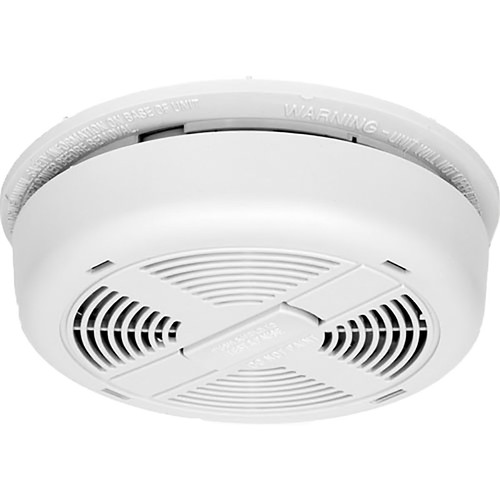
Two ways to make particles visible
In a photoelectric alarm, a light source shines through a dark chamber towards a direction that normally misses the detector. Clean air leaves the detector mostly dark. When particles enter, they scatter some of the light sideways. If enough reaches the detector, the electronics trigger the alarm. The device is not photographing smoke; it is converting scattered light into an electrical signal.
An ionisation alarm uses a different proxy. A tiny, shielded radioactive source ionises air between two electrodes, allowing a small current to flow. Particles entering the chamber capture some of those charged species and reduce their movement. The alarm watches the current and sounds when the disturbance crosses its threshold. The US National Institute of Standards and Technology gives a clear account of both mechanisms and notes that the radioactive material is safely shielded inside the unit.
The distinction matters because fires do not produce one standard “smoke”. Particle size, colour, concentration and chemistry change with the material, oxygen supply and whether combustion is flaming or smouldering. Photoelectric alarms tend to respond more readily to the larger, lighter and more reflective particles common in smouldering fires. Ionisation alarms tend to respond faster to the numerous smaller soot particles produced by flaming fires. Both technologies can detect both kinds; these are tendencies, not a rule that identifies the fire from the alarm type.
The threshold is part of a system
A sensor signal alone is not a warning. The alarm must decide when the change is large and persistent enough to justify waking a household. Set the threshold too insensitive and a dangerous fire develops unnoticed. Set it too sensitive and toast, frying aerosols, steam or dust cause repeated nuisance alarms. People may then silence or remove the device, turning better sensitivity into worse protection.
Modern standards increasingly test this discrimination rather than treating every particle source as equivalent. UL Solutions describes how newer editions of its UL 217 smoke-alarm standard include cooking-nuisance tests and additional flaming-fire scenarios. Some current designs combine several sensor signals and evaluate them with algorithms. That does not make the alarm omniscient: NIST reported in September 2024 that new alarms tested in a mock kitchen still produced cooking-related nuisance alarms. The improved system is a better classifier under specified tests, not a fire laboratory on the ceiling.
This is also why the test button has a limited but important meaning. It checks the alarm’s power, electronics and sounder according to the product design; it does not recreate every fire or prove that smoke can reach the device from every room. A successful beep is necessary evidence, not a complete validation of the building’s protection.
The strongest objection: the sensor type may not be the main problem
A mechanism-focused article can tempt readers to optimise the wrong variable. Knowing whether an alarm is photoelectric or ionisation does little if the unit has no power, is past its service life, cannot be heard by a sleeping occupant or sits in a location that local rules do not accept. The US Fire Administration states that location may be more important than sensor type in some scenarios and recommends either both technologies or a dual-sensor alarm in its jurisdictional guidance. It also stresses interconnection, accessibility for people with hearing loss and following manufacturer instructions.
Requirements differ between countries, building types, tenancies and alarm systems. A reader should not relocate, replace or rewire a safety device solely from a general article. Hardwired work belongs to a qualified person, and landlords or building managers may carry the legal responsibility. The mechanism helps people ask better questions; it does not override local fire-safety rules.
Nuisance alarms deserve the same seriousness. Disabling a unit is not an acceptable calibration method. The USFA’s smoke-alarm guidance, last reviewed on 13 October 2026, advises using an alarm’s hush function and ventilation rather than removing the battery, and checking the manufacturer’s placement instructions. If nuisance alarms persist, the useful evidence is when, where and during which activity they occur—not an improvised exposure to smoke.
A safe alarm inventory
A practical experiment can begin without producing any aerosol. Make a simple map of the home and give every alarm an identifier. Without opening the sensing chamber, record what the external label or manual states: model, manufacture or replacement date, power source, sensor type if declared, interconnection, hush function and any visual or vibrating alert. Photograph the label for future reference, but avoid covering vents or repainting the alarm.
Then use only the manufacturer-approved test control. Record whether the alarm sounds and whether linked alarms or accessibility devices respond as intended. If the model’s instructions or local authority specify a testing interval, put the next check in a shared calendar. The current USFA guidance uses monthly button tests and replacement at ten years for many domestic alarms, but the product instructions and applicable local rules should govern the actual decision.
Finally, keep a short nuisance log for four weeks: date, activity, which alarm sounded, doors or extractor fans in use, and whether the hush function worked. Do not deliberately recreate an alarm. The log can reveal whether one location repeatedly receives cooking aerosol or steam and gives a qualified installer, landlord or fire-safety authority something more useful than “it goes off all the time”.
The experiment enables one immediate decision: identify the alarm whose type, age, power or connection is unknown and resolve that uncertainty through its manual, responsible building manager or local fire service. The deeper lesson is that safety depends on a chain—particles reaching a chamber, a physical signal crossing a tested threshold, a warning reaching people and people being able to act. The ceiling device is small; the system around it is not.
Author
What concrete example would confirm or challenge this article?
Choose a reaction, write a comment, or ask your AI assistant to send a proposal for review. Comments are reviewed before publication.