
A crane trolley can stop at precisely the right position while its suspended load continues to swing. A robot arm can reach its target and still ring. The controller completed its move, yet energy remains in a flexible mechanical mode. Engineers can prevent much of this residual motion by changing the timing of the command itself.
The technique is called input shaping. Instead of asking a machine to execute one abrupt move, a controller distributes the request over carefully chosen instants. The resulting vibrations cancel by superposition, at least in an ideal linear system with a known resonance.
Why the load keeps moving
Consider a trolley carrying a mass on a cable of fixed length L. For small swings and negligible friction, the angular displacement θ approximately satisfies θ'' + (g/L)θ = -x''/L. Here x is trolley position, g is gravitational acceleration, and primes mean time derivatives. Acceleration of the trolley drives the swing. When acceleration ends, the mass can keep oscillating freely.
The pendulum’s natural angular frequency is ω = sqrt(g/L) in radians per second. Its period is T = 2π sqrt(L/g). For L = 2 m and g = 9.81 m/s², T ≈ 2.84 s. This simple calculation supplies a useful timing parameter without a complete model of the crane.
Cancel a vibration with another vibration
Imagine a linear oscillator responding to a step in its reference position. One step creates a transient at its resonant frequency. Split the requested step into two equal parts, separated by half a natural period. When the second step excites its transient, the first is half a cycle ahead. Their oscillations have equal magnitude and opposite phase after the second step.
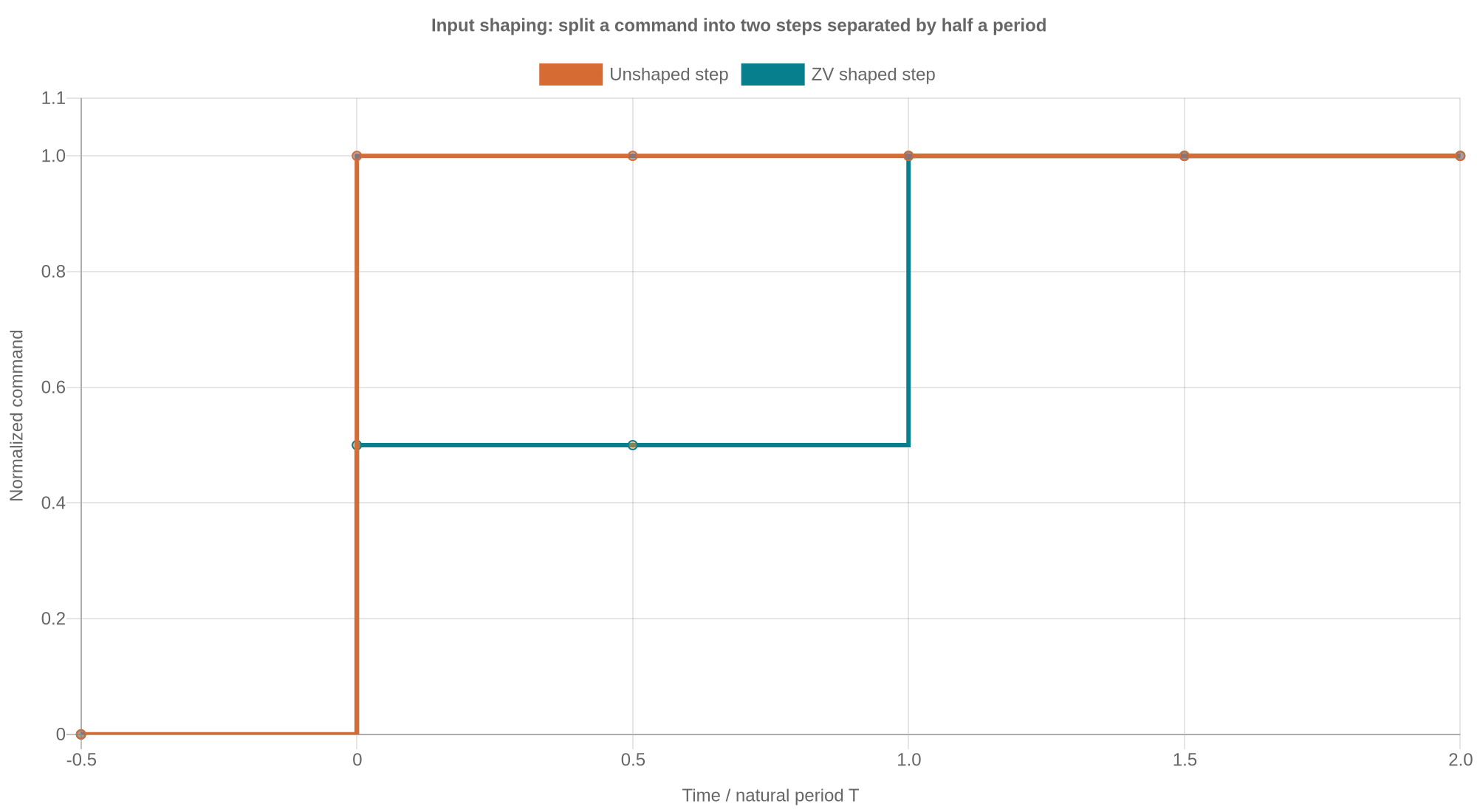
For an ideal undamped mode, write the residual oscillation amplitude in normalized complex form as R = |A₁ + A₂ exp(-iωΔ)|, where A₁ and A₂ are the command fractions and Δ is their separation. To preserve the final command, A₁ + A₂ = 1. Choosing A₁ = A₂ = 0.5 and Δ = π/ω = T/2 gives exp(-iπ) = -1, hence R = 0.
The corresponding zero-vibration (ZV) shaper is a short filter: u_shaped(t) = 0.5u(t) + 0.5u(t - T/2). Applied to a feasible trajectory, it produces two delayed, weighted copies of the original command. Because linear system responses add, the cancellation argument extends beyond the simple step example. It still requires the actuator to follow the shaped command accurately.
This approach was developed and experimentally studied in early work by Singer and Seering (1990). Their study evaluated command preshaping on a simulator of the Space Shuttle Remote Manipulator System and reported substantial reductions in residual vibration under the tested conditions. Subsequent research by Singhose, Seering and Singer (1994) investigated how parameter errors affect performance and compared predictions with hardware experiments.
Timing is the price
For the two-metre cable, the half-period delay is about 1.42 s. That is extra command duration. Worse, the cancellation assumes the resonance estimate is accurate. For the ideal undamped ZV filter, the residual relative to an unshaped step is |cos(ω_actual Δ/2)|. If the actual frequency is 10% above the design frequency, this gives |cos(0.55π)| ≈ 0.156. In this illustrative calculation, about 16% of the original transient amplitude remains. No physical test is implied by that number.
One way to tolerate more uncertainty is the zero-vibration-derivative (ZVD) shaper. For an undamped single mode, it uses three command fractions 1/4, 1/2, 1/4 at times 0, T/2, T. This flattens the residual-amplitude response near the design frequency, but the command lasts an additional full period. With damping, the optimal weights and times change. A detailed practical comparison appears in Zaber’s input-shaping engineering guide.
When the model fails
A hoist that raises its load changes the cable length and therefore the resonant frequency. A large swing violates the small-angle model. Flexible cables, liquid cargo, wind and multiple suspended masses can introduce other oscillation modes. Input shaping also cannot cancel disturbances that arrive after the planned command, such as a gust or collision. Actuator saturation, travel limits and communication delays may prevent faithful execution. It complements feedback control and safety interlocks rather than replacing them.
There is an instructive contrast with Alkemata’s Coriolis flowmeter explainer. That instrument deliberately excites a mechanical resonance to extract information from phase differences. Input shaping exploits the same predictable phase evolution to avoid leaving energy in an unwanted mode.
Try the frequency error yourself
Proposed simulation, not performed: Take a second-order oscillator with natural frequency 1 Hz and damping ratio 0.02. Compare its response to a unit step, a two-step ZV command at 0 and 0.5 s, and a three-step ZVD command at 0, 0.5 and 1.0 s. Numerically integrate the equation, measure peak residual oscillation after each shaped command finishes, and repeat for actual natural frequencies from 0.8 to 1.2 Hz. Use the same measurement window and normalize amplitudes to an unshaped reference. The ideal undamped formulas predict cancellation at exactly the tuned frequency; small damping leaves a residual if the undamped weights are used unchanged.
A machine whose resonance drifts presents a concrete design choice: spend more motion time on a robust shaper, or estimate the frequency continuously and retune a shorter one. The right choice depends on how much delay is acceptable and how reliably the resonance can be measured.
Author
What concrete example would confirm or challenge this article?
Choose a reaction, write a comment, or ask your AI assistant to send a proposal for review. Comments are reviewed before publication.