
Could the plasma instabilities that plague fusion reactors become the very mechanism that propels a spacecraft? A research-led proposal for an engine built around magnetic reconnection, plasmoid ejection and the space environment—plus a realistic route from laboratory physics to flight.
The wrong starting point: putting an Earth reactor on a spaceship
Most fusion propulsion concepts begin with an essentially terrestrial question: how can we shrink a fusion reactor, confine its plasma and attach a nozzle? Yet a spacecraft is not a power station. Its objective is not electricity generation; it is to transfer momentum into escaping matter or into an external medium, producing a useful change in velocity.
That changes what counts as a loss. In a terrestrial reactor, a magnetic instability that tears apart confinement is an enemy. In propulsion, a carefully directed burst of escaping plasma may be the product. Rather than maintain perfect confinement indefinitely, perhaps we should confine briefly, trigger a controlled magnetic eruption, and let the plasma leave.
1. Turn confinement failures into an exhaust cycle
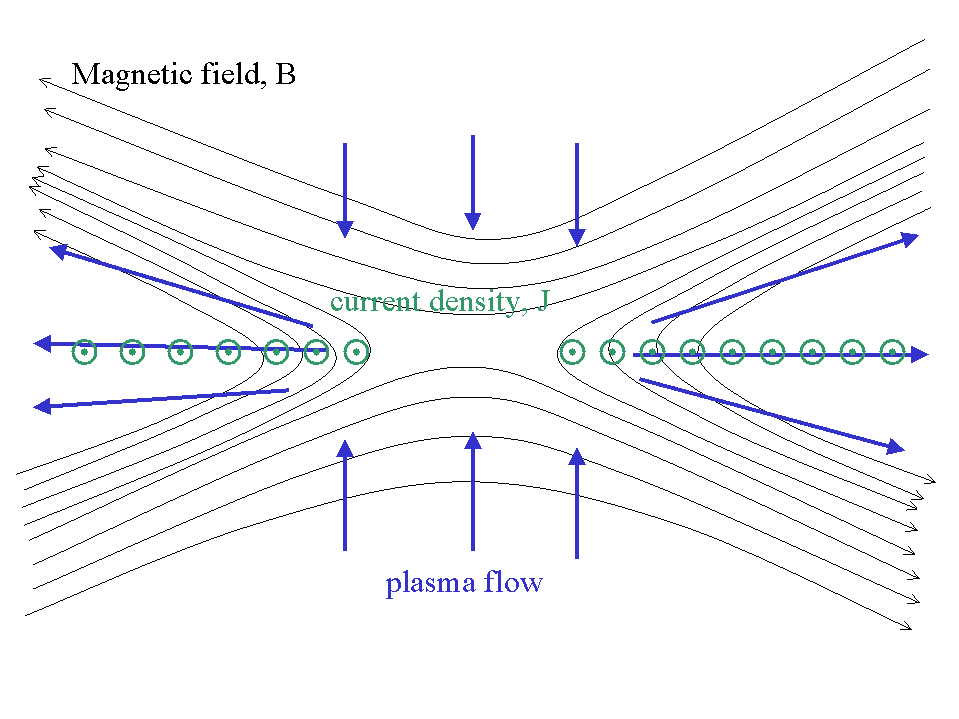
Consider a plasma column carrying strong electric currents. Its magnetic field can develop a thin current sheet. Under suitable conditions the sheet tears; magnetic field lines reconnect, releasing magnetic energy into plasma flows, particle heating and sometimes compact structures called plasmoids. The process is familiar from the Sun, Earth’s magnetosphere and fusion research.

An instability-driven thruster would follow a simple operating cycle:
- Load: inject a small amount of propellant and establish magnetic flux and electric current.
- Store: supply electrical or fusion-derived pulse energy to the magnetized plasma.
- Trigger: allow a current sheet to reach a controlled reconnection threshold.
- Eject: use the resulting aft-directed reconnection outflow or plasmoid to carry momentum away.
- Reset: re-establish the magnetic configuration for the next pulse.
The important engineering word is controlled. Random turbulence heats equipment and disperses thrust; reproducible, directional ejection might replace part of a conventional acceleration-and-detachment system.

2. Which instabilities could help?
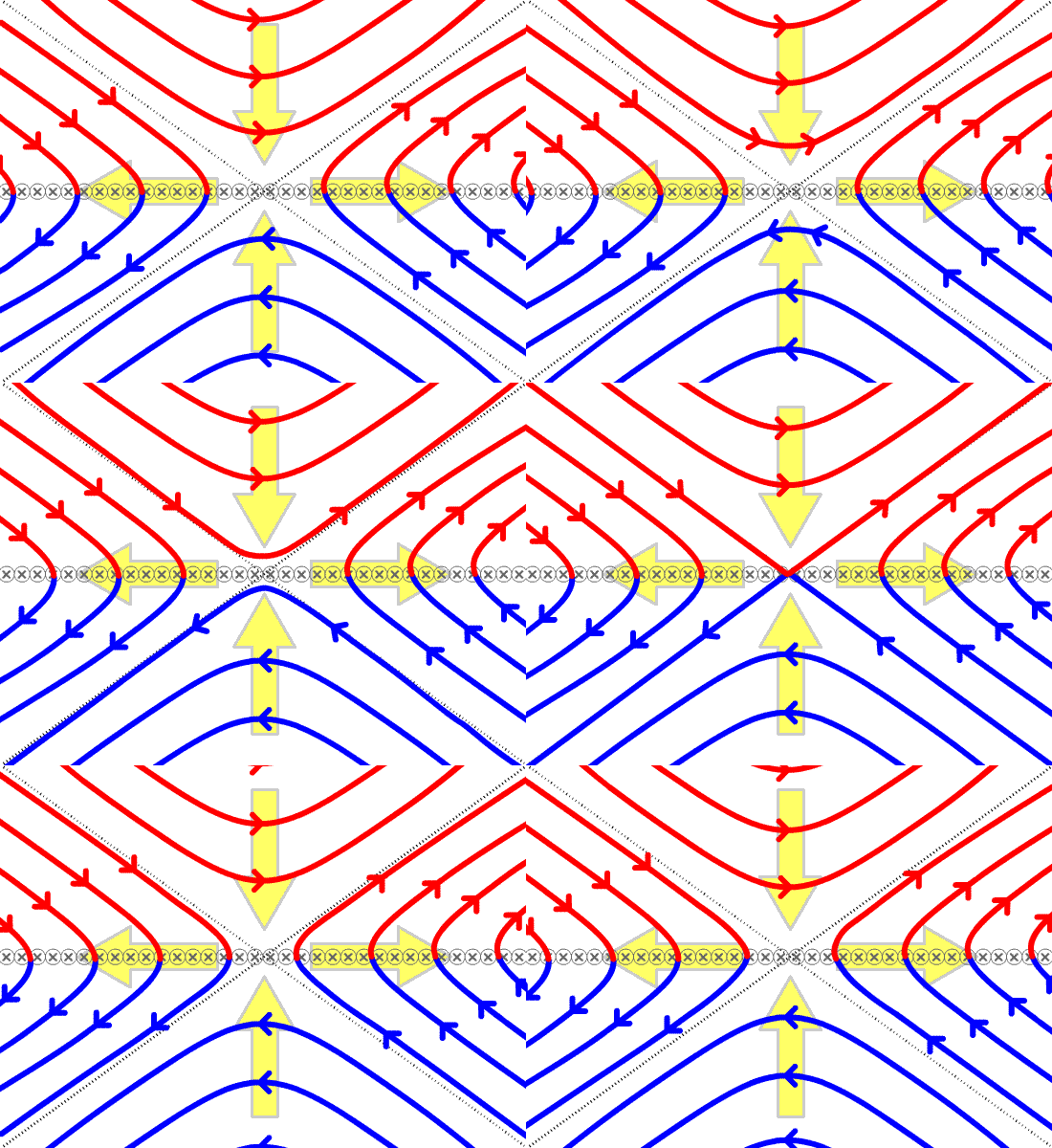
Tearing and plasmoid instability are the most directly useful: they can create reconnection jets and separate magnetic structures that leave with the exhaust. Kink instability, normally an undesirable helical distortion, might serve as an intentionally driven trigger, although a kink does not by itself guarantee net axial thrust. Kelvin–Helmholtz shear instability at the interface between an exhaust plume and ambient plasma could enhance mixing or generate new current sheets; whether it assists detachment or merely wastes momentum must be measured. Lower-hybrid and related drift instabilities can increase cross-field transport and ion heating, potentially beneficial in a carefully localized exhaust region but dangerous elsewhere.
There is no law that an unstable plasma makes a better rocket. The useful criterion is momentum delivered in the chosen direction per unit of input energy and onboard mass, compared under the same conditions with stable alternatives.
3. What has actually been built?
NASA’s Plasmoid Thruster Experiment (PTX) investigated repeated compact-toroid formation using an inductively driven conical theta pinch. NASA’s 2005 progress report describes reproducible ionization with different propellants and measured plasmoid velocities up to 20 km/s in a laboratory back-fill. It was a real propulsion-relevant experiment, not a working fusion rocket: NASA PTX report.
Fatima Ebrahimi’s Alfvénic reconnecting plasmoid thruster, published in 2020, is an explicit propulsion design in which reconnection repeatedly generates plasmoids in an annular channel. The paper reports 20–500 km/s exhaust velocities from numerical simulations, not demonstrated flight hardware or verified whole-system efficiency: Journal of Plasma Physics.
A significant update in November 2026: Princeton Plasma Physics Laboratory reported construction of the Princeton Plasmoid Magnetic Reconnection Thruster prototype. That is genuine progress toward hardware validation, but it should not be mistaken for published proof of a flight-ready engine: PPPL, 3 November 2026. A 2025 APS poster also described a roughly 35-cm experimental design using permanent magnets to simplify field generation.
Plasma magnets and magneto-plasma sails form a parallel experimental lineage. John Slough’s NASA NIAC studies investigated plasma-supported magnetic structures interacting with a simulated solar wind. This is momentum exchange with a flowing external plasma, not necessarily plasma ingestion into a fusion engine: Plasma Magnet NIAC report.
4. The space medium is not empty—but it is exceptionally thin
Interplanetary space offers sunlight, solar wind, electrons, ions and an embedded magnetic field. Interstellar space also contains neutral hydrogen, plasma, magnetic fields and dust. These are opportunities unavailable to a typical terrestrial fusion device, but their dilution imposes a severe accounting constraint.
At a representative solar-wind density of 5 protons/cm³ and speed of 400 km/s, even a perfect, circular collector of 100 m radius intercepts only about 1 × 10⁻¹⁰ kg/s. This estimate uses the idealized mass-flux relation ṁ = ρ v A and ignores real capture inefficiency. The arriving plasma also carries momentum; collecting or slowing it produces an opposing force. At these illustrative conditions the intercepted momentum rate is around 4 × 10⁻⁵ N. Enlarging the effective area helps, but does not make collection or the associated drag free.
In a ram-augmented rocket, the relevant speed is relative to the craft, and any net benefit requires outgoing propellant momentum to exceed the momentum taken from incoming matter, with power, magnetic structure and collection losses included. A magnetic field can exchange momentum with the ambient medium without capturing all the incident particles; it cannot create reaction mass or energy from nothing.
That suggests prioritizing three roles for the environment: solar-wind sailing when the flow supplies external momentum; magnetic or plasma-sail braking during high-speed arrival; and plume interaction and charge exchange in carefully investigated regimes. Ambient matter harvesting should remain an optional experimental mode, not the foundation of the engine’s performance claim. For the interstellar case, the classic Andrews–Zubrin magnetic-sail study is especially relevant to braking.
5. A genuinely space-native hybrid architecture
Imagine a spacecraft with three deliberately distinct systems:
- A compact pulsed power / fusion module. Initially batteries, capacitors and a conventional power supply. In a much later version, fusion would produce pulse energy or energetic charged particles. Fusion ignition is not assumed to be easy.
- A reconnection accelerator. Magnetic coils or permanent magnets shape a current sheet behind the craft, which ejects repeated plasmoids. A compact propellant tank guarantees operation even in vacuum.
- An optional deployable plasma-magnet interface. Used separately as a sail, brake or experimental boundary-conditioning structure. It is not assumed to be an enormous, lossless magnetic intake.
In a schematic flow: onboard energy → magnetized propellant → controlled reconnection → aft-directed plasmoid exhaust → spacecraft impulse. A second, independently measured path is ambient solar wind ↔ external electromagnetic structure ↔ spacecraft force. Combining the two is worthwhile only if experiments show a measurable improvement over operating them separately.
The design intentionally avoids treating the solar wind as a pre-compressed fusion fuel. No realistic interplanetary or interstellar plasma density substitutes for the pressure and confinement required for practical fusion ignition. Nor does a magnetic instability create extra energy: it redistributes stored energy, some of which must become directed momentum rather than heat or radiation.
6. A research roadmap with honest decision gates
| Phase | Test | Evidence required to advance |
|---|---|---|
| 1. Non-fusion bench physics (illustrative 0–2 years) | Reproduce controllable plasmoid formation and measure impulse per pulse. | Independent thrust and plume diagnostics; power and mass balance; a fair conventional-thruster comparison. |
| 2. Instability control (2–4 years) | Map tearing thresholds, imposed perturbations, detachment and plume divergence. | Repeatable aft thrust and lifetime without destructive side loads or unacceptable heating. |
| 3. Ambient interaction (3–6 years) | Expose the thruster and optional plasma magnet to a solar-wind analog. | Net improvement after subtracting drag, power overhead and losses; no assumption that chamber background gas resembles space automatically. |
| 4. Non-fusion flight demonstrator (5–9 years) | Space-qualify pulsed power, thermal control, magnetic hardware and diagnostics. | Measured spacecraft acceleration and mission-level advantage over available electric propulsion. |
| 5. Fusion coupling (long term) | Integrate a credible compact fusion source with the exhaust accelerator. | Complete-system advantage including reactor, fuel, neutron shielding where relevant, thermal radiators and reliability. |
These phases and timings are a proposed program, not an existing funded project or reliable prediction. The early experiments can progress without fusion.
7. The experiments that would teach us the most
Experiment A — controlled tearing as a valve. Use magnetic probes, imaging and a thrust stand to correlate reconnection onset with impulse. Can a small imposed perturbation increase directional momentum rather than just instability amplitude?
Experiment B — plasmoid detachment. Map magnetic flux, current closure and momentum before and after ejection. Does a compact toroid actually depart cleanly, or does return-field coupling reduce thrust?
Experiment C — vacuum versus ambient plasma. Repeat matched discharges with and without an external plasma flow, keeping power and propellant fixed. Separately record the additional force from the plasma magnet. This isolates any beneficial external coupling from simple solar-wind drag or facility effects.
Experiment D — fusion-pulse surrogate. Couple an electrically delivered short energy pulse into the accelerator and compare exhaust efficiency with a continuous-power configuration. Only if that works does an actual fusion-driven pulse begin to make engineering sense.
8. The decisive quantities
Useful first-order checks are F ≈ ṁ ve for a rocket with negligible pressure correction, Pjet ≈ ½ ṁ ve² for exhaust kinetic power, and vA = B / √(μ₀ρ) for the characteristic Alfvén velocity in an appropriate MHD regime. Together they expose the central trade-off: increasing exhaust velocity improves propellant efficiency but, at fixed kinetic power, reduces thrust. A striking simulated exhaust velocity is not by itself evidence for a high-performance spacecraft.
For every prototype, record net thrust per electric watt, propellant utilization, plume divergence, energy closure, thermal losses, dry mass, reliability and the momentum exchange with any background plasma. The key comparison is not against an ideal chemical rocket but against existing electric-propulsion mission alternatives.
A different philosophy of fusion propulsion
Perhaps the future fusion engine will not look like a miniature power plant surrounded by a magnetic bottle. It may look like an instrument designed to make a particular plasma instability happen—at the right time, in the right place, in the right direction. Fusion would be one possible energy source for that instrument; reconnection would be one possible way to turn the energy into exhaust.
Space offers an additional opportunity: external plasma and magnetic fields can sometimes provide momentum exchange or braking without consuming onboard propellant. But their scarcity means they must be approached as a separate, measurable physics system—not a limitless feedstock.
The research question is therefore not simply “can we control fusion?” It is “can we make controlled magnetic eruptions a more efficient way to accelerate a spacecraft?” That question can be tested today, before anybody builds a spaceborne fusion reactor.
Further reading
- Ebrahimi (2020), An Alfvénic Reconnecting Plasmoid Thruster — numerical basis for the concept.
- NASA PTX experiment progress — historical hardware precedent.
- PPPL (3 Nov 2026) — announcement of prototype development.
- APS DPP 2025 design poster — permanent-magnet reconnection thruster simplification.
- NIAC Plasma Magnet study — external plasma-field interaction.
- Physics of Plasmas (2026): Recent laboratory experiments on radiofrequency plasmas in magnetic nozzles — propulsion-related nozzle physics.
Author
What concrete example would confirm or challenge this article?
Choose a reaction, write a comment, or ask your AI assistant to send a proposal for review. Comments are reviewed before publication.