
A newly poured pavement is often hidden under plastic, damp fabric or a pale sprayed membrane. To an observer, the covering can look backwards. If the goal is a hard surface, why stop it from drying?
Because concrete is not clay left in the sun. Its cement does not become strong by losing water. It becomes strong by reacting with water. That reaction—hydration—builds new solid compounds, releases heat and continues only while moisture and a workable temperature remain available. Curing is therefore not an optional wait after the “real” work. It is part of making the material.
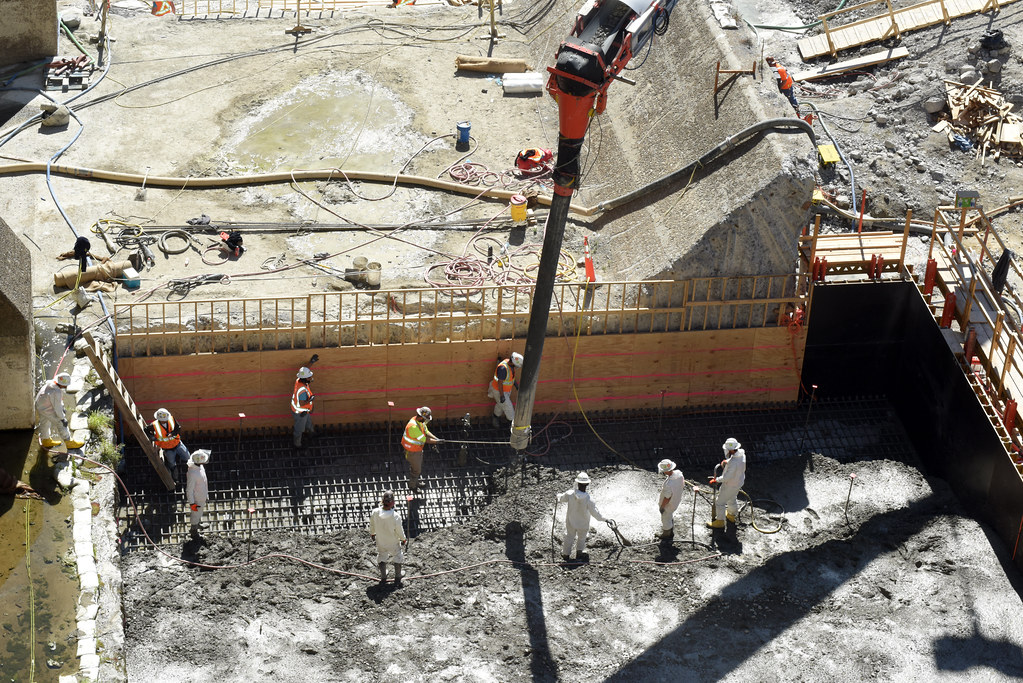
Water becomes part of the structure
Concrete is a composite: aggregate such as sand and stone is bound by a paste made from cement and water. When water reaches the cement grains, several reactions begin. Among their products is calcium silicate hydrate, often abbreviated C-S-H, which grows through the space between particles and binds the mass together. The material changes from a workable suspension into a connected, load-bearing microstructure.
The US Federal Highway Administration’s technical brief on curing concrete paving mixtures describes hydration as an exothermic reaction: it generates heat while producing compounds including calcium silicate hydrate and calcium hydroxide. It defines curing as maintaining enough moisture and suitable temperatures for those reactions to continue until the required properties develop.
This is the first useful mental model: water has two competing exits. Some is chemically or physically incorporated into hydration products; some can evaporate from the surface. If evaporation wins too early, hydration slows and the surface can shrink while the concrete is still weak. The same piece may therefore appear dry and solid while its near-surface zone is more porous and less durable than intended.
The heat is both evidence and risk
Hydration’s heat is easy to miss in a thin garden slab but consequential in a thick foundation, dam or bridge component, where the interior cannot shed heat quickly. The centre warms and expands. Later, as it cools, it tends to contract. Restraint from cooler outer layers, reinforcement, foundations or adjoining concrete can turn that contraction into tensile stress.
Concrete is comparatively weak in tension, especially at an early age. The FHWA’s guidance on early-age pavement behaviour explains that hydration rate and heat depend on cement type, fineness, water-to-cementitious-material ratio, admixtures and curing temperature. It also notes that temperature changes and gradients can produce cracking when stress exceeds the developing tensile strength. More heat is not simply more progress; temperature must be managed across both time and thickness.
This produces a second mental model: young concrete is changing its strength, temperature and volume at once. A curing decision alters all three. Insulating blankets may protect against cold, yet massive concrete may need staged pours, lower-heat mixtures or cooling measures. A membrane may conserve moisture, but it cannot by itself correct a large internal temperature gradient. “Keep it wet” is a principle, not a complete construction plan.
Why adding more mixing water is not the answer
There is an apparent contradiction. If hydration needs water, why not make the mix wetter? Because water added during mixing and water preserved during curing play different roles. Excess mixing water can leave behind connected capillary pores as it departs, reducing strength and increasing permeability. Curing instead protects the designed mixture from losing the water it needs and keeps the reaction within a useful temperature range.
The American Concrete Institute’s definition of curing emphasises moisture and temperature control rather than indiscriminate soaking. The right method depends on the mixture and the work: sprayed curing compounds, wet coverings, plastic sheets, fogging or carefully supplied internal reservoirs. NIST’s review of internal curing describes one such approach, using pre-wetted lightweight aggregate to release water from within as hydration or self-desiccation creates demand.
The strongest counterargument is practical: perfect curing is impossible on a windy road, a crowded site or a repair that must reopen quickly. That is true, and it is why a specification needs priorities rather than ritual. The vulnerable interval, expected weather, evaporation risk, member thickness, opening criteria and responsibility for inspection should be explicit. A blanket duration copied from another project can hide as much as it controls.
Make curing visible
Curing quality is difficult for a future user to see. The pavement looks finished before its internal reactions are finished, and a crack years later rarely carries a label naming the rushed afternoon that helped cause it. This creates an accountability gap: clients can inspect dimensions and surface finish immediately, while moisture retention and temperature history disappear into site memory.
A small public-works team, housing cooperative or maker space could test a simple remedy: a one-page curing receipt for one non-critical repair. It would record the mixture reference, placement time, weather, concrete temperature where the project already measures it, curing method, time protection began and ended, and the person who checked it. Photographs would show the covering or membrane, not merely the finished surface. Any decision to open the work would cite the project’s specified evidence, such as an approved strength test or maturity procedure, rather than appearance alone.
The experiment is not to invent a universal curing recipe. It is to ask whether making the process legible changes behaviour. Did protection start promptly? Was there a gap during a shift change? Did a hot, dry forecast trigger a different plan? After the pilot, the team can compare the receipt with the project specification and decide which fields were useful, missing or burdensome.
The next time fresh concrete is covered, the important question is not “When will it dry?” but “What reaction are we trying to sustain, and how will we know we protected it?” That shift turns curing from passive waiting into an engineering decision—and gives the people paying for, making and living with the structure something concrete to examine.
Author
What concrete example would confirm or challenge this article?
Choose a reaction, write a comment, or ask your AI assistant to send a proposal for review. Comments are reviewed before publication.