
From time to time, Alkemata takes a short break for art and culture. Last time, we looked for wind in a Van Gogh. Today, watch a thin stream of milk fall into a bowl. Everything around it seems to hold still. How did Vermeer make that ordinary moment worth looking at?
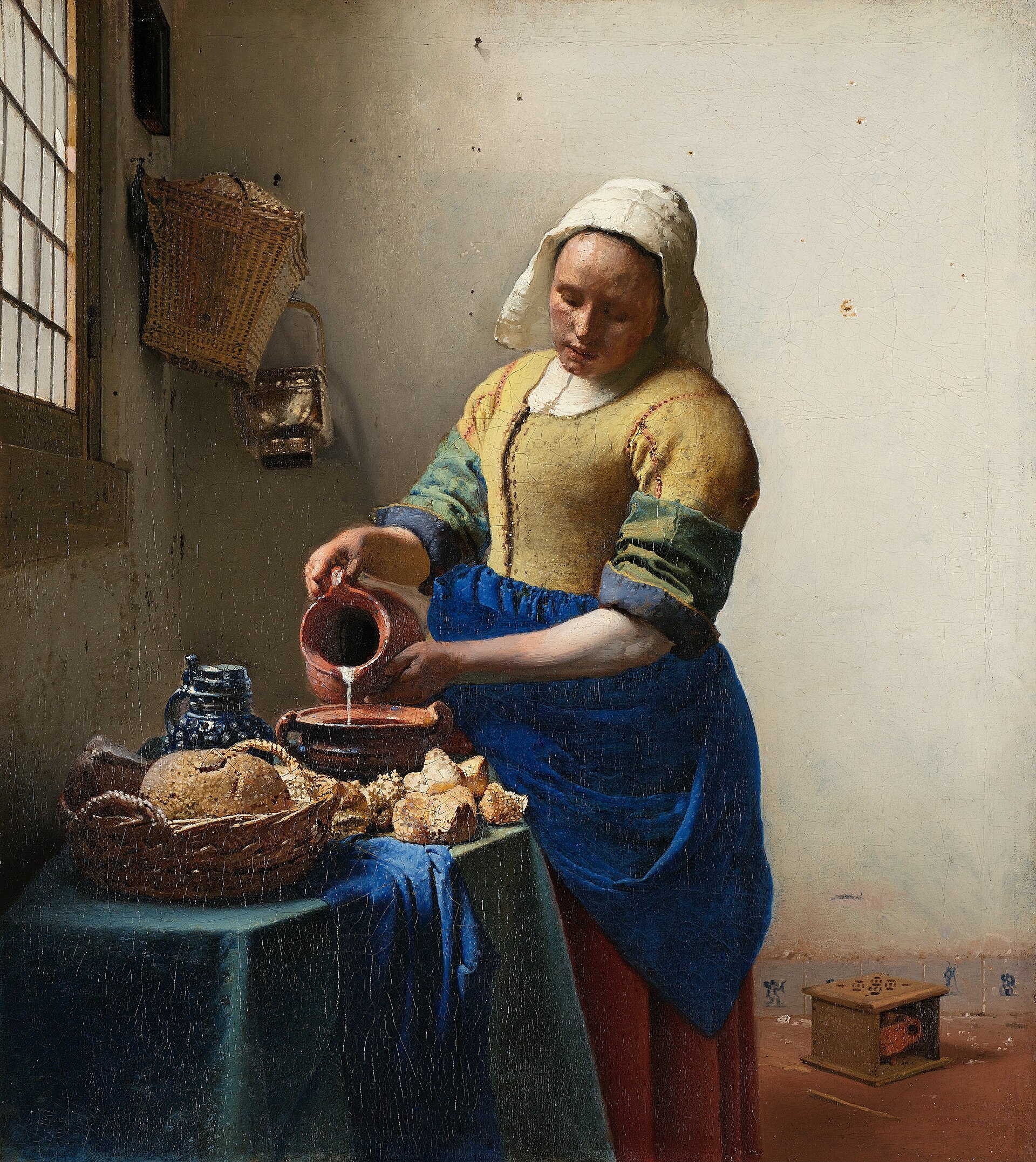

A kitchen in seventeenth-century Delft
Johannes Vermeer (1632–1675) was a painter and art dealer in Delft. He began with biblical and mythological subjects and became known for interiors where people read letters, play music or attend to household tasks. The woman in The Milkmaid, painted around 1660, is a kitchen servant. The canvas is just 45.5 centimetres high, yet Vermeer sets the viewpoint low enough that we look slightly up at her. The Rijksmuseum’s biography of Vermeer · Exhibition notes.
The room Vermeer painted over
In 2022, the Rijksmuseum reported what scans had revealed beneath the finished surface. Behind the woman’s head, Vermeer had sketched a wooden rack with hanging jugs. At the lower right, he had painted a large fire basket, a household warmer that held a bowl of glowing coals. He covered the rack with the pale wall and replaced the basket with floor, tiles and a small foot warmer. The scans also picked up a broad black stroke beneath her left arm, a trace of how loosely he blocked in the scene before adding its fine detail. The Rijksmuseum’s scan findings, with an infrared image.
Where the eye goes
Look at the pale wall beside her cap, then at the crusts of bread. Vermeer leaves a broad space around her head and clusters tiny dabs of pale paint on the bread and wicker. The bare wall makes her outline easy to follow. The flecks on the table give the window light a texture you can almost feel. Between them, her lowered gaze and the tilted jug lead to the single thread of milk. The painting gives a routine task the presence of a portrait while keeping our attention on what her hands are doing.
Look again and imagine a row of hanging jugs behind her. Would your eye reach the stream of milk as quickly?
Author
What concrete example would confirm or challenge this article?
Choose a reaction, write a comment, or ask your AI assistant to send a proposal for review. Comments are reviewed before publication.