
A physicist wants to photograph a process that lasts only a few trillionths of a second, or deliver a precisely timed burst of energy into a tiny region of matter. An ordinary laser can provide light, but the useful instrument is often a pulse so brief that its power becomes extraordinary. The difficulty is that a pulse intense enough for the experiment may destroy the very optical components used to amplify it.
The solution sounds backwards: make the pulse much longer before trying to make it stronger. Stretch it in time, amplify it while its peak intensity is manageable, then compress it back into a brief burst. This is chirped-pulse amplification (CPA), developed by Donna Strickland and Gérard Mourou and demonstrated in their 1985 paper. Their work was recognised by the 2018 Nobel Prize in Physics. The striking principle is not a new source of energy; it is a way of arranging when the energy passes through vulnerable equipment.
Explore: the pulse that threatens its own amplifier
Power is energy delivered per unit time. For a short pulse with energy E and duration τ, a useful order-of-magnitude estimate is Ppeak ≈ E/τ; the exact coefficient depends on the pulse shape and on how duration is defined. Consider a hypothetical 1 millijoule pulse lasting 30 femtoseconds. Dividing 10−3 J by 30 × 10−15 s gives about 33 gigawatts of peak power, despite the tiny total energy. That is not continuous electrical power and says nothing by itself about the average power: the pulse exists for an extraordinarily short time.
Now imagine passing this burst repeatedly through an optical amplifier. The medium may have enough stored energy to amplify it, but the instantaneous light intensity can induce unwanted nonlinear responses. The refractive index changes with intensity, distorting the wavefront and the phase of the pulse; self-focusing can concentrate the beam; coatings and crystals can be damaged. A technical lecture from LMU Munich describes precisely this conflict between energy gain, nonlinear propagation and damage.
It would be tempting to solve everything by reducing the beam’s power. But then the desired high-intensity experiment cannot be performed. CPA instead keeps the intensity low during amplification and reserves the extreme peak power for the final interaction with the target.
Understand: three operations, one counterintuitive result
The method starts with a short pulse containing a range of optical frequencies. That spread is essential: a very short waveform cannot consist of one perfectly monochromatic frequency. A dispersive stretcher—often an arrangement involving diffraction gratings—gives different frequency components different travel times. Rather than arriving together, they become ordered across the pulse: one portion of the spectrum arrives earlier, another later. The result is a chirp, named by analogy with a sound whose pitch changes with time.
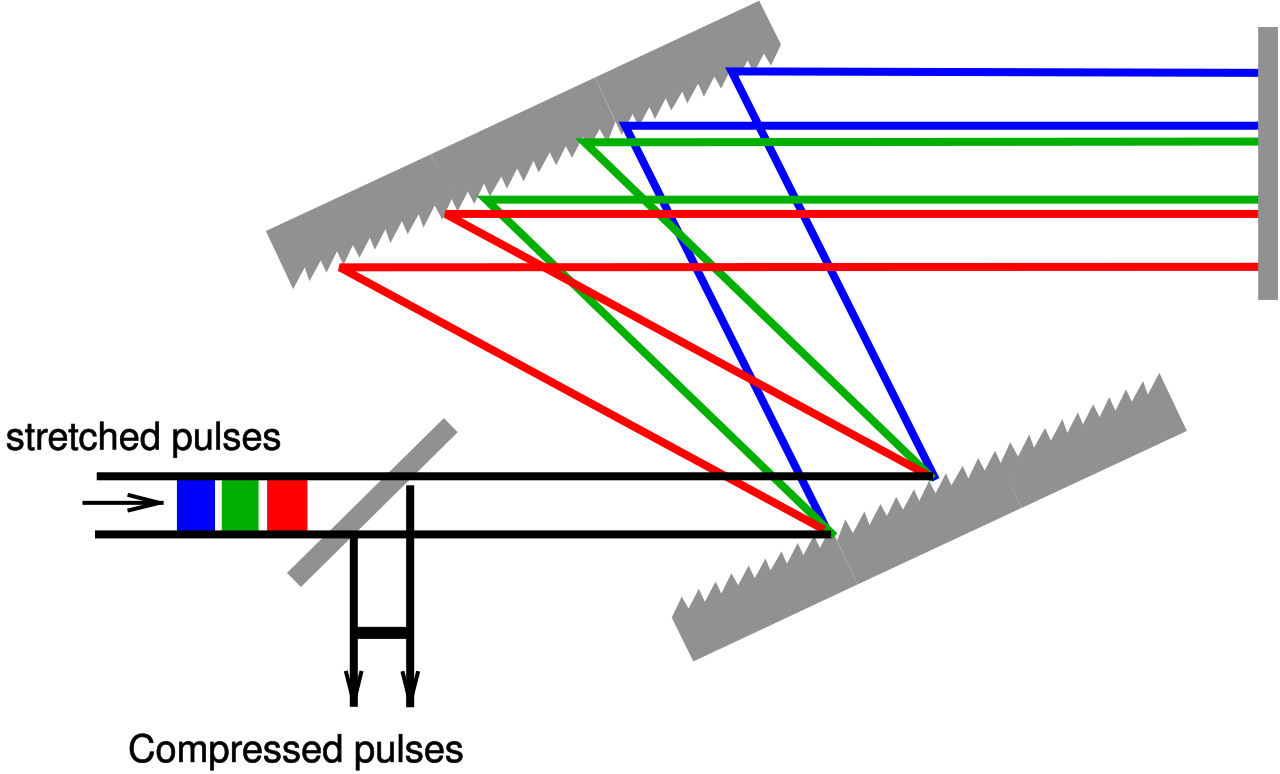

The long, chirped pulse now passes through one or more amplifiers. A pumped gain medium transfers stored energy to the optical pulse by stimulated emission, but the energy is spread over a longer interval. Beam expansion can further reduce the intensity at optical surfaces. Finally a compressor introduces dispersion of the opposite sign so that the previously separated frequency components arrive together again. The output is short and now contains substantially more energy than the original seed. The compressor does not add energy; the amplifier did that. The compressor concentrates the amplified energy into a shorter time.
Strickland and Mourou’s original arrangement used fibre stretching and grating compression. Subsequent systems developed better-matched grating stretchers and compressors. Mourou’s Nobel autobiographical account explains why matching these components was an engineering obstacle rather than a mere adjustment.
The mathematical trick: control the phase, not just the amplitude
To understand what a stretcher changes, picture the pulse as a superposition of many nearby angular frequencies ω. The relative phases of these components determine whether they reinforce one another in a short instant or are spread across time. A dispersive optical system changes the spectral phase. Near the central frequency ω0, we can write it approximately as
φ(ω) = φ0 + φ1(ω−ω0) + ½φ2(ω−ω0)² + …
The constant term φ0 changes the overall phase; the linear term shifts the pulse in time. The crucial quadratic term, φ2, is the group-delay dispersion. Different frequency components experience different delays because
τg(ω) = dφ/dω ≈ φ1 + φ2(ω−ω0).
When φ2 is appreciable, the group delay varies across the spectrum, and the pulse stretches. To recompress it, the compressor must provide roughly φ2,compressor = −φ2,stretcher, while also compensating dispersion accumulated elsewhere. In the ideal case the components again interfere constructively within a narrow time window. This is the deeper trick: optical phase is used as a reversible form of temporal organisation.
For a transform-limited Gaussian pulse, the familiar time–bandwidth relation is Δt Δν ≈ 0.44 when both widths are measured at half maximum. A chirped pulse can be much longer without narrowing its spectrum proportionately, because it is no longer transform-limited. Removing the added spectral phase can recover a short pulse; it cannot produce an arbitrarily short pulse from an arbitrarily narrow spectrum.
A numerical thought experiment: four orders of magnitude of breathing room
Return to the illustrative 1 mJ, 30 fs pulse. Stretching it to 300 picoseconds increases its duration by a factor of 10,000. With energy essentially unchanged, the estimate E/τ falls from roughly 33 GW to 3.3 MW. Suppose an amplifier then increases the energy to 1 joule while the pulse remains stretched. Its peak power is now of order 3.3 GW. Compress it back near 30 fs and the corresponding peak power becomes roughly 33 terawatts, before accounting for losses and pulse-shape factors.
These numbers are a deliberately simplified illustration, not a safe amplifier design. Stretching lowers peak intensity, but it does not reduce energy per unit beam area (fluence). Real systems must manage both intensity-dependent nonlinearities and fluence-related damage, often by increasing beam diameter. Gain bandwidth, pump energy, thermal loading, compressor efficiency and residual spectral phase all limit the achievable result. The LMU lecture provides a concrete modern CPA chain with stretched pulses, multi-stage amplification, beam expansion and vacuum compression.
Where the reversal breaks down
The compressor is not a perfect rewind button. A small mismatch in the dispersion leaves a longer output pulse, satellite pulses or a temporal pedestal. Higher-order spectral phase cannot always be cancelled by tuning a single parameter. Grating alignment affects both temporal compression and the spatial quality of the beam. At high energy, the compressor itself must handle large fluence and often requires large optics. Amplification can also distort the spectrum through gain narrowing, which lengthens the shortest pulse obtainable after compression.
There is a more subtle limitation: a small amount of light arriving before the main pulse can preheat or modify the target, spoiling an experiment intended to observe an initially undisturbed material. Work on spectral modulations and pulse contrast shows that nonlinear amplification can redistribute energy into unwanted side pulses. High peak power alone is therefore an incomplete specification. The pulse’s temporal contrast, beam quality, pointing stability and shot-to-shot repeatability matter as well.
These trade-offs explain why CPA is not merely a recipe for maximum wattage. It is a coordinated design of energy, time, spectrum, beam size and material limits. It is also why a tabletop idea can become a facility-scale engineering system.
Shape: design the delay before buying the amplifier
A safe way to explore the idea requires no powerful laser. In a spreadsheet or a short numerical model, represent a pulse as a sum of equally spaced optical-frequency components with amplitudes under a Gaussian envelope. First give all components a flat spectral phase and calculate the inverse Fourier transform: the components align into a short pulse. Next add a quadratic phase proportional to (ω−ω0)² and observe how the pulse broadens while the total spectral energy stays the same. Multiply the spectral amplitude by a constant gain factor, then apply the opposite quadratic phase. The pulse should contract again while its energy remains higher than at the start.
Measure the full width at half maximum and the fraction of energy in the main peak. Then deliberately make the compressor phase 5% too weak. Does the peak fall even though total energy hardly changes? Add a small cubic spectral-phase term: can a quadratic correction still restore the original shape? This is a compact, falsifiable exercise in phase engineering, and it exposes why precise optical alignment and dispersion measurement are indispensable.
High-power laser systems are hazardous and should not be assembled as casual demonstrations. The computational experiment tests the core principle without exposing anyone to intense beams.
The wider lesson is an engineering one: sometimes a system cannot survive the final performance level during every stage of its construction. The solution is to temporarily transform the thing being processed into a form the intermediate equipment can handle, and reverse that transformation only at the end. What other processes could benefit from that separation between a safe intermediate state and an extreme final state?
Sources and further reading
Strickland and Mourou (1985), Compression of amplified chirped optical pulses, original demonstration; Royal Swedish Academy of Sciences (2 October 2018), award background; Mourou’s historical account, stretcher–compressor matching; LMU Munich, Laser-Ion Acceleration Lecture 3, technical overview and modern system; Schimpf et al. (2008), nonlinear pulse-contrast limitations.