
On a cold morning, the radiators in a flat can be warm even though no boiler is burning in the building. Somewhere below the pavement, water is moving through an insulated supply pipe. It crosses a heat exchanger in the basement, gives up part of its energy to the building and returns cooler to be heated again.
The appealing story is that a city can warm homes with heat it already has: warmth leaving a data centre, a factory, a sewer or the ground. The harder truth is that heat is not interchangeable merely because it is measured in kilowatt-hours. Temperature, distance, timing, network condition and contractual control determine whether a warm stream is a useful resource or just a coloured area on a heat map.
District heating becomes genuinely valuable when it is treated as a system for matching heat quality to human need. That means lowering temperatures where buildings permit it, upgrading low-grade sources with heat pumps, buffering mismatches with storage, limiting distribution losses and preserving backup capacity. It also means deciding who carries the risk when the only supplier, a major heat source or an ageing pipe fails.
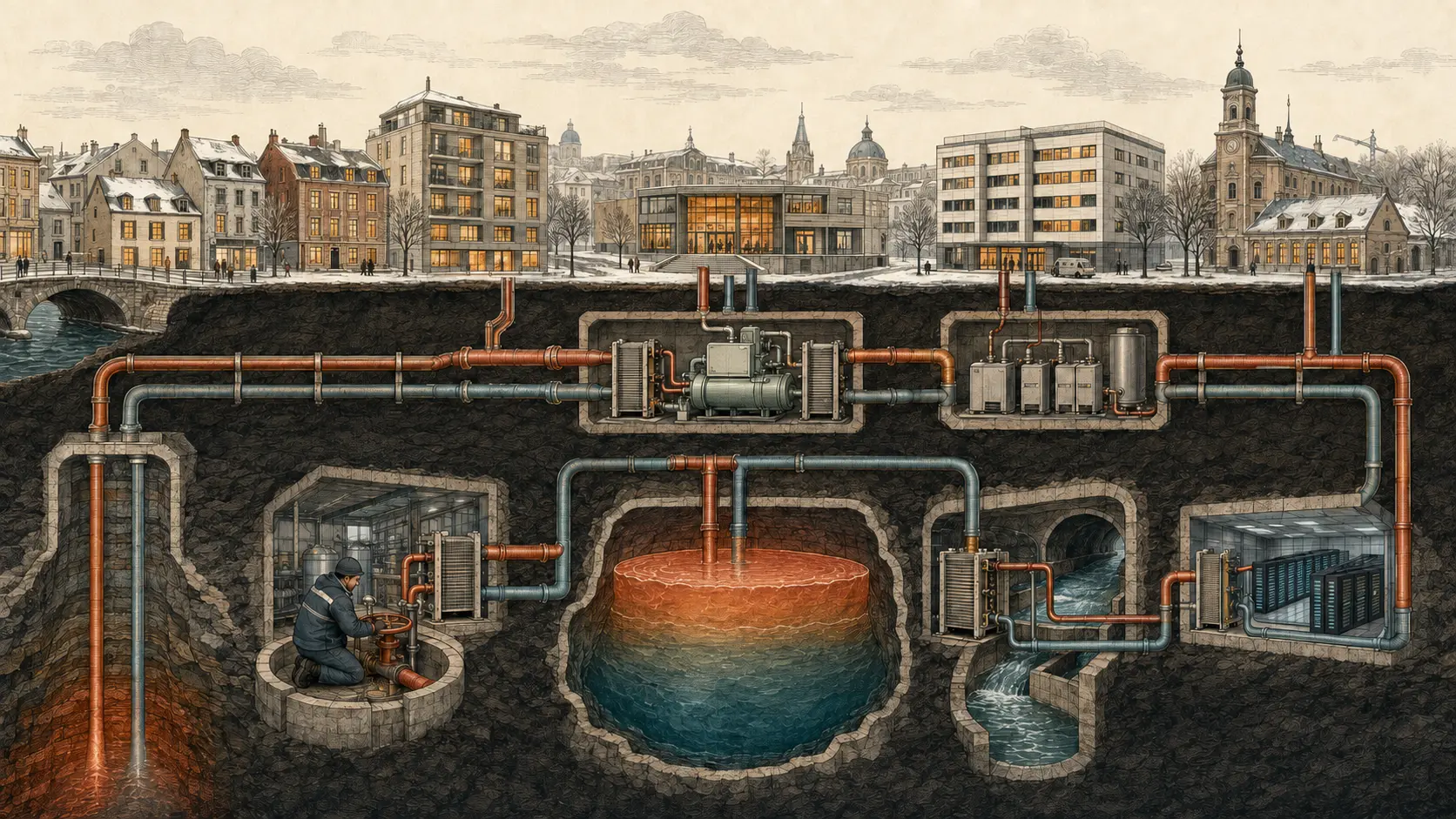
Heat has a quality as well as a quantity
A kilowatt-hour of electricity can drive a motor, illuminate a room or become heat. A kilowatt-hour of water at 25°C cannot directly do everything that a kilowatt-hour of steam can do. The difference is not energy content alone but the ability to transfer that energy into a colder destination and, more fundamentally, to do useful work. Engineers often discuss this in terms of temperature level or exergy: high-temperature heat is more versatile, while low-temperature heat is abundant but useful only when the receiving system is colder or a heat pump raises its temperature.
For a flowing network, the delivered thermal power depends mainly on how much water moves and how much it cools between supply and return. In compact form, power is mass flow multiplied by the specific heat capacity of water and by the temperature difference. A building that returns water almost as hot as it arrived extracts little heat from each kilogram, forcing the network to circulate more water for the same service. That increases pumping demand and can crowd the capacity of pipes and substations.
Temperature also drives loss. A buried pipe continuously leaks heat through its insulation into colder soil. The larger the temperature difference between the water and the surroundings, the stronger that leakage tends to be. Better insulation helps, but a network operating at 65°C has an inherent advantage over one operating at 110°C if both can satisfy the buildings they serve.
From one hot plant to many cooler sources
Early district systems commonly distributed steam from a central plant. Later generations used pressurised hot water, often at temperatures chosen for large radiators, poorly insulated buildings and central coal or gas plants. High temperature made the network tolerant of demanding buildings and allowed a large source to serve a wide area. It also increased losses and locked the system to sources capable of producing heat at that level.
Modern low-temperature networks reverse the logic. Instead of asking every source to reach the temperature of an old network, they try to reduce the temperature demanded by buildings. Better envelopes, larger or better-controlled emitters, well-sized heat exchangers and lower return temperatures make it possible to integrate solar heat, geothermal resources and waste streams that would otherwise be too cool.
This is a transition, not a switch. A well-insulated new quarter with underfloor heating can work at much lower temperatures than an unrenovated stone building with small radiators. Domestic hot water creates another constraint because the system must manage hygiene as well as comfort. Some networks therefore lower temperatures by zone, retain hotter branches, use building-level boosters or renovate the worst-performing connections first. The International Energy Agency’s 2026 district-energy assessment identifies lower supply temperatures, reduced losses, digital controls and coordinated building renovation as linked parts of modernisation, not independent upgrades.
The scale is already consequential. The same IEA assessment reports that district heating serves more than 600 million people through over one million kilometres of networks. Yet the global system remains predominantly fossil-based, and renewables supplied only 7% of district heat in the data assessed. The pipes are therefore neither automatically clean nor automatically obsolete. They are long-lived infrastructure whose value depends on what can be connected to them and at what temperature.
The machinery between source and room
A heat exchanger is the network’s boundary keeper. Hot water from an industrial site, geothermal well or primary network passes on one side of a conductive surface; a separate water circuit flows on the other. Heat crosses, but the fluids do not mix. This protects drinking-water and building circuits from the chemistry, pressure and contaminants of the source. It also lets operators isolate a fault without draining an entire city loop.
A heat pump solves a different problem. It uses electricity to move heat uphill from a cooler source to a warmer sink. A refrigerant evaporates at low pressure while absorbing heat, a compressor raises its pressure and temperature, and the refrigerant condenses while releasing heat to the network. The crucial variable is the temperature lift. Raising water from 20°C to 55°C generally requires less work than raising it to 90°C. Source temperature, network temperature and compressor performance therefore determine how much useful heat is delivered for each unit of electricity.
This is why low network temperatures change which resources count. The IEA’s work on heat pumps in district systems describes the use of sources below 45°C, while its December 2025 analysis notes that substantial waste heat below 100°C is still discharged. A large heat pump can upgrade that heat, but the project’s economics and emissions then depend on electricity prices, grid carbon, operating hours and the lift required.
At the building, a heat-interface unit or substation transfers energy into space heating and hot-water circuits. Control valves regulate flow; meters infer delivered heat from flow and temperature difference; pumps maintain circulation; sensors reveal pressure, temperature and abnormal losses. The resident experiences all of this as a radiator that warms promptly and a bill that can be understood. That ordinary outcome depends on the least glamorous components: clean heat-exchanger surfaces, balanced valves, accurate meters and return water that is genuinely cool.
Four sources, four different constraints
Industrial heat is often the easiest to understand. Furnaces, refrigeration plants, chemical processes and compressors reject heat after the primary process has used what it needs. A sufficiently hot, steady stream close to dense demand may feed a network through an exchanger with little or no temperature boost. But industrial production is not scheduled around domestic heating. A plant may close, relocate, change process or stop for maintenance. A city that treats an external factory as permanent baseload inherits the factory’s commercial risk.
Geothermal heat can be steadier. In direct-use systems, hot water is brought from depth, transfers heat at the surface and is commonly reinjected after cooling. The US Department of Energy describes direct-use resources in roughly the 27°C to 149°C range, with suitability depending on geology and application. The resource is local and potentially durable, but exploration wells are expensive, subsurface performance is uncertain before drilling, and water chemistry can cause scaling or corrosion. Reinjection and reservoir management are part of the system, not an afterthought.
Wastewater is cooler but spatially convenient. Sewers and treatment works carry a relatively continuous flow near the people who need heat. An exchanger can recover energy without mixing wastewater with network water, and a heat pump raises the temperature. Fouling, access, minimum wastewater temperatures and the energy needed for pumping all matter. The technology is operational, not merely speculative: a UK government award announced in January 2024 backed a Bolton network intended to use sewer and waste-water heat for nearly 2,000 homes and businesses. That announcement describes a funded project, however, not proof of its lifetime cost or reliability.
Data centres turn almost all the electricity they consume into heat, but usually at modest temperatures. Recovery can be technically straightforward while integration is contractually awkward. The data centre wants uninterrupted cooling; the heat network wants dependable supply; neither may want to own the connection risk. The IEA estimates that 70–80% of data-centre heat can be recoverable with heat pumps and that integration depends on proximity, compatible temperatures, connection costs and tariff structures. A headline about “free heat” therefore omits the exchangers, pumps, pipework, electricity and commercial agreement that make it useful.
Summer supply, winter need
A city’s heating demand peaks when outdoor temperatures fall. Industrial and data-centre heat may be available year-round, solar heat peaks in summer, and geothermal supply may be steady. None naturally follows the exact hourly profile of buildings. A network must balance that mismatch continuously.
Short-term storage is comparatively simple. A large insulated water tank can absorb surplus heat for hours and discharge during the morning or evening peak. It allows a heat pump to run when electricity is cheaper or more renewable and reduces rapid cycling of production equipment. The tank stores hot water, not electricity, which avoids converting heat back into a more versatile but harder-to-store form.
Seasonal storage is a larger geological and civil-engineering proposition. Pit stores, aquifers and borehole fields can accept heat in summer and return part of it in winter. The US Department of Energy’s overview of underground thermal energy storage distinguishes open aquifer systems from closed borehole storage and deeper reservoir concepts. These are real categories with operating installations and demonstrations, but performance is site-specific. Heat diffuses, groundwater moves, wells interfere, materials age and not all geology permits the same design.
Storage also has an economic boundary. A technically possible store may spend most of the year idle, while the pipe, land and financing costs remain. Its value rises when it can avoid peak boilers, absorb cheap electricity, accept surplus heat from several sources and provide cooling as well as heating. It falls when the temperature is too high, the source is intermittent without notice or the network has large standing losses.
Efficiency can conflict with resilience
A network optimised around one large source may look efficient until that source trips. A diversified system can combine industrial heat, geothermal energy, heat pumps, storage and boilers, but diversity adds valves, controls, contracts and failure modes. Redundancy also costs money and may leave backup equipment running for few hours a year.
Resilience therefore needs explicit design criteria. How long can thermal storage bridge an outage? Can pumps operate during a power failure? Is there a second electrical feed? Can one pipe section be isolated while the rest of the network runs? Does the backup plant start in cold conditions after months of inactivity? Are spare pumps and trained technicians available locally? A nominal reserve capacity is not equivalent to tested recovery.
Efficiency claims must likewise include the whole chain. Useful heat delivered to rooms should be compared with electricity for pumps and compressors, heat lost from pipes, source-side energy, maintenance and backup fuel. A high heat-pump coefficient of performance at design conditions says little about a frozen morning with elevated network temperatures and a fouled exchanger. Annual performance and peak behaviour both matter.
A natural monopoly needs visible rules
For a household, a heat network can replace a boiler but also remove a familiar form of choice. The resident usually cannot dig a competing pipe to the building. Generation, network operation, metering and retail supply may belong to one organisation or to several parties bound by long contracts. Prices must recover capital and maintenance as well as energy, yet opaque cost allocation can make efficiency gains invisible to customers.
Good governance separates questions that engineering cannot settle. Who pays for a connection that mainly benefits a private data centre and who receives the value of its heat? What happens to tariffs if an industrial supplier closes? Which costs are fixed, which vary with consumption, and how are losses allocated? Who funds the building upgrades needed to lower return temperatures? Can a municipality audit performance data and intervene before reliability degrades?
Great Britain offers a current example of the institutional problem. Heat-network consumer rules took effect on 27 January 2026, and Ofgem’s framework addresses fair pricing, understandable bills, customer service and supply reliability. The significance is not that one jurisdiction has completed the model. It is that decarbonising the heat source does not remove monopoly, billing or continuity risks; it makes explicit regulation more important as networks expand.
Contracts with third-party heat suppliers should consequently define temperature and availability, measurement, maintenance access, outage notice, liability, change of ownership and exit arrangements. A city should be able to replace a source without rebuilding the network. A supplier should be rewarded for useful heat delivered at the required conditions, not for gross waste heat that the network cannot absorb.
The decision below the pavement
The strongest district-heating project is not the one with the most sources drawn on a map. It is the one in which source temperatures, building demand, pipe losses, heat-pump lift, storage duration and backup capacity have been measured as one system. It has a credible path for renovating difficult buildings, contracts that survive commercial change, tariffs that expose rather than hide performance, and operators with the authority and resources to maintain it.
If you would like more engineering explained from machinery back to human capability, you can subscribe to Alkemata for future deep dives.
The remaining question for any proposed network is specific: which combinations of source failure, winter demand and electricity constraint can it withstand while keeping homes safely warm at an affordable price? Until that scenario is tested against real buildings and accountable contracts, the heat beneath the city is a promising resource, not yet a resilient public service.
