
A passenger reaches a stop where the display promises a bus every eight minutes. Nothing comes for eighteen minutes. Then two buses appear together: the first crowded, the second with empty seats. The timetable may record two vehicles only a few minutes late. The passenger has experienced something else—a long, uncertain wait followed by duplicated capacity.
This familiar irritation is not merely the sum of traffic jams and unlucky signals. Frequent bus services contain a feedback loop that can turn a small delay into a moving cluster. The practical consequence is important: on a “turn up and go” route, the public service should be judged primarily by the spacing between buses and the waiting time people experience, not only by whether each vehicle follows its timetable.
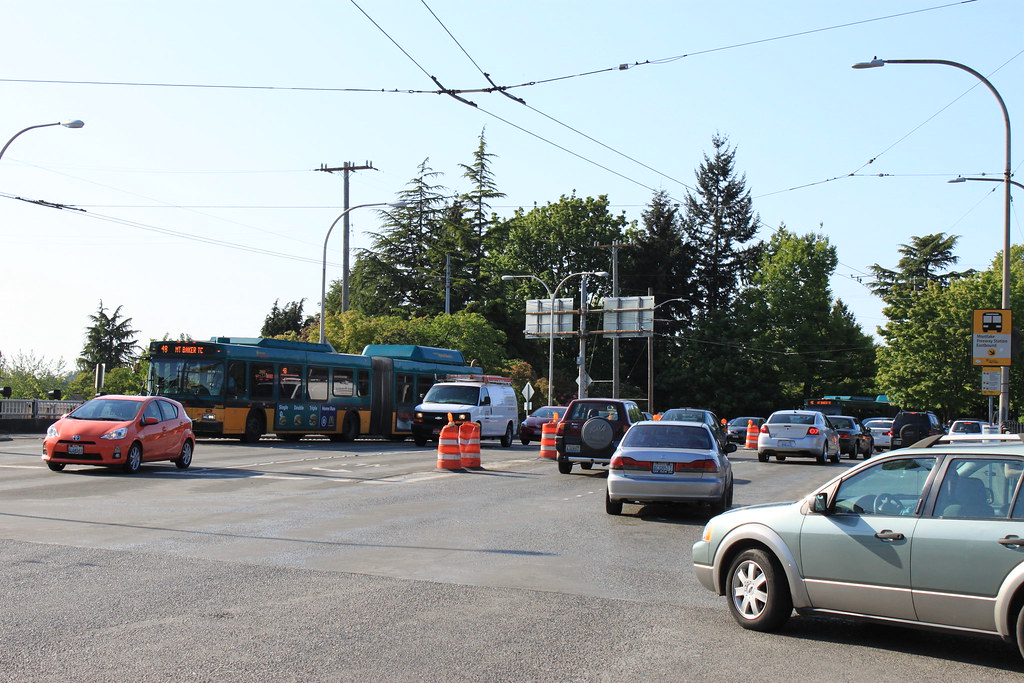
The delay that feeds itself
Imagine three buses leaving a terminus at equal intervals. The first encounters a short obstruction and reaches the next stop late. During the extra minutes, more passengers accumulate. More people then need to board, so the bus spends longer at the stop. At the following stop the queue is larger again. The original delay has changed the workload of the bus.
The next bus encounters the mirror image. Because the late bus has recently collected many of the waiting passengers, fewer people remain. Boarding is quicker, so the second bus gains on the first. Once the vehicles are close, the leading bus tends to do most of the work while the following bus keeps catching up. A random disturbance has become a self-reinforcing operational pattern.
The US Federal Transit Administration describes transit headways—the time gaps between vehicles—as inherently unstable and notes that irregular service increases mean waiting time, crowding and the risk that passengers cannot board. Its evaluation guidance explains why some form of control is normally required to preserve regular service. A peer-reviewed analysis by Carlos Daganzo and Josh Pilachowski formalised the same mechanism and tested a cooperative control idea in which buses respond to spacing ahead and behind, rather than treating their own schedule in isolation (Transportation Research Part B, 2011).
Why the average gap is not enough
Suppose six buses pass in an hour. Their average interval is ten minutes whether they arrive neatly every ten minutes or in three pairs separated by twenty-minute gaps. Capacity per hour is identical. The experience at the stop is not.
For passengers who arrive independently of the timetable, long gaps count disproportionately because more people arrive during them. There is a compact way to express this. If the observed gaps are H, expected waiting time is the sum of the squared gaps divided by twice the sum of the gaps. Squaring is the key: one twenty-minute gap harms waiting time more than two ten-minute gaps, even though both occupy the same total time.
This is why a punctuality percentage can be technically correct yet publicly misleading. It evaluates vehicles against planned moments. Riders on a frequent route experience a distribution of gaps. Transport for London distinguishes the two cases explicitly. Its route reliability reports use “excess waiting time” for high-frequency services: the additional wait caused by irregular or missing buses. For lower-frequency services, where missing one departure can destroy a connection or add a long delay, timetable punctuality remains the relevant measure. TfL’s 2025 contracting and tendering document also makes regularity on frequent routes an operational performance measure.
Control helps, but it makes choices visible
Real-time vehicle location allows controllers to see gaps forming. They can hold a bus briefly, adjust departure times, turn a vehicle before the end of its route, allow one bus to pass another, or direct drivers to regulate their speed. Bus-priority lanes and traffic-signal priority can reduce the disturbances entering the system. Faster boarding and accessible stop design can reduce variable dwell time.
None of these measures is free. Holding a bus protects people waiting farther along the route by delaying people already on board. Turning a bus early may repair service in one direction while forcing current passengers to transfer. Drivers require lawful breaks and feasible schedules; controllers cannot manufacture road space. A mathematically even service could also become brittle if it leaves no recovery time at the terminus.
The strongest case for ordinary timetables is therefore serious. People need dependable first and last buses, timed connections and accessible information. Operators need plans for staffing and vehicles. The answer is not to abandon schedules. It is to match the public measure to the service promise: punctual departures for infrequent routes and connections; regular headways, long-gap frequency and passenger-weighted waiting for frequent routes. Both should be reported, rather than allowing one aggregate punctuality figure to hide the other.
A waiting-time audit anyone can test
A transport authority, school class, neighbourhood group or curious passenger can run a small audit without tracking individuals. Choose one stop on a frequent route and a bounded period—perhaps 60 to 90 minutes on three comparable weekdays. Record only the time each bus serving one direction reaches the stop, plus whether it is too full to board. Do not photograph passengers or collect device identifiers.
From those observations, calculate each gap. Compare three numbers: the advertised interval, the simple average observed gap and the passenger-weighted expected wait using the squared-gap calculation above. Also count gaps longer than twice the advertised interval and buses arriving less than two minutes apart. A spreadsheet is enough. The result is not a verdict on the whole route; weather, roadworks and a short observation window limit what can be inferred. It is a test of whether the published performance language matches a lived hour at one place.
If the pattern repeats, the next step is institutional rather than merely technical. Ask the operator to publish headway distributions and excess waiting time by route and time band, explain which control actions are authorised, and report who bears the delay when service is regulated. The question resembles Alkemata’s broader argument that a queue is a policy decision: waiting time is allocated, even when no one announces the allocation.
Two buses arriving together can look like proof that a city simply needs more buses. Sometimes it does. But adding vehicles without stabilising their spacing can add another bus to the cluster. The more useful first question is visible at the stop: are vehicles being managed as individual timetable entries, or as a shared promise about how long people should have to wait?
