
Most social networks are designed to make leaving feel like failure. There is always another post, another notification, another measure of approval and another reason to return. Their success is commonly expressed through activity: more content, more reactions, more time spent and more frequent visits.
What would happen if a network adopted the opposite objective? What if it considered a quiet day a success, treated attention as something to protect, and judged itself by the quality of the relationships and projects that continued after people had logged out?
Idea status: first exploration. The original seed appeared in the Alkemata forum in July 2024.
The seed: a network that values silence
The initial idea was a “silent social network”: fewer interactions, longer reflection, stronger trust and more space for ideas to mature. Silence, in this context, does not mean an empty platform. It means the absence of pressure to perform continuously.
At first, this sounds like a conventional social network with fewer notifications. But that would leave its underlying machinery unchanged. If the platform still rewards visibility, counts reactions and optimises return visits, users will adapt to those incentives. A calmer interface cannot compensate for an economic and social structure built around attention.
To take the idea seriously, silence must become a design constraint and a measure of success.
Explore: what if absence were a positive outcome?
A network designed around protected attention would not contain an infinite feed. It might have no feed at all. A person could arrive with a question, a developing idea or a request for a particular kind of help. The system would show a small number of relevant contributions and then stop.
Publication could include a reflection delay. A draft written in anger or excitement would remain private for several hours before it could be sent. Contributions might be limited to one or two per week, not as punishment but as an invitation to choose what deserves other people’s attention. There would be no public follower counts, trending topics or universal reputation score.
These restrictions would make the network feel inefficient by current standards. That inefficiency is part of the proposal. Friction can protect a community when speed and scale would otherwise reward impulsive reactions, repetition and strategic self-presentation.
The idea at its limit: infrastructure for protected attention
Pushed further, the project stops being a quieter social network. It becomes social infrastructure whose product is protected cognitive time, durable trust and the capacity to act together.
The system would not ask how much interaction it generated. It would ask whether participants understood a difficult position more accurately, found a person able to challenge their assumptions, made a decision they could explain, or began useful work together. The most valuable event might occur weeks later in a laboratory, municipal office, workshop or shared room.
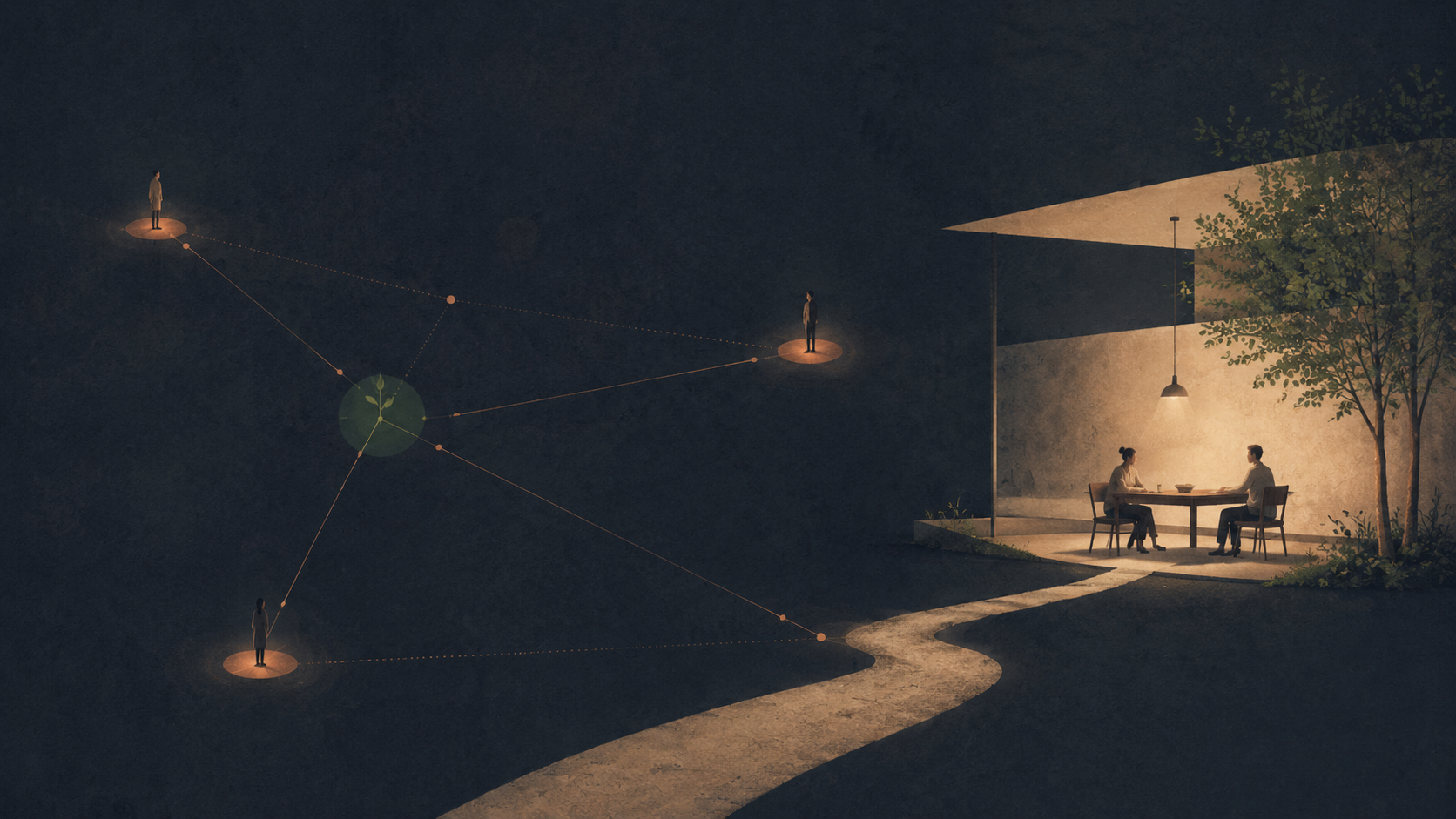
This changes the role of technology. The network is not the destination. It is a temporary passage between solitude and encounter: a way to find the right person, prepare a serious exchange, preserve its reasoning and then make space for work elsewhere.
What should artificial intelligence do?
AI could easily destroy the premise by producing more text than anyone can absorb. A system that automatically writes replies, proposes endless topics and predicts what will keep each person interested would recreate the attention economy under a calmer visual style.
A more appropriate role would be subtractive. AI might identify that two participants are using the same word differently, show where a claim lacks evidence, group repeated contributions, or prepare a neutral map of agreement and disagreement. It might help a person shorten a message before sending it. It should not manufacture apparent participation or decide whose ideas deserve visibility without an understandable and contestable process.
The governing question would be: does the machine reduce the amount of attention required while preserving the meaning and responsibility of the people involved?
Trust without turning people into scores
The original forum discussion considered measuring trust. That is attractive because conventional engagement statistics would be unsuitable. Yet a trust index could become more damaging than likes. It would compress relationships into a portable score, encourage strategic behaviour and allow the platform to define what a trustworthy person looks like.
Trust is often contextual. Someone may be an excellent technical critic, a patient listener or a reliable collaborator without being all three. Instead of scoring individuals, the network could record commitments and outcomes at the level of a specific interaction. Was a promised review delivered? Did the recipient find it useful? Did both sides agree that the exchange could be visible as an example? The record would remain limited in scope and expire rather than becoming a permanent social rank.
An economy that benefits when people leave
Advertising would create a direct conflict with the project’s purpose. A platform paid according to exposure cannot credibly celebrate absence. Premium engagement tools would introduce a similar tension if revenue depended on increasing activity.
A viable model would have to resemble infrastructure, a cooperative service or a small professional network. Participants, partner institutions or project sponsors could pay for a bounded service: a carefully prepared cohort, a facilitated problem-solving cycle, a secure workspace or an evaluation of what the process produced. Payment would be connected to an outcome, not to the volume of messages.
This probably limits growth. It may also be what keeps the idea intact.
The counter-limit: silence can exclude
A quiet network is not automatically a fair one. Long reflection periods may favour people with stable lives and abundant time. Sparse participation can allow established relationships to become closed circles. An expectation of polished contributions can silence people who think through conversation, write imperfectly or communicate in a second language.
Moderation could also acquire disproportionate power. When only a few contributions are visible, the decision to include or exclude one matters greatly. The platform would therefore need transparent selection rules, several legitimate modes of participation and an appeal path. Silence should protect people from pressure, not make them invisible.
The strongest boundary is that the system must not become a universal gatekeeper for credibility. It should remain one place among others, easy to leave and incapable of following its social judgments into the rest of a person’s life.
Shape: the first experiment needs no platform
The idea can be tested before any software is built. Invite twenty participants for six weeks. Each week, allow the group to pose one carefully framed question. Give every participant a maximum of two contributions and impose a forty-eight-hour delay between drafting and publication. Remove likes, public activity counts and follower relationships.
At the end of each cycle, participants should be able to request a small private conversation or propose a concrete piece of work. The experiment would measure neither message volume nor time spent. It would examine whether people could accurately restate another participant’s position, whether anyone changed their mind, whether the process caused strain, and whether useful relationships or projects continued outside it.
If the delay merely kills conversation, if only highly educated participants feel able to contribute, or if the process produces polished text but no durable understanding, the central hypothesis would be weakened. If it produces fewer exchanges but stronger recall, more intellectual movement and real collaboration, there would be reason to build a narrow prototype.
From a network to a civic practice
The radical form of this idea may not be a global platform. It could become a protocol used by small groups: research teams, public servants, local associations or people developing projects without an established network. Different communities could operate their own spaces while sharing a small set of principles about pacing, transparency, limited metrics and the right to leave.
The technical achievement would then be modest compared with the cultural one. The project would demonstrate that digital social space does not have to maximise speech, visibility or presence. It can create the conditions for people to think separately, meet deliberately and build something together—and know when to become quiet again.
Author
What concrete example would confirm or challenge this article?
Choose a reaction, write a comment, or ask your AI assistant to send a proposal for review. Comments are reviewed before publication.