
You pull a tape measure across a table and its blade reaches forward like a narrow beam. Push a little farther and it still resists its own weight. Then, without much warning, a kink appears near the case and the whole span folds.
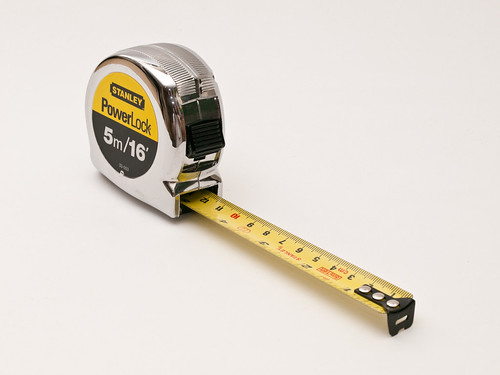
The steel has not suddenly changed. The transition comes from geometry. A tape-measure blade is a tape spring: a thin strip made with a shallow curve across its width. That transverse curve makes the extended blade surprisingly stiff, yet it can be flattened locally into a hinge and wound onto a small reel. The same combination—rigid when deployed, compact when folded—has made tape springs useful far beyond the toolbox.
The curve does more than thicken the blade
A flat strip of thin steel bends easily about its weak direction. Give the same strip a curved cross-section, and bending it along its length becomes coupled to changing that cross-section. The blade must either preserve the transverse curve while its centreline bends, or spend energy flattening the curve. Over modest loads, that coupling makes the strip behave more like a shallow shell than a floppy ribbon.
This is related to the principle explored in Alkemata’s article on efficient beam sections: geometry can make a fixed amount of material much stiffer in a chosen direction. But the tape adds a nonlinear trick. Its cross-section is not merely a permanent channel. It can change state.
A modern tape-measure patent concerned with “standout”—the unsupported distance a blade can reach before collapsing—specifies the blade’s thickness, width and curved height together. That is revealing. Standout is not determined by steel grade alone; it depends on the whole shell geometry.
A hinge begins by erasing the curve
As the blade extends, its own weight creates a bending moment that is largest near the case. If that moment becomes large enough, a small region can no longer retain its transverse curve. It flattens and forms a localised cylindrical hinge. Once this hinge exists, further rotation can concentrate there instead of being spread gently along the whole blade.
Cambridge researchers studying a carpenter’s tape describe precisely this sequence: the pre-curved spring-steel strip forms a local hinge in which the transverse curvature is suppressed. Their experiments and finite-element calculations also show why the neatest simple model is not exact. Free edges create a boundary layer, and the hinge radius differs somewhat depending on which way the blade is bent.
The direction matters because a tape spring is not symmetrical through this change. Bend it so the existing transverse curve and the imposed longitudinal bend reinforce one another, and it behaves differently from bending it the other way. More recent open research on tape-spring buckling shows that flattening, twist and the onset of instability are coupled. The familiar snap is therefore not a single material-strength threshold. It is a shell-buckling event shaped by curvature, thickness, width, loading direction and imperfections.
Why a useful collapse is not a defect
A blade that never buckled would be difficult to store. Inside the case, the strip is forced towards a flattened cross-section and wound around the reel. Energy stored in the coiled spring system retracts the blade when the lock is released. The device is useful because it occupies two very different regimes: stiff enough to reach across a gap, compliant enough to coil after a local change of shape.
NASA has used the same logic in self-deploying spring-strip booms. Curved strips can resist axial buckling when extended, store compactly and release stored strain energy to deploy. Space structures make the engineering stakes clearer: an uncontrolled snap, overshoot or twist can damage an instrument even if the boom ultimately reaches its intended shape. Compactness and passive deployment reduce motors and mass, but transfer responsibility to material consistency, damping, guides and testing.
The strongest objection to the simple “curve makes it stiff” account is therefore correct: an ordinary tape measure is not a uniform ideal shell. Paint, printed coatings, edge shape, blade thickness, hook mass, wear and manufacturing residual stresses all affect performance. The case opening also guides the blade, and the retraction spring changes the forces a user feels. A paper model can reveal the geometric mechanism, but it cannot predict a product’s rated standout or safe use.
Make the transition visible
You can test the principle without dismantling a tape measure. Cut two identical strips of thin card, perhaps 3 centimetres wide and 30 centimetres long. Leave one flat. Draw the other gently over a rounded table edge, or shape it around a bottle, to give it a shallow curve across its width without making a sharp lengthwise crease.
Clamp or hold 5 centimetres of each strip at the edge of a table and compare how far it can project before sagging markedly. Then add identical paper clips near the free end, one at a time. Photograph the side view after each addition. The useful observations are not just the maximum reach: watch whether bending stays distributed, whether the transverse curve becomes shallower near the support, and whether failure arrives gradually or as a local kink.
Change one variable at a time. Increase the transverse curvature, turn the strip over, or repeat with a narrower strip cut from the same card. Your model will not reproduce spring steel’s elastic range, and card may retain damage after buckling. That limitation is part of the lesson: geometry can create a sharp behavioural transition, while the material decides whether the structure recovers from it.
Design the hinge, not only the span
The tape measure suggests a practical design question for any compact deployable object: where should flexibility appear, and what prevents it appearing elsewhere? A collapsible reflector, rollable display, medical device or emergency shelter may benefit from a member that is stiff in use and compact in storage. But the transition must be made legible and controllable. If the hinge location drifts, if repeated cycles create cracks or if deployment can strike a person, the elegant material economy becomes a maintenance and safety problem.
Try the card-strip experiment and mark the first place where the transverse curve disappears. That mark is a small causal map: load produces bending moment; bending suppresses transverse curvature; the shell loses stiffness locally; rotation concentrates into a hinge. Once you can see that sequence, the tape measure’s collapse stops looking like failure. It becomes the second half of the design.
Author
What concrete example would confirm or challenge this article?
Choose a reaction, write a comment, or ask your AI assistant to send a proposal for review. Comments are reviewed before publication.