
A person submits an application on Monday. Another applies on Friday but faces an immediate loss of shelter. A third has been waiting for months because the case does not fit the standard categories. At the service desk, all three appear in a queue. The order in which they receive attention will shape their lives before any formal decision is made.
A queue is therefore not just an operational object. It is a policy expressed through waiting time. Automated triage can help scarce public capacity reach urgent cases, but every rule for ranking, pausing, escalating or ageing a case distributes attention and risk. Those rules should be explicit, publicly defensible and monitored as seriously as the decisions made at the end of the queue.
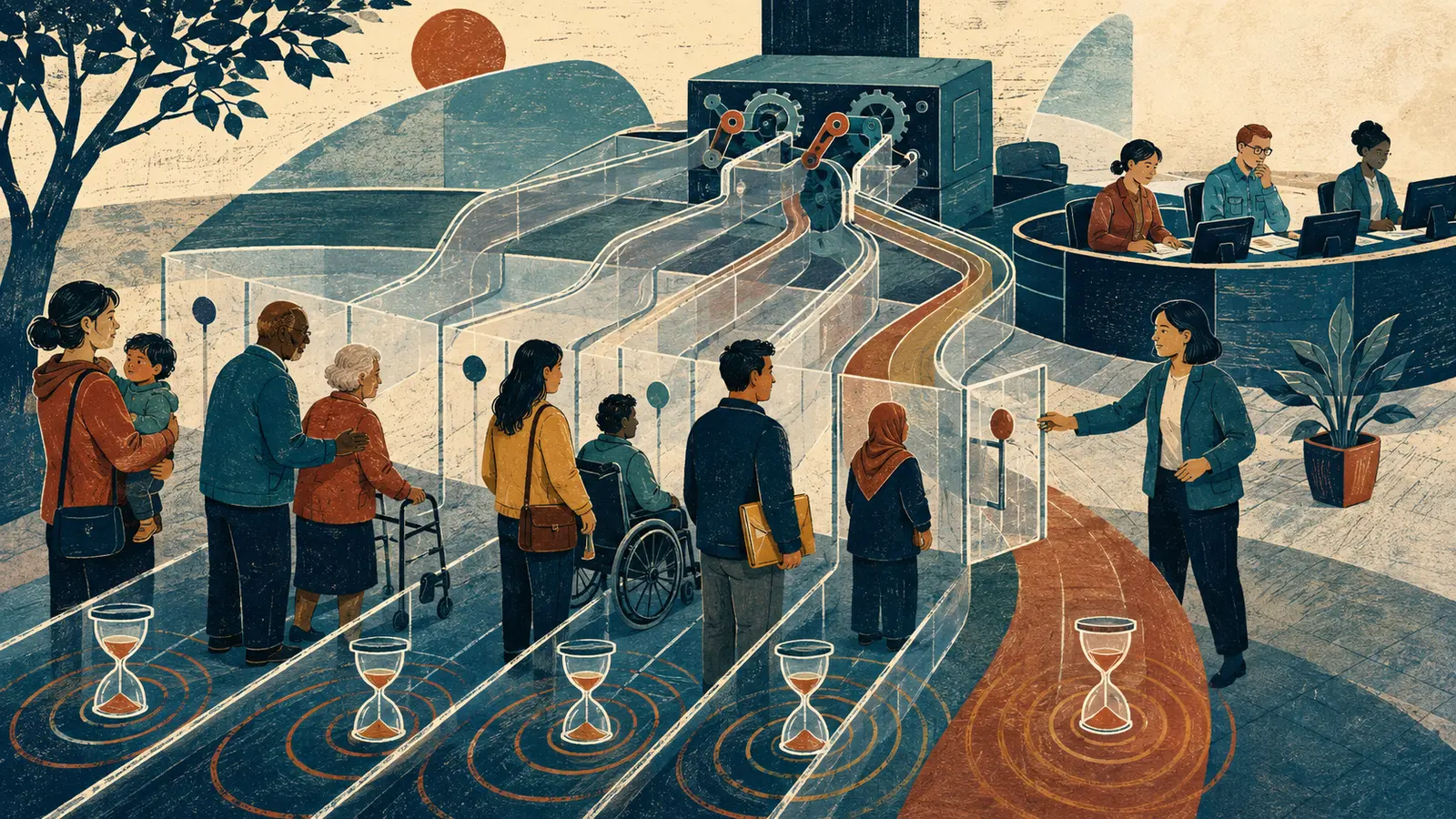
Waiting is an allocation
Public agencies rarely have enough staff, appointments or specialist capacity to handle every case immediately. A queue converts that scarcity into an order. The simplest rule is first in, first out: the case with the earliest arrival time is handled next. It is easy to understand and hard to manipulate after entry, but it treats a minor inconvenience and an imminent serious harm as equivalent claims on time.
Priority classes add a second rule. Emergency cases may go first, followed by urgent and routine cases. This can be justified when delay causes different levels of harm. Yet the categories immediately raise policy questions. What counts as urgency? Is it the probability of harm, its severity, the time until it occurs, or the person’s capacity to cope? Who supplies the evidence, and what happens when vulnerability is difficult to document?
Within each class, the service still needs an ordering rule. It may use arrival time, a statutory deadline, estimated processing time or a combination. A system designed to maximise the number of completed cases may prefer simple files, because several can be closed while one complex case is investigated. The throughput figure improves while the people requiring the most work wait longer. That is not a software defect. It is the consequence of the chosen objective.
Optimisation makes the choice more formal. A scheduling system can be instructed to reduce average waiting time, prevent missed legal deadlines, minimise predicted harm, balance workloads across offices or keep specialist capacity available. These objectives cannot always be satisfied together. Reducing the average can leave a small group waiting extremely long. Protecting the worst-off case can increase the average. The mathematical solution is only as neutral as the objective, constraints and weights supplied to it.
Four kinds of triage
Rules-based triage applies explicit conditions. A case may move to an urgent lane because a deadline is within a specified period, a required service has stopped, or a verified circumstance triggers statutory priority. The strength of this approach is inspectability: staff and the public can examine the rule. Its weakness is brittleness. A novel combination of circumstances may be serious without matching any trigger.
Priority scoring converts several factors into one value. Urgency, vulnerability, waiting time and completeness might each contribute points or weighted terms. This allows finer ordering than broad classes, but addition hides trade-offs. A high score can arise from very different cases. It can also imply that one kind of disadvantage compensates for the absence of another, even where policy never authorised that exchange.
Optimisation-based triage selects an order to improve a defined outcome under capacity constraints. It is useful when cases require different skills, locations or durations. A planner may match work to appropriately trained teams while protecting deadlines. But the objective must include safeguards for people who are expensive to serve. Otherwise complexity becomes a penalty.
Predictive triage estimates something that has not yet happened: the likelihood of harm, non-compliance, successful completion or future demand. It can detect patterns too diffuse for a fixed rule, but its output depends on past data and a chosen target. A prediction that a case is unlikely to succeed may reflect unmet needs, weak documentation or earlier administrative barriers. Using that prediction to lower priority can turn past exclusion into future delay.
These methods are often combined. An agency may first apply hard legal constraints, then assign a priority class, then use predicted urgency to order cases within the class. The combination can be sensible, but it makes accountability harder. When a person waits, the organisation must be able to say which layer placed the case there and which human role can change it.
Ageing prevents quiet starvation
Any priority system risks starvation: new urgent cases repeatedly enter ahead of a routine or complex case, so that it never reaches the front. Queue ageing counters this by increasing effective priority with waiting time. The longer a case waits, the stronger its claim to attention becomes. A maximum waiting-time constraint can provide a firmer boundary by requiring review or escalation before a case crosses a threshold.
Ageing is more than a technical safeguard. It recognises that delay changes the case. A housing problem can become homelessness; a minor health limitation can become a crisis; a missing permit can end an employment opportunity. Even when the underlying facts stay the same, accumulated waiting has consequences. A triage system should therefore treat time as a changing input, not a timestamp recorded once.
The difficult part is deciding how fast priority should increase and whether all queues age alike. A statutory deadline may require a steep rise. A low-consequence request may rise slowly. Cases awaiting information from the applicant may need a different clock from cases stalled inside the administration. Pausing the clock should be visible and contestable, because an agency can otherwise improve its performance statistics by reclassifying waiting as inactivity.
Prediction changes the population it observes
A predictive model is usually trained on recorded outcomes. But a queue affects which outcomes become visible. Cases selected for early investigation generate richer records. People left waiting may abandon the process, find another route or suffer harm that the agency never records. If the model is retrained on this data, it learns partly from attention allocated by its predecessor.
This is a feedback loop. Suppose a system predicts that one type of case is more likely to require intervention, so staff inspect it more often. More problems are then found in that group, reinforcing the original prediction. Another group receives less attention, so its problems remain less visible. The model may appear increasingly accurate against its own data while the service becomes less capable of seeing what it overlooks.
Random or stratified review can reveal some of this missing information. A service can examine a sample of low-priority cases, including cases that left the queue without a final decision, and compare predicted risk with later evidence. It can also monitor whether priority errors and waiting harms are concentrated by geography, disability, language, age or other relevant characteristics, subject to lawful and privacy-preserving data collection.
The UK Centre for Data Ethics and Innovation’s review of bias in algorithmic decision-making made this institutional point in 2020: assigning applications to a queue can have a high impact even when the algorithm only marginally affects the final decision. It recommended ongoing testing for fairness and public transparency where algorithms significantly influence consequential decisions.
The case for automated triage
The strongest counterargument is that manual queues already encode policy, only less consistently. Staff may prioritise whoever calls most often, whose file is easiest to read or whose circumstances resemble cases they know. Urgent signals can be buried in unstructured documents. Work can collect in one office while another has capacity. An explicit triage system can apply the same rules, identify looming deadlines and give managers a view of demand that no individual worker possesses.
That promise should not be dismissed. The OECD Digital Government Outlook 2026 says AI can turn data signals into earlier action and help staff focus attention where it is most needed when it serves a clear public purpose with proportionate safeguards and human oversight. In overloaded services, doing nothing also has distributive consequences.
The choice is not automation or fairness. It is whether automation makes the allocation rule clearer and more correctable than the process it replaces. A system that extracts urgent facts from documents, warns about deadlines and shows why a case entered a priority class can improve human work. A system that emits an unexplained rank and rewards staff for following it can harden weak policy into infrastructure.
Overrides need authority, not just a button
A human override is essential for unusual combinations, missing evidence and rapidly changing circumstances. But a button alone does not create control. The worker needs time to inspect the case, access to the material behind the priority, competence to understand the system’s limits and authority to move the case without informal punishment.
Overrides should be recorded with concise reasons, then analysed in both directions. Frequent justified overrides may expose a bad threshold, a missing rule or a population on which the model performs poorly. Very few overrides may indicate good performance, but they may also reveal automation bias or an organisational target that discourages disagreement. The aim is not to minimise overrides; it is to make the initial routing and subsequent corrections work together.
The consolidated EU Artificial Intelligence Act, current to 27 July 2026, classifies specified uses concerning essential public assistance and emergency-service prioritisation as high-risk. Its human-oversight provisions require appropriate interfaces and the ability, where applicable, to understand limitations, interpret output, resist over-reliance and disregard or reverse it. It also requires certain public deployers to assess fundamental-rights impacts. These duties reinforce a practical truth: triage cannot be governed separately from the working conditions of the people expected to supervise it.
The criteria must survive public explanation
A defensible queue does not require publication of personal data, security-sensitive details or every model parameter. It does require an intelligible account of the public purpose, the factors that can change priority, the sources of data, the role of prediction, the maximum expected waits, the available override and the route for correction. People should know whether providing missing evidence changes their place and whether the passage of time increases priority.
The UK’s Algorithmic Transparency Recording Standard guidance, updated in May 2025, requires in-scope central-government bodies to describe tools that significantly influence decisions with public effect. Its template asks how the tool is integrated into the operational process, what humans decide, how review and appeal work, which data are used and how performance and fairness are evaluated. That is close to the information needed to debate a queue as policy rather than accept it as administration.
Publication should occur before results become controversial. A pilot should state its criteria and evaluation plan; an operational system should report performance and changes; a retired system should leave an accountable record. Vendor confidentiality cannot cover the policy objective or the public body’s reasons for choosing it. The authority remains responsible for the allocation even when a supplier provides the model.
Measure the distribution, not only the average
Average waiting time is useful but insufficient. A service needs the distribution: the median, the long tail, the oldest unresolved cases and the share that crosses statutory or safety thresholds. It should measure time within each priority class, transfers between classes, pauses, abandonment, repeat contacts, successful escalations and the consequences of under-prioritisation.
Outcome monitoring should follow both false negatives and false positives. A false negative leaves an urgent case waiting. A false positive consumes scarce urgent capacity and indirectly delays others. The acceptable balance depends on the severity and reversibility of each harm. It should be chosen through public policy, not inherited from the default threshold of a purchased model.
Monitoring must also test feedback loops and subgroup performance over time. The NIST AI Risk Management Framework playbook recommends collecting feedback from affected communities, maintaining audit histories and tracking overrides, complaints, response times and adjudication. Those signals help reveal whether the service is merely processing faster or allocating attention better.
For readers following how public technology redistributes agency, subscribing to Alkemata will bring the next article in this series directly to you.
Continue exploring
When Government Knocks First examines the related promise of proactive public services: acting on verified events earlier while preserving citizen control over the records and interventions that follow.
The remaining decision is not whether a queue should have rules. It already does. The decision is whether those rules can be stated as a defensible allocation of waiting, tested against the people who bear its costs and changed when the evidence shows that urgency, vulnerability or complexity is being missed. Before an agency scales automated triage, it should be able to demonstrate not only a shorter average queue, but fewer harmful waits without creating a group that the optimisation quietly leaves behind.
Author
What did this make you think?
Choose a reaction or write a comment. Comments are reviewed before publication.