
A person opens a public-service portal after moving home. The address on one page is correct. A benefits service still shows the old municipality. A tax notice has already gone to the new address, while a school application is waiting for proof that the government itself holds. A single screen displaying “your data” would make this contradiction visible, but visibility alone would not resolve it.
A genuine citizen control panel must do more than collect records behind a polished interface. It must show where a fact came from, who used it, for what purpose and under which authority; connect that use to any resulting decision; and provide a route for correction, propagation and appeal. Its purpose is not to give every person a fictional veto over lawful government. It is to make distributed administration legible and contestable.
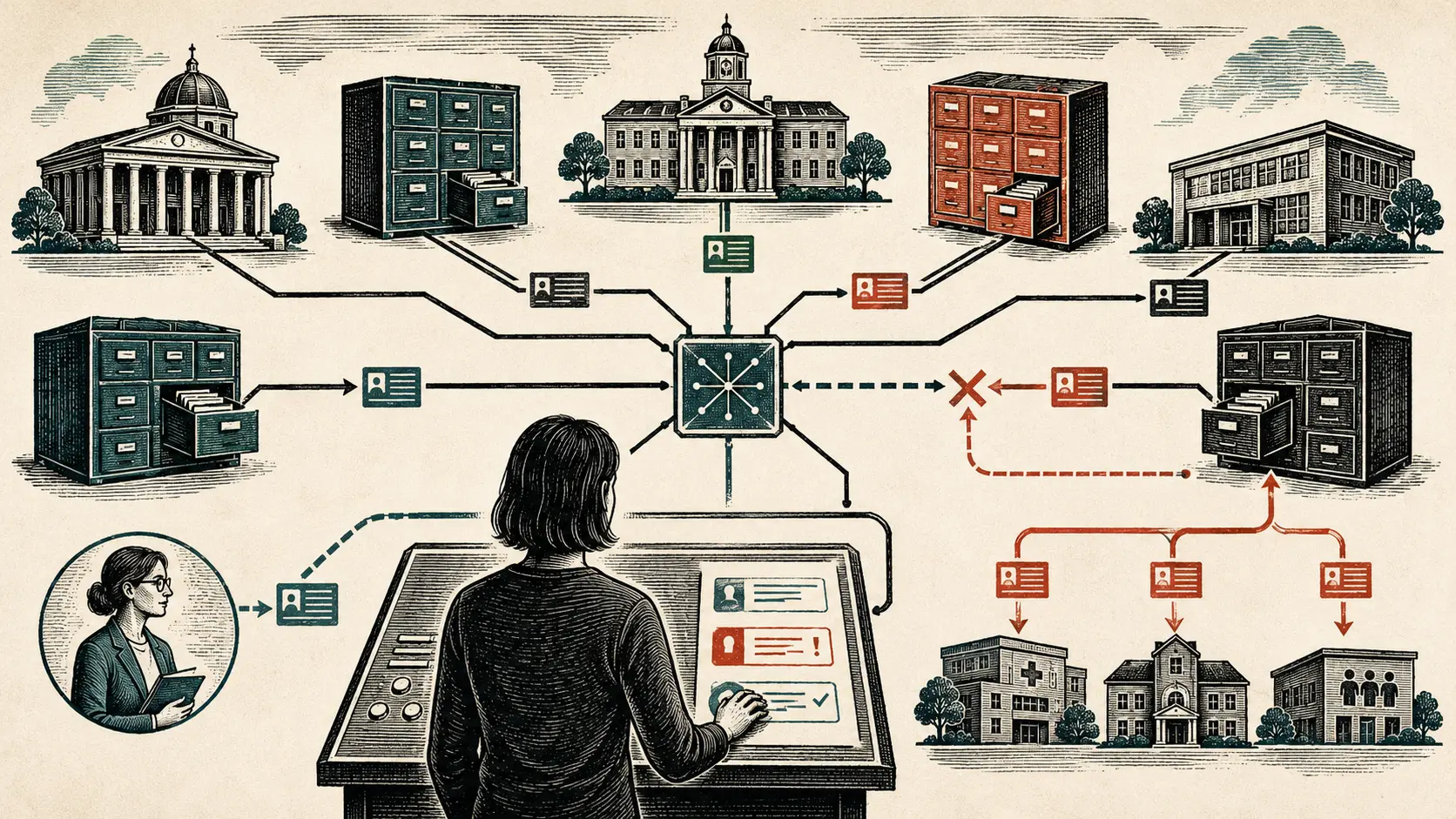
That distinction changes the architecture. The useful unit is not the field on the screen but the chain from a source register, through an authorised query or event, into a decision and back through a correction. A control panel that cannot reconstruct that chain is a window, not a control.
One interface, many accountable sources
Governments do not usually keep a single complete file for each person. A civil register may be authoritative for birth and family status, a population register for address, a tax authority for earnings records, and a licensing body for a professional qualification. Local agencies then hold their own case records and decisions. This distribution can limit the damage caused by one compromised system and keep responsibility for a fact with the institution able to verify it.
The control panel should therefore be a map of sources, not a new master database. For each important fact it needs to identify the responsible authority, the value or status currently supplied, the time it was last confirmed and, where relevant, the version or effective period. It should distinguish a fact held by an authoritative register from a value copied into a case-management system. Otherwise a citizen may correct the visible copy while the next automated query silently restores the error.
Estonia’s official explanation of its X-tee data-exchange layer makes this separation concrete. Organisations remain responsible for their own registers, while authorised participants send requests through a distributed exchange layer. Access is both technical and legal: membership in the exchange does not by itself entitle an organisation to every dataset. This is a useful model for a control panel because it preserves the answer to “who owns this fact?” rather than dissolving accountability into a portal.
Queries, events and decisions are different things
A service can obtain data in several ways, and the panel should reveal which mechanism mattered. An attribute query asks a source a bounded question. A service assessing an age threshold may need confirmation that a person is over a certain age, not a copy of a birth certificate. A residence check may require a current municipality, not an entire address history. Returning the smallest sufficient attribute can reduce disclosure, but only if the query, response and purpose remain auditable.
An event works differently. When a source register changes, an event broker can notify subscribed services that something happened: an address changed, a child was born, a licence expired. The receiving service may then fetch fresh data or begin a workflow. An event is not necessarily the fact itself. It is a signal that a fact changed, and treating the signal as the whole record can lose provenance, effective dates and later corrections.
Finally, a decision system combines data with rules. It may grant a payment, calculate a charge, issue a notification or refer a case for review. A transaction log showing that Service A queried Register B at 10:14 does not explain why an application was refused at 10:15. For that, the administration must preserve the decisive attributes, the source and time of each, the rule version, any failed query or fallback to cached data, and the resulting action.
This layered model matters because each failure has a different remedy. A missing source record requires correction or evidence at the source. A failed exchange requires technical recovery. An outdated local copy requires propagation. A correctly retrieved fact used under the wrong rule requires the decision to be reconsidered. “Something is wrong with my data” is too vague for either a citizen or a caseworker to act on.
An access log must answer a human question
An ordinary security log is designed for operators. It records requests, timestamps, system identifiers and errors. A citizen needs a translation that keeps the relevant precision. The useful record names the organisation and service that accessed the data, the category or attribute used, the date, the stated purpose and legal basis, and the decision or case to which the access contributed. It should also distinguish a human caseworker opening a record from an automated eligibility check and from background system maintenance.
Estonia’s operational Data Tracker provides a real, partial example. The Information System Authority says the service gives people an overview of operations performed with their data on the eesti.ee state portal. Each participating database owner must implement a common protocol so its usage information can be displayed uniformly. This is significant: a national interface does not manufacture transparency by itself. Every source system must produce compatible, trustworthy records.
The remaining gap between an access log and meaningful control is context. “Authority X accessed a record” may be accurate but unhelpful if the person cannot tell whether the access concerned a benefit renewal, a fraud investigation or a request they initiated. Yet too much detail can expose security-sensitive operations, another person’s information or protected investigations. A credible design needs defined exceptions, not an opaque promise that all accesses will appear. When information must be withheld, the system should record the applicable reason and the route for independent oversight, subject to the governing law.
Viewing is not understanding, and understanding is not correction
The EU General Data Protection Regulation gives people rights that help separate these functions. The GDPR requires information about processing to be concise, transparent and intelligible; Article 15 provides a right of access, while Article 16 addresses rectification and Article 18 restriction of processing in specified circumstances. Article 19 requires certain rectifications or restrictions to be communicated to recipients, unless that is impossible or involves disproportionate effort.
The European Data Protection Board’s guidelines on the right of access describe its practical aim as enabling people to understand how their data are processed, the consequences of processing and whether the data are accurate. That is a demanding standard for interface design. A downloadable archive may technically disclose data while leaving a person unable to identify the decisive record, its source or its effect.
A control panel should therefore present three connected but separate actions. Viewing shows the current record and its provenance. Understanding explains where and why it was used, in language related to an actual service or decision. Correction sends a structured request to the authority able to change the source, accepts supporting evidence, issues a receipt and exposes progress. Combining them in one screen is convenient; pretending that they are one operation is dangerous.
Consent is not the master switch for government
It is tempting to design the panel as a row of permission toggles. That metaphor fits some voluntary data-sharing arrangements, but much public-sector processing is based on a legal obligation or a task carried out in the public interest or under official authority. A tax authority does not ordinarily need a citizen’s revocable consent to process the data required by tax law. A child-protection agency cannot make its statutory duties depend on a dashboard setting.
The European Data Protection Board’s consent guidelines warn that public authorities often face a power imbalance that makes consent an inappropriate legal basis. Presenting statutory processing as consent creates false agency: the person appears able to switch it off, but the authority either cannot honour the choice or should not have asked.
The better control is purpose-specific transparency and contestability. The panel should state the legal basis and purpose in comprehensible terms, reveal which data are necessary for that task, show any compatible further use, and explain the rights that actually apply. Where genuine consent is used—for example, an optional transfer to a non-government service—the choice should be distinguishable, specific and withdrawable. Consent, access, objection, rectification and appeal are different controls with different legal effects.
Correction must travel farther than the field
Suppose the address register accepts a correction. The next question is where the old address went. Some services may query the source live, while others hold a cache or received an earlier event. A school application may already be paused and a benefit decision may already have been made. Simply displaying the new address gives the appearance of completion while consequences based on the old one persist.
A robust correction workflow records the original dispute without erasing history, identifies known recipients and dependent cases, and sends a new event or prompts a fresh query. Each receiving system acknowledges whether it updated its copy and whether an earlier decision needs review. The citizen sees not only “corrected at source” but the propagation state: which services have incorporated the change, which remain pending and which require a separate legal process.
During the dispute, the system needs a state more precise than true or false. It may mark the value as contested, preserve the evidence submitted and restrict use where the applicable law permits or requires it. An urgent service may need an interim human decision rather than waiting for a slow register amendment. This is where technical state machines meet administrative justice: the cost of uncertainty should not automatically fall on the person who cannot inspect the machinery.
The European Union’s cross-border once-only technical system regulation shows how much coordination an apparently simple evidence transfer requires. It distinguishes evidence requesters, evidence providers, intermediary platforms, identity matching and secure delivery. For covered procedures it also establishes an evidence-preview mechanism, with specified exceptions. This is not a complete citizen control panel, but it demonstrates that seeing evidence before it is used has to be engineered across the full exchange, not added as decoration to the last screen.
Delegated access needs narrower keys
Not everyone manages public services alone. A parent may act for a child, an adult child for a parent, a lawyer for a client, or an employee for an organisation. A personal portal that assumes one autonomous individual can exclude precisely those people who need help. But handing a representative the citizen’s own credential destroys accountability and gives far more access than the task requires.
Delegation should be explicit, scoped and visible. The system needs to record who represents whom, under what authority, for which services or actions, from when until when, and whether the delegation can be revoked. A representative allowed to submit evidence for a housing appeal need not see health records or change bank details. Both parties should be able to inspect a delegation’s use, and sensitive actions may require additional confirmation or professional authority.
There is no single rule for all relationships. Parental responsibility, guardianship, power of attorney and organisational representation arise from different laws. The control panel therefore has to consume authoritative representation attributes while preserving the limits attached to them. Delegation is not a convenience feature layered on identity; it is part of the rights architecture.
The appeal must be connected to the decision
A person who sees an incorrect fact should not have to guess whether to contact the register, the service that copied it or the authority that made the decision. The panel should connect the decision notice to the decisive data and offer the appropriate route: correct the source, submit contrary evidence, challenge the rule’s application, or appeal the administrative outcome. These routes may belong to different bodies, but the interface can preserve the hand-off and case reference.
A complete journey includes notification, a comprehensible reason, evidence submission, a deadline, status tracking and access to human review where required. It should also show whether the adverse effect is paused. Without that last point, a formally available appeal can still impose severe costs through a stopped payment, missed school place or expired licence.
The administration can measure whether this machinery works. Useful indicators include the time to acknowledge a dispute, the time to correct the source, the share of affected downstream systems updated, the frequency of overturned decisions and the number of times a person must resubmit the same evidence. A panel should make these processes observable to service owners as well as citizens; otherwise recurring failures remain individual anecdotes.
The minimum useful control panel
The smallest credible version would show authoritative sources for high-impact attributes, recent meaningful access, current delegations, active disputes and the decisions connected to them. It would let a person open an access entry to see purpose and legal basis, start a correction at the right source, receive a trackable reference, follow propagation and reach the appropriate review or appeal. Notifications would report material changes and completed actions without turning every background transaction into noise.
It would not copy all government data into one profile. Federation limits the sensitivity of the portal itself, but the panel still creates a valuable map of a person’s dealings with the state. Strong authentication, session protection, minimal caching, separation of especially sensitive domains and tamper-evident audit records are therefore necessary. Recovery matters too: a person who loses a credential must have a secure route back that does not depend on the very record being disputed.
The strongest counterargument is that such integration creates a new attack surface and a costly promise of uniformity across old systems. That is true. A superficial national dashboard may conceal uneven logs, incompatible identifiers and agencies unable to propagate corrections. The answer is to narrow the first release to consequential data and services, publish conformance requirements, test end-to-end correction and expand only when participating authorities can meet the standard. Interface breadth is a poor measure of control.
Control means the ability to trace and contest
A citizen control panel is sometimes imagined as a personal cockpit for the state. The metaphor overstates individual choice and understates institutional duty. Citizens cannot administer the tax system from a screen, and lawful public powers cannot be reduced to preferences. What people can reasonably demand is the ability to see how administrative machinery represents them, understand how that representation was used and activate an effective remedy when it is wrong.
This returns the design to human agency. The important capability is not possession of a data copy. It is the ability to connect a harmful consequence to a source, a purpose, an accountable authority and a path that can change the outcome.
Continue exploring
Alkemata’s explainer When a Database Says You Do Not Exist examines how identity and eligibility errors propagate across federated registers. When Government Knocks First explores the promise of services triggered by life events. A control panel is the necessary counterweight: the same connections that make government proactive must also make it correctable.
If you value close examinations of public technology from mechanism to human consequence, you can subscribe to Alkemata for future deep dives.
The remaining decision is not how many controls fit on the dashboard. It is whether every participating authority can answer four connected questions: which source supplied the fact, who used it and why, which consequence followed, and how a correction or appeal will travel far enough to repair that consequence. Until the system can answer those questions, the citizen has an interface but not control.
Author
What concrete example would confirm or challenge this article?
Choose a reaction, write a comment, or ask your AI assistant to send a proposal for review. Comments are reviewed before publication.