
A tenant receives a notice with a response deadline. An online form asks whether the problem concerns rent, repairs or eviction, then requests dates and documents. For a familiar case, those questions can turn a frightening blank page into a usable first step. But suppose the notice uses an unfamiliar procedure, the dates conflict, or the tenant reveals that opening correspondence at home is unsafe. Should the form keep going?
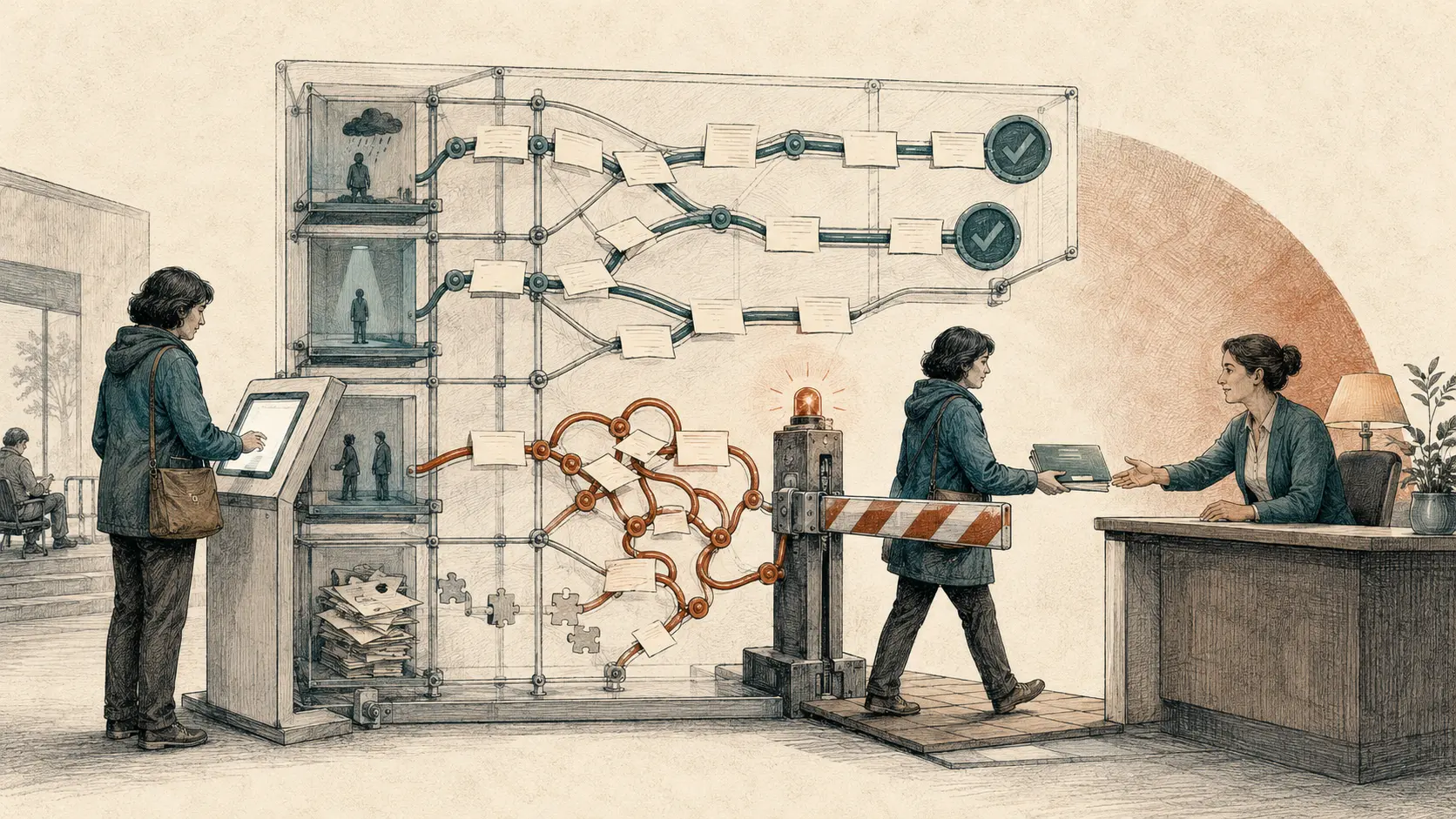
A human-centred legal intake tool needs more than a route to the end. It needs a reliable way to stop. Guided forms are valuable when they collect facts, explain standard pathways and prepare documents. They become dangerous when completing the questionnaire is mistaken for resolving the legal problem. The central design task is therefore not to automate every answer, but to recognise when uncertainty, urgency or vulnerability requires a qualified person.
What the form can do well
A guided interview is a structured conversation. One answer determines the next question: where the person lives establishes jurisdiction; the date of a notice may reveal a deadline; the kind of dispute selects a relevant form. The system can check whether required fields are present, reuse an answer consistently and turn plain-language responses into an organised document.
This is not speculative technology. The US Legal Services Corporation documents interactive document-assembly interviews used to guide people through housing, public-benefits, family and consumer-law forms. Its records also describe online intake and triage systems that link users to legal information, self-help material and in-person providers. In one documented design, users answer only a small number of initial questions before carefully planned logic directs them towards an appropriate resource.
The benefit is not that software understands law as a lawyer does. It is that much early work is structural. A person must identify the problem, preserve a deadline, gather documents and reach the right service. Technology can make those steps available outside office hours and reduce repeated data entry. For legal-aid staff, information submitted by the user can turn clerical intake into a review task, leaving more time for interpretation and judgment.
Information is not the same as advice
The boundary between legal information and legal advice is defined differently across jurisdictions, but the practical distinction is useful. Information describes rules, procedures and available routes. Advice connects those rules to a person’s particular facts, assesses risk and recommends what that person should do. A form can accurately explain a filing deadline without being able to decide whether an unusual notice is valid or whether negotiation is safer than litigation.
Problems arise when an interface hides that distinction. A sequence of confident screens may feel like a professional conclusion even when the system has merely matched keywords to a standard pathway. A generative model can make this worse by summarising uncertain facts in fluent language. Fluency removes visible friction; it does not remove legal ambiguity.
The form should therefore preserve the user’s words, identify which answers produced a route and state the limits of that route. If a model produces a summary, the person should be able to correct it before anyone relies on it. The system should not silently convert “I am not sure” into the fact that makes its next branch work.
Stopping conditions are part of the legal service
A stopping condition is a rule that prevents the automated pathway from pretending it can safely continue. Some stops are legal. The facts may fall outside the jurisdiction, several procedures may plausibly apply, or a deadline may be close enough to require immediate review. Some are factual: dates conflict, a decisive document is missing, or the person cannot tell which organisation sent the notice. Others concern the person’s situation, including coercion, disability, language barriers, homelessness or an unsafe device.
These conditions should not all produce the same message. An expired or imminent deadline may require a telephone number or urgent appointment. A non-standard case may need a referral with the collected information attached. A person who cannot use the interface may need assisted digital support or a non-digital route. The stopping mechanism is not an error page; it is a designed transition to another form of help.
The OECD’s principles for people-centred justice describe services as a continuum and call for triage, seamless referrals and transfers across legal and human-service providers. They also say that technology should enhance inclusive access while preserving access to a service provider for people challenged by technology. That makes the exit from an online form part of the justice pathway, not an admission that the digital product failed.
The strongest case for continuing automatically
Stopping too readily has costs. Legal services are scarce, and a form that refers every uncertainty to a lawyer simply moves the queue. People may abandon a process if each unfamiliar answer blocks progress. Standardised questioning can also reduce arbitrary differences between intake workers and help organisations reserve professional time for difficult cases.
This is the strongest argument for capable automation, but it does not justify false certainty. A better response is proportional escalation. The system can continue collecting undisputed facts while marking unresolved questions. It can offer general information without recommending an outcome. It can schedule a short review rather than a full consultation, or connect a user to a trained navigator when the issue is procedural rather than legal. The goal is to match scarce human expertise to the uncertainty that actually requires it.
That division of work also protects the professional. Instead of receiving a raw narrative, the adviser sees the original answers, relevant documents, detected contradictions, deadlines and the reason the automated route stopped. The machine provides memory and structure; the person supplies interpretation, responsibility and the ability to notice that the questionnaire asked the wrong question.
Access includes the ability not to use the form alone
Even a well-designed questionnaire excludes some people if it becomes the only entrance. The UK Government Service Manual’s guidance on assisted digital support recognises that users may lack internet access, digital skills, confidence, motivation or trust, and that support may be needed by telephone or in person. Legal services add further pressures: distress, unfamiliar terminology and the consequences of disclosing sensitive information.
Accessibility is not satisfied by technically conforming screens alone. A person may need an interpreter, help reading a document or a private place to answer. Someone assisting with the form should not be given unnecessary access to the whole case, and the user should know whether information is stored, sent to a legal provider or used to improve the system. A safe device question can matter as much as a correct jurisdiction question.
The useful performance measures follow from this purpose. Completion rate matters, but so do incorrect routes, missed urgent cases, referrals that reach an available provider, repeated questions, abandoned sessions and whether users understand their next step. A form that achieves a high completion rate by excluding complicated people is efficient only on its own terms.
If you value close examinations of how technology can strengthen public and legal services without displacing human responsibility, you can subscribe to Alkemata for the rest of this series.
The remaining design decision is concrete: which uncertainty may the form safely carry forward, and which uncertainty must transfer control to a person? That boundary should be set by legal professionals, service staff and users together, tested with difficult cases and monitored after deployment. The most trustworthy legal form may not be the one that always produces an answer. It may be the one that knows when an answer would be irresponsible.
