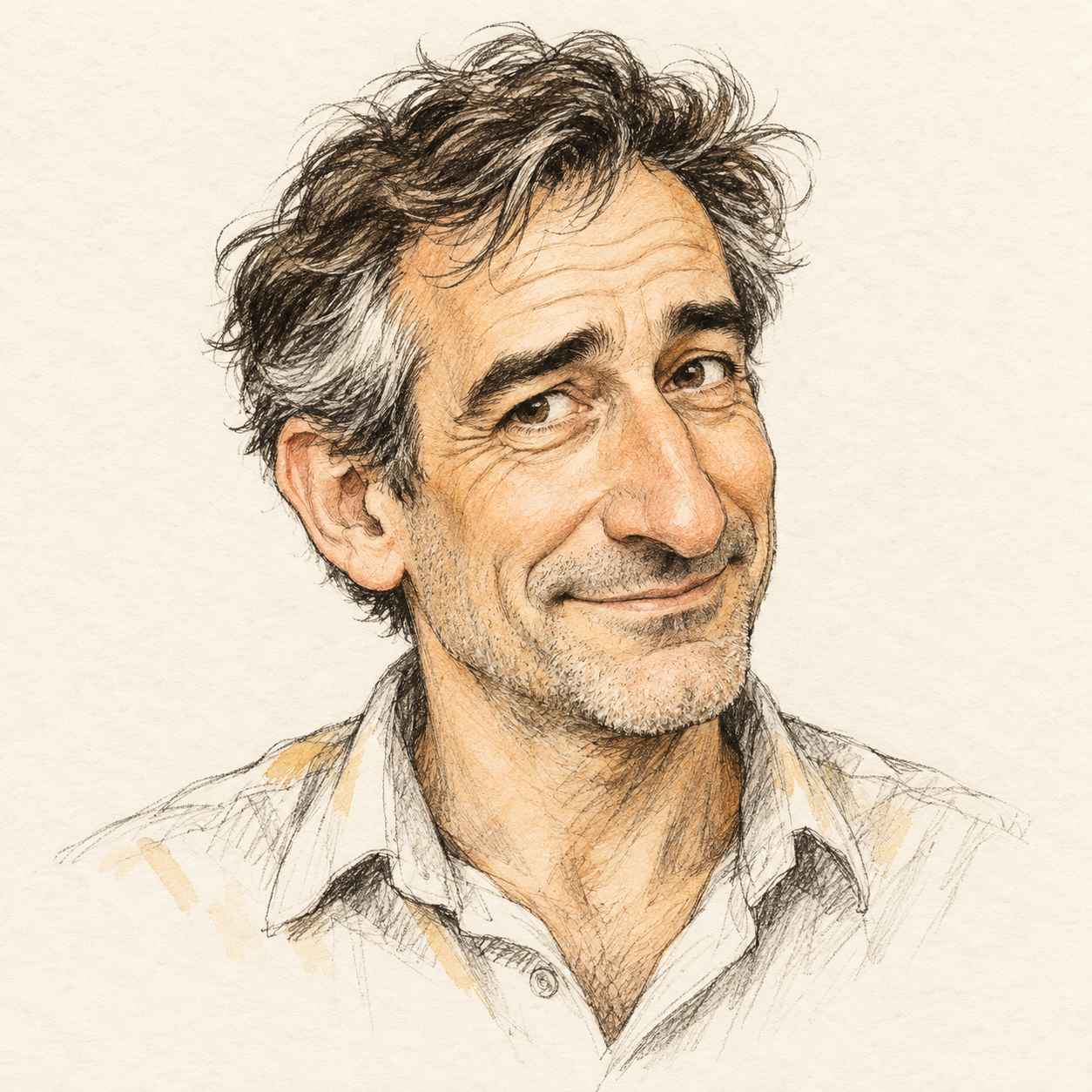
From time to time, Alkemata will take a short break for art and culture. We’ll spend a few minutes with a work, meet the person who made it, and look closely at a choice that gives it its character. We begin in a wheat field in southern France.
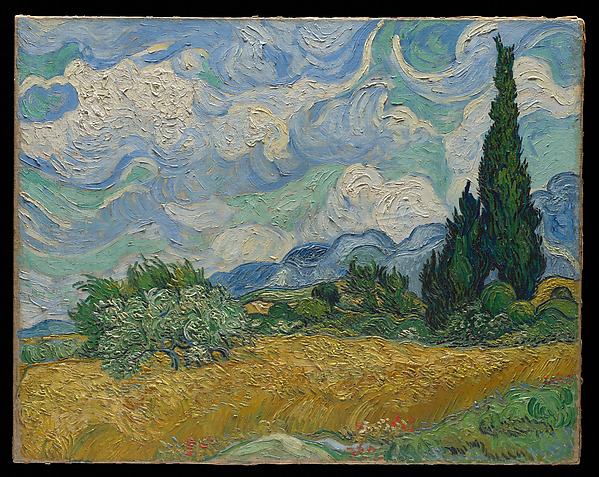
Start with the dark trees on the right. Your eye climbs the cypresses, catches a bend in the clouds, and follows it back across the sky. Below, dozens of short marks make the wheat seem to stir. How does a still canvas make the air feel so restless?
From Paris to a field in Provence
Vincent van Gogh (1853–1890) was a Dutch painter who spent the last years of his life in France. In Paris, he encountered Impressionist and Neo-Impressionist painting and began experimenting with brighter colours and shorter, more distinct brushstrokes. He moved to Arles in 1888. The following year, while a patient at Saint-Paul-de-Mausole in Saint-Rémy, he began a series of studies of the local cypresses. The Met’s biography.
He painted the canvas shown here outdoors in late June 1889. Writing to his brother Theo on 2 July, he compared the sky to a multicoloured Scottish plaid and described the paint as thickly applied, citing the French painter Adolphe Monticelli. In September he returned to the composition in the studio, making a canvas of the same size, now in London, and a smaller version intended for his mother and sister. Letter to Theo · National Gallery’s account of the three versions.
How the brush makes the wind visible
Look at how the marks change from one part of the picture to the next. In the wheat they are short and upright, with slightly different tilts. Across the sky they lengthen into looping bands. The distant hills pick up some of those bends. Van Gogh gives each part of the landscape its own kind of movement, then repeats enough curves to make field, hills and sky feel caught in the same gust.
The cypresses give all that motion something to turn around. Their dark green gathers into a single tall shape against the pale sky, while the edges are full of little flicks. The thick paint, known as impasto, gives the strokes a physical relief that a reproduction can only suggest. What makes the painting distinctive is how those decisions work together. The trees hold your eye for a moment, and the curves send it moving again. The Met’s notes on the outdoor study.
Try one last look, this time starting with the wheat in the bottom left. Where do you first feel the wind, and which marks carry your eye from there into the sky?
Author
What concrete example would confirm or challenge this article?
Choose a reaction, write a comment, or ask your AI assistant to send a proposal for review. Comments are reviewed before publication.