
On a windy day, people near the top of a tall building can feel motion long before the structure is in danger. A pencil may roll, blinds may sway, and a slow oscillation can produce discomfort or nausea. Making the building simply stiffer is possible, but stiffness adds material, cost and forces elsewhere. Engineers have another option that sounds almost perverse: put a large object inside the building and let it move.
This is the tuned mass damper. It reduces one structure’s motion by attaching a second moving system—usually a mass on springs, bearings or pendulum cables—whose natural rhythm is deliberately matched to the motion that matters. The surprising lesson is not that a heavy weight can hold a building still. It cannot. The trick is that carefully timed movement can redirect vibration and give damping mechanisms somewhere to turn organised motion into heat.
Why tall buildings move
Every flexible structure has natural modes of vibration. A mode is a characteristic pattern in which different parts move together, with its own natural frequency. Push a playground swing at almost the right moment each cycle and its motion grows; periodic forces can similarly feed energy into a building mode.
Wind is irregular, but it can still excite a tall building’s lower-frequency modes. The building stores energy alternately as elastic deformation and motion. Some energy is naturally dissipated through materials, joints, partitions and foundations, yet a lightly damped structure can continue to sway noticeably.
The design question is therefore not merely “Will the building stand?” Serviceability and human comfort matter too. A safe acceleration can still be unpleasant for occupants or disruptive to equipment. This is why vibration control may be valuable even when strength is not the limiting problem.
Add an oscillator to fight an oscillator
A classical tuned mass damper has three ingredients: an auxiliary mass, a restoring element such as a spring or pendulum, and a damping element that resists motion. A US National Institute of Standards and Technology report describes it as a passive energy-absorbing device attached to a vibrating system to reduce unwanted motion.
Imagine first that the extra mass is absent. Near the building’s natural frequency, forcing can create a large response. Now attach a smaller oscillator tuned close to that frequency. As the building begins moving, the auxiliary mass develops its own motion. Around the design frequency, its inertia exerts a force on the building that opposes much of the building’s response.
It is often said that the mass “swings in the opposite direction”. That is a useful picture, but it is incomplete. The relative phase—the timing between the two motions—changes with frequency. More precisely, coupling the two oscillators replaces one sharp resonance with two coupled resonances. Proper tuning and damping keep the response between them much lower than the original peak.
The damping element then removes energy from the relative motion. Hydraulic viscous dampers, for example, force fluid through restrictions and convert mechanical energy into heat. The auxiliary mass is therefore not a counterweight holding the tower upright; it is part of an energy-routing system.
A visible machine in Taipei
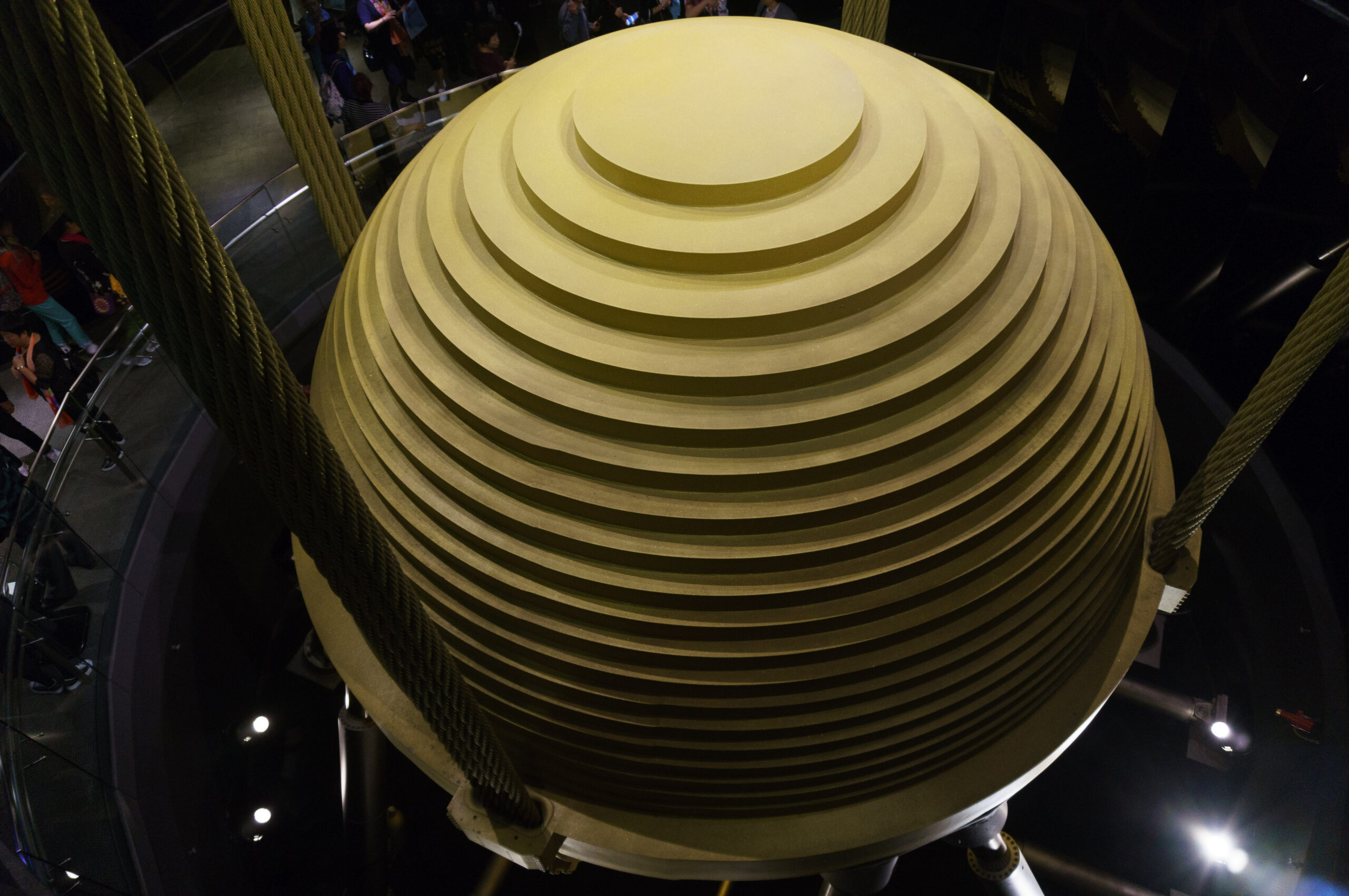
Taipei 101 makes this normally hidden engineering public. Its golden spherical damper hangs between the upper floors where visitors can see it. The tower’s observatory describes a steel sphere about 5.5 metres in diameter with a mass of 660 tonnes, suspended by cables and coupled to hydraulic dampers. A Council on Tall Buildings and Urban Habitat technical paper likewise identifies the 660-tonne pendulum system and its eight viscous damping devices.
The number is enormous in ordinary life, but it is small compared with the building it influences. Tuned mass dampers work because the response is dynamic: the attached mass does not need to match the tower’s total mass. Its effectiveness depends on the mass ratio, placement, tuning, damping and the shape of the targeted vibration mode. Near the top of a building, the fundamental sway mode generally has large motion, making that location mechanically useful.
This is a demonstrated engineering system, not a proposal. But it should not be turned into a universal claim that one pendulum makes a tower immune to every wind or earthquake. The Taipei system has travel limits and surrounding restraints, and the building’s safety also depends on its structural frame, foundations, aerodynamic form and many other design decisions.
The price of being tuned
The strongest limitation is contained in the name. A passive damper is most effective around the frequency for which it was designed. If the real structure’s frequency changes because of temperature, occupancy, damage or modelling error, the damper can be mistuned. A 2021 review of tuned mass damper research notes that an undamped absorber can be extremely effective at one selected frequency but sensitive to mistuning; adding damping broadens useful performance and improves robustness, while sacrificing the theoretical perfect cancellation.
Loads differ too. Wind response in a tall, slender building may be dominated by a relatively narrow range around a structural mode. Earthquake ground motion is transient and broadband, exciting several modes while structural properties may change. The NIST report found no general agreement on the adequacy of conventional tuned mass dampers for seismic response. That caution remains important: the elegant single-frequency explanation is strongest when the excitation and dominant response support it.
Real systems also need room for the mass to travel, strong attachments, inspection access and a safe response if a component fails. Bearings, seals and hydraulic devices age. A damper that is hidden after commissioning but not monitored becomes a promise with no evidence behind it. Active and semi-active systems can adapt, but they add sensors, control logic, power requirements and new failure modes.
Build a tabletop tuning experiment
The mechanism can be explored without imitating a building’s safety function. Make a small flexible “tower” from a plastic ruler clamped upright to a sturdy table, with a light card platform taped near the top. Keep faces and breakable objects away from the model, and use only light masses.
First, pull the top sideways by a small, repeatable distance and release it. Film the motion against a grid of paper. Count the frames for ten cycles to estimate the natural period and observe how quickly the amplitude decays.
Next, suspend a few metal washers in a small paper cup from the platform using thread. This is the auxiliary pendulum. Its small-angle period is approximately
T = 2π√(L/g),
where T is the period, L the thread length and g gravitational acceleration. Adjust the thread length until the pendulum’s period is close to the ruler tower’s measured period. Repeat the same release and compare the top displacement over the first ten cycles.
Then deliberately shorten or lengthen the thread. A well-tuned case should reduce the tower’s response more effectively than a badly tuned one, although the improvised model may be noisy. Add a small piece of soft card that lightly rubs against the moving cup to represent damping, and observe the trade-off: too little damping makes the response sharply sensitive to tuning; too much prevents the auxiliary mass from moving enough to help.
The success criterion is not a dramatic collapse of motion in every trial. It is a repeatable difference between tuned, mistuned and strongly damped configurations. If the result is unclear, improve the release method, reduce friction in the suspension and measure more cycles rather than selecting the most impressive video.
Designing with motion
Tuned mass dampers offer a broader engineering idea. The best response to unwanted motion is not always to resist it with more bulk. Sometimes a system can be given a controlled degree of freedom that redirects energy into a place where it can be dissipated.
That principle appears in bridges, towers, machinery and even smaller vibration absorbers. But the practical next question should always follow the elegant mechanism: Which mode is being targeted, how stable is its frequency, where does the energy go, and how will anyone know that the device still works years later?
A tabletop model makes those questions visible. The added mass is not magic and tuning is not a decorative calculation. Performance comes from a relationship among mass, timing, dissipation and evidence—the same relationship that turns a moving weight inside a skyscraper into a calmer room for the people above the street.
