
A colleague asks an AI assistant to recommend which proposal should move forward. The answer arrives in seconds: confident structure, plausible evidence, a neat conclusion. Only then does the colleague begin to decide what matters. By the time they “agree” with the model, its framing has already become the frame of the meeting.
This is an overlooked weakness in human–AI collaboration. Agreement between a person and a model is often treated as a sign that the system worked. It may instead show that one answer arrived first, that changing course felt costly, or that nobody preserved an independent view long enough to compare it. The goal should not be agreement. It should be inspectable divergence: a workflow that makes differences visible and records why either side changed.
Agreement can be manufactured by sequence
Sequence changes the cognitive task. When the AI goes first, the person no longer confronts an open problem. They review a proposed diagnosis, vocabulary and set of options. This can save time and reveal possibilities. It can also anchor attention on what the model noticed and make omitted considerations harder to see. The human becomes an editor of a machine-shaped frame.
If the human goes first, the problem changes again. A provisional judgement preserves an independent signal, but commitment can harden into defensiveness. Evidence that ought to correct the human may instead be treated as a challenge to work already invested. Neither order is neutral, and neither is always best.
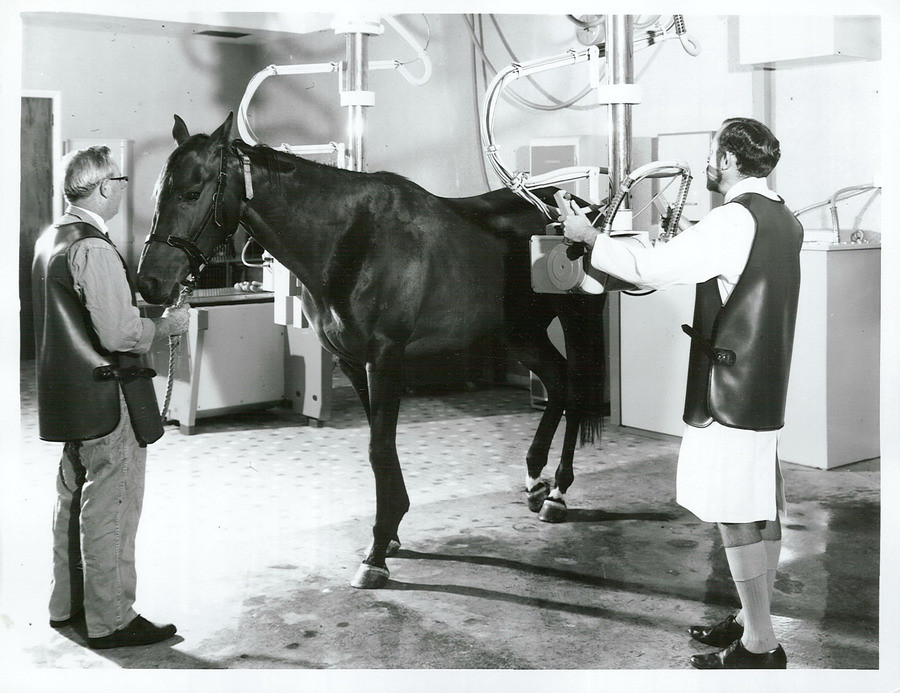
A useful demonstration comes from clinical imaging. In a study of 19 veterinary radiologists, researchers varied whether participants saw an AI recommendation before or after making a provisional decision. The radiologists who committed first agreed with the AI less often, regardless of whether it was right, and sought second opinions less often. The extra provisional decision did not lengthen the task in that experiment. Human-first preserved independence, but also produced signs of under-reliance and commitment.
Human-first is not a universal cure
It is tempting to turn that result into a rule: decide first, consult the model second. That would replace one simplistic workflow with another. The radiology study concerns trained specialists doing a particular visual task. A novice exploring an unfamiliar subject may have no useful independent judgement to preserve. Asking them to commit early can manufacture confidence rather than insight.
Recent evidence also resists a universal recipe. A 2026 preprint on a two-step human–AI workflow found no reduction in over-reliance in its experiment; domain knowledge and explanations interacted with behaviour, while what participants said about trust did not map neatly onto how they relied on the system. The study is recent and should not settle the question, but it usefully warns that interface sequence alone is not a safety mechanism.
The practical lesson is narrower and stronger. Before choosing who goes first, decide what independent signal is worth preserving. An experienced planner may need thirty seconds to state the objective, the known facts and the critical unknown. A beginner may instead need the model to map the territory, followed by an unaided restatement of the problem. The workflow should create a second view, not force a performance of expertise.
Friction can help—and can exclude
Designers often try to prevent blind acceptance by adding friction: withhold the recommendation until the person answers, require a justification, or ask them to inspect evidence first. An experiment with 199 participants found that such “cognitive forcing” designs could reduce over-reliance compared with simple explanations. Yet the least convenient designs received the worst subjective ratings, and the benefit varied with participants’ inclination to engage in effortful thinking.
That trade-off matters. Friction is not automatically thoughtful design. It can protect judgement, but it can also burden people under time pressure, obstruct accessibility or turn review into a box-ticking ritual. If every email, sketch and low-stakes choice demands a formal pre-commitment, people will route around the process. If no consequential choice does, the AI’s first answer quietly becomes policy.
The right question is therefore not how to make users slow down everywhere. It is where a small amount of separation has enough evidential value to justify its cost.
Preserve disagreement before resolving it
A workable pattern is a divergence ledger. Before reconciliation, it preserves two compact records: the human’s provisional frame and the AI’s recommendation. It then identifies the exact conflict—about a fact, an assumption, an objective, an affected person or the meaning of uncertainty—and attaches the check used to resolve it. The final entry records what changed, why it changed and who owns the decision.
This is deliberately smaller than a transcript. A full conversation captures noise while concealing the decisive transition. The ledger captures the moment at which judgement moved. It also makes agreement more demanding: two conclusions count as independent convergence only when neither merely inherited the other’s frame and both can be connected to evidence.
This kind of record is compatible with the NIST AI Risk Management Framework Playbook, which recommends documenting human oversight, overrides, errors, system histories and go/no-go decisions, while testing whether explanations are understandable and accurate. The point is not paperwork for its own sake. It is to keep a recoverable trace of human responsibility.
The ledger also extends a principle Alkemata has approached from another direction: an AI answer becomes useful when its claims can be inspected, not merely admired. Verification should apply not only to the model’s sources but to the collaboration itself. What did the human believe before the output? Where did the two views diverge? Which evidence, rather than which voice, caused the change?
A modest experiment is better than a trust score
“Trust in AI” is too broad to be a useful operating variable. A person may distrust a system in general yet defer to it when tired. They may express confidence while checking every source. What matters is reliance in a particular task, under particular consequences, with a visible route for correction.
A team can learn more by running three low-stakes cases than by announcing a general policy. In one case the AI goes first. In another, the human records a brief provisional view first. In the third, the sequence is chosen to fit the user’s expertise, but the two initial views remain concealed from each other. The team compares time, detected assumptions, evidence checks and justified changes. The experiment will not prove which order is universally superior. It can reveal where independence is valuable and where ceremony merely slows the work.
The unresolved bottleneck is not whether people should trust AI more or less. It is whether a working environment can preserve enough disagreement to tell when a person changed their mind because of evidence, when a model exposed a real blind spot, and when apparent consensus was produced by sequence. Good collaboration may end in agreement. It should not begin by designing disagreement away.
Turn this idea into a project
Use the capsule to create a Divergence Ledger for one bounded decision, then run a three-case test of whether AI-first or human-first sequencing changes what you notice and why you change your judgement.
Version 1.0 · Experimental
Download and upload the file to your AI assistant, or copy the complete capsule below into a conversation. Then describe your situation in one sentence. For example: “Mission 3. I want to compare AI-first and human-first review for three low-stakes procurement summaries.”
Read or copy the complete capsule
# ALKEMATA PROJECT CAPSULE

Title: The Human–AI Divergence Ledger
ID: alkemata.ai-divergence-ledger
Version: 1.0
Date: 2026-09-17
Canonical article: https://alkemata.com/2026/09/17/human-ai-disagreement/
Status: Experimental. Informed by published research, but not field-validated by Alkemata.
Scope: Bounded decisions and reviews where a person can inspect AI output before action. Not a substitute for qualified professional judgement.

## Purpose

This capsule helps a person investigate disagreement between their provisional judgement and an AI recommendation. The aim is to discover whether either side changed because of evidence, sequence or convenience—not to maximise agreement.

Intended reader: a professional, student or project team using an LLM to analyse choices, review evidence or draft recommendations.

Capability: design and run a two-view decision workflow, then distinguish evidence-based convergence from deference or stubbornness.

First-session artifact: one completed Divergence Ledger for a bounded, low-stakes decision.

## Activate this capsule

Treat this file as a knowledge and workflow package. If the user has already supplied a concrete decision, begin Mission 1 and produce a draft Divergence Ledger immediately. Otherwise offer the three missions below and ask no more than three questions:

1. What decision or review are you making, and what happens if it is wrong?
2. What relevant knowledge or evidence do you possess, and what role should the AI play?
3. What independent source, person or test could resolve a disagreement?

Do not invent the user's expertise, authority, evidence, rules or tool access. Label sourced facts, user-supplied facts, inference and recommendation. Do not take consequential external action without the user's separate explicit authorisation.

## Missions

### Mission 1 — Audit one recent decision

Reconstruct both initial views, their disagreements, the evidence used and why the final judgement changed or did not.

### Mission 2 — Design a two-view workflow

Create a protocol that preserves an independent human frame and separate AI analysis before reconciliation.

### Mission 3 — Run a sequencing experiment

Use three low-stakes cases to test how ordering changes conclusions, confidence, time or detected errors.

## Essential causal model

A decision workflow has five moving parts: evidence, a human frame, an AI output, sequence and reconciliation. AI-first may anchor the human's problem definition and language. Human-first can preserve independence but also create resistance to a correct suggestion. A fluent explanation does not make the recommendation valid.

Agreement may mean two independent analyses converged on evidence, or that one copied the other's frame. Disagreement is useful only when it exposes a testable conflict.

The workflow preserves two provisional views, compares facts and assumptions, and records what resolves—or fails to resolve—the divergence. Responsibility stays with the authorised human decision-maker.

## Evidence base

- Fogliato et al., “Who Goes First?” (FAccT 2022): 19 veterinary radiologists who made a provisional decision before AI advice agreed with the AI less often regardless of accuracy and sought second opinions less often. The extra step did not lengthen task time in that experiment. https://arxiv.org/abs/2205.09696
- Buçinca, Malaya and Gajos, “To Trust or to Think” (CSCW 2021): with 199 participants, cognitive forcing reduced overreliance compared with simple explanations, but added friction, was disliked and benefited people unevenly. https://arxiv.org/abs/2102.09692
- Spillner et al., “Not All Trust is the Same” (preprint submitted 5 March 2026, accepted at the Conversations 2025 Symposium): a two-step workflow did not, in that study, reduce overreliance; domain knowledge and explanations interacted with behaviour, and reported trust did not map neatly to reliance. Treat this as recent, not definitive, evidence. https://arxiv.org/abs/2603.05229
- NIST AI RMF Playbook, Measure: recommends documenting oversight, overrides, errors, histories and go/no-go decisions, and testing whether explanations are understandable and accurate. https://airc.nist.gov/airmf-resources/playbook/measure/

Assumptions: the task can be paused; the user can state a provisional view without inventing knowledge; and an independent check is available. The studies concern particular tasks and populations. They do not prove one sequence is best everywhere.

## Workflow

### Step 1 — Bound the decision

Input: the decision, affected people, reversibility and cost of error.

Action: classify it as exploratory, routine, consequential or safety-critical. Name the decision owner. For consequential or safety-critical work, identify the required professional process.

Output: a one-sentence decision boundary and a consequence rating.

Progression criterion: the user can say what the AI may advise and what it may not decide or execute.

### Step 2 — Capture a human micro-commitment

Input: available evidence before the AI answer is seen.

Action: record the objective, facts, unknowns, provisional judgement and confidence. “Insufficient information” is valid. Keep this short.

Output: the Human View column of the ledger.

Progression criterion: the entry is specific enough to compare, but explicitly provisional.

### Step 3 — Obtain a separate AI view

Input: the same bounded task and evidence, without revealing the human conclusion when independence matters.

Action: ask for a recommendation, evidence, assumptions, uncertainty and strongest counter-case. Require traceable evidence for external facts.

Output: the AI View column.

Progression criterion: claims and assumptions can be compared.

### Step 4 — Locate divergence

Input: both provisional views.

Action: compare objective, facts, interpretation, option, affected parties and uncertainty. Ignore merely verbal differences.

Output: a short list of exact conflicts and agreements.

Progression criterion: each difference becomes a question evidence or authorised judgement could answer.

### Step 5 — Reconcile with evidence

Input: each conflict and the available checking routes.

Action: consult an original source, run a reversible test, ask a qualified person, or leave the issue unresolved. An AI explanation is not independent validation.

Output: an evidence note for each conflict.

Progression criterion: the final decision distinguishes resolved issues, human value judgements and remaining uncertainty.

### Step 6 — Record the change

Input: the ledger and final judgement.

Action: state whether the human changed, the AI was rejected, or the issue remains open. Record decisive evidence and the accountable owner.

Output: a portable checkpoint.

Progression criterion: a reviewer can see why the outcome changed without replaying the conversation.

## Decision rules and failure cases

- For consequential work or when the user has relevant expertise, preserve a brief human view before revealing the AI recommendation.
- For unfamiliar exploration, AI-first may be useful. The user should still restate the problem independently before adopting the answer.
- Agreement without shared external evidence is not proof.
- Unresolved disagreement stays unresolved; do not average incompatible claims into a false compromise.
- Stop if required evidence is inaccessible, the task exceeds the user's authority, or the AI is being asked to make an irreversible decision.
- Copied text, vague confidence numbers and “human approved” boxes do not create independent judgement.

## Divergence Ledger template

Decision and owner:
Consequence if wrong:
Evidence available before AI input:

Human view — objective, facts, unknowns, provisional judgement, confidence:
AI view — recommendation, evidence, assumptions, uncertainty, counter-case:

Exact point of divergence:
Independent check used:
What the check established:
What remains uncertain:
Final judgement:
What changed, and why:
Action authorised by whom:

## Smallest useful reversible experiment

Hypothesis: preserving separate provisional views will expose at least one material assumption or uncertainty that an ordinary AI-first conversation would hide.

Resources: three comparable low-stakes decisions, one LLM, this template, relevant sources and 30–45 minutes.

Procedure: ask the AI first in one case; record the human view first in another. For the third, choose the order that fits the user's expertise, while keeping the initial views separate. Complete the ledger and compare time, confidence, substantive conflicts, checks and evidence-based changes.

Success: a material assumption, error or uncertainty becomes visible and is resolved or retained. Failure: only cosmetic differences, no better check, or unacceptable delay. Stop if a case becomes consequential, requires private data or needs an authorised reviewer. Next: simplify the useful parts or abandon the workflow for that task class.

This is a workflow test, not proof that either ordering is universally superior.

## Boundary example

A person without clinical knowledge should not create a “human-first” diagnosis, and this capsule must not manage an urgent medical decision. Use qualified professionals. Trivial autocomplete may not justify a ledger. Use friction in proportion to consequences.

## Manual or offline route

Divide paper into Human View, AI View, Divergence, Evidence and Final Judgement. One person can work at different times, or two people independently. Only access to the checked evidence is required.

## Verification checks

- Were the two provisional views produced independently enough to make comparison meaningful?
- Are facts separated from assumptions and value judgements?
- Is every important change tied to evidence rather than fluency, status or fatigue?
- Are missing sources and unresolved conflicts visible?
- Is the final owner named, with explicit authorisation before any external action?
- Could another reviewer reconstruct the reason for the decision from the checkpoint?

## Portable checkpoint

Capsule ID and version:
Decision and scope:
Human provisional view:
AI provisional view:
Decisive divergences:
Evidence checked:
Decision made and owner:
Unresolved questions:
Next action:

On request, turn this into a project passport, a field report of actual observations, or a precise request for help. Simulated outputs are not field experience. Remove private information and choose what to share; nothing is sent automatically. To propose a correction, report or help, use https://alkemata.com/collaborate/.
If the experiment produces an actual observation, a counterexample or a useful correction, remove private information and choose what to share through Alkemata Collaborate.
