
You switch on an electric kettle. At first there is little more than the click of the switch. Then comes a rising hiss and a rough, almost gravelly roar. Just before the kettle stops, the sound often softens or changes character—even though the water is hotter and energy is still pouring in.
The quieting seems backwards. If sound simply measured heat, the kettle should become steadily louder until boiling. It does not, because the sound mainly tracks what vapour bubbles do between the heater and the surface.
The central idea is simple: early vapour bubbles are born in water that is still too cool to let them survive. They collapse. As the whole kettle warms, more bubbles can complete the journey. The changing noise is an audible map of an uneven temperature field becoming more uniform.
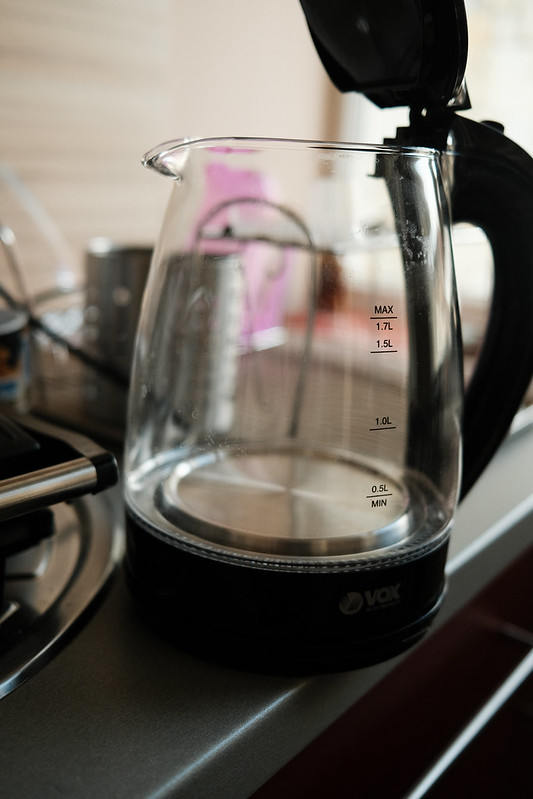
One kettle, two temperatures
An electric element or heated metal base transfers energy into the water touching it. That thin boundary layer warms first. Natural convection carries some warm water upward while cooler, denser water moves down, but mixing is not instantaneous. For much of the heating cycle, the water beside the heater can be hot enough to create vapour while the bulk water above it remains below its boiling temperature.
This state is called subcooled boiling: boiling begins locally at the hot surface even though the average liquid is cooler than the saturation temperature set by the surrounding pressure. Vapour appears most readily at nucleation sites—tiny scratches, pits or particles where a bubble can begin without creating an entirely new interface from nothing.
Once a small vapour bubble leaves the hot region, it enters cooler water. Vapour condenses back into liquid, the bubble loses volume and surrounding water rushes inward. Many such rapid growth-and-collapse events create pressure fluctuations that the kettle body and kitchen air turn into sound. More than a century ago, Lord Rayleigh’s analysis of a collapsing spherical cavity was prompted in part by descriptions of the sounds from water approaching the boil.
The word cavitation is often used for the kettle’s noise, but it needs care. Engineering convention usually reserves cavitation for vapour cavities created by a local pressure drop, such as around a propeller. A kettle creates them mainly by raising temperature at roughly constant pressure. The collapse physics is related; the route to making the bubble is different.
Why the loud phase ends
As heating continues, convection and conduction narrow the temperature difference between the base and the rest of the water. A rising bubble now meets warmer surroundings, so less of its vapour condenses. Its collapse becomes weaker, or it survives long enough to reach the surface. The sharp chorus of subsurface collapses therefore diminishes even while visible boiling becomes more vigorous.
This is not a perfectly tidy sequence. Bubbles also grow, oscillate, merge, detach and burst; flowing water excites the kettle’s structure; the lid and housing resonate. A 2025 peer-reviewed roadmap for decoding boiling sound describes acoustic emissions across a wide frequency range and warns that microphones capture a mixture of bubble events and structure-dependent effects. The familiar rise and fall is real, but no single tone belongs to one universal water temperature.
The heater’s automatic switch-off is a separate mechanism. Most kettles do not listen for quiet. They route steam towards a thermostat, whose temperature-sensitive element changes shape and opens the electrical contact. The sound can therefore reveal the approach to boiling, but it is not the control system that makes the appliance safe.
What scale changes
A new acoustic pattern does not automatically mean a failing kettle. Fill level, starting temperature, lid fit, heater power, container shape and the room itself all change what a phone microphone records. Water chemistry matters too. Mineral scale creates a rough, insulating layer on the heated surface. It changes both heat transfer and the sites at which bubbles form.
Consumer NZ reported a practical comparison in which the same scaled kettle became quieter after cleaning, with sound level falling from 79.1 to 75.4 decibels in its test. That is evidence about one appliance, not a universal conversion from noise to scale thickness. It supports a more modest claim: a kettle’s own sound can change when its internal surface changes.
The strongest objection to “listening” as a diagnostic is therefore correct. A recording cannot tell you the water temperature, prove that scale is present or certify that the thermostat works. Nor should anyone defeat the lid, hold a microphone over steam or interrupt the automatic shut-off to obtain a cleaner trace. The value lies in comparison under the same ordinary conditions.
A three-boil audio diary
You can reveal the pattern without modifying the appliance. On three different days, fill the kettle to the same marked level with cold tap water under similar conditions. Place a phone on a dry surface at a fixed, safe distance and start a voice recording before switching on. Keep hands, cables and the phone away from the kettle, and let the appliance stop normally.
For each recording, note four times: switch-on; the beginning of the loud, rough phase; the moment the sound noticeably softens or changes; and automatic switch-off. Most voice-recording apps display a waveform, but exact decibel values are unnecessary. Compare the shape and timing of the three recordings rather than comparing your kettle with someone else’s.
A repeatable quieting phase shows that the sound carries information about the transition from strongly uneven heating to sustained boiling. Large differences between trials may come from starting temperature or fill level before they indicate a fault. If the pattern changes over months and visible scale is present, follow the manufacturer’s cleaning instructions; do not invent a stronger descaling mixture. If the kettle fails to switch off, leaks, smells burnt or behaves erratically, stop using it rather than treating an audio experiment as a safety test.
The diary also offers a broader lesson about everyday instruments. As with a phone’s battery percentage, a convenient signal can reveal hidden state without measuring it directly. The responsible question is not whether the sound “knows” the temperature, but which mechanism produced the signal and which uncertainties travel with it.
Next time the kettle grows quiet, listen for a change in bubble fate: from vapour that repeatedly forms and disappears below the surface to bubbles that survive the climb. The useful experiment is not to predict the exact boiling point by ear. It is to discover how much physical information an ordinary appliance already makes audible—and where that information stops.
Author
What concrete example would confirm or challenge this article?
Choose a reaction, write a comment, or ask your AI assistant to send a proposal for review. Comments are reviewed before publication.