
Imagine needing a sewing machine for one repair, a projector for one evening and a carpet cleaner after moving home. Buying all three would purchase not just their useful hours, but years of storage, maintenance and eventual disposal. Borrowing sounds obvious until the object is unavailable on the only day you can use it.
Here is the idea worth extending: what if a neighbourhood treated occasional access to useful equipment as infrastructure, with a published service standard, rather than a fortunate encounter with somebody else’s spare drill? The ambitious version is not a city that owns everything. It is a city where more people can complete practical projects without first becoming owners. The limit is that shared objects cannot be in two homes at once. A credible experiment must begin with that constraint, not conceal it.
From a collection to a capability
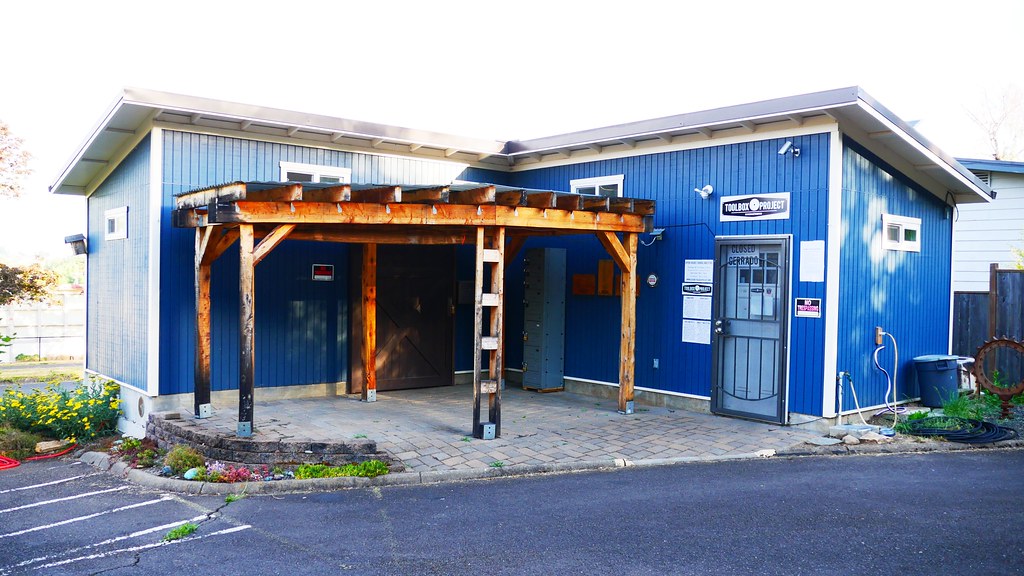
Tool lending is not a new invention awaiting an app. Berkeley Public Library records that its Tool Lending Library began in 1979, with community focus groups helping determine the tools and support people wanted. Its history also describes the dedicated space needed to house, repair and store equipment. The institution mattered alongside the inventory.
A contemporary version already operates through Library of Things: borrowers reserve equipment online, collect and return it through local kiosks, and can join skill-sharing activities. Its published workflow demonstrates that this service can be organised. It does not establish that every neighbourhood, item or borrower will obtain the same economic or environmental benefit.
Now push the proposition further. A network of neighbourhood hubs could offer a defined set of capabilities: mend clothes, clean a carpet, host a small event or maintain a garden. Each capability would include suitable equipment, required accessories, understandable instructions and a named route to help. The catalogue would describe the project someone can attempt, not merely a product model they must already recognise.
This is more demanding than lending objects. A sewing machine without the right foot, a projector without a compatible cable or a tool without an essential attachment is inventory that cannot perform its promised task. Completeness becomes a service requirement. The shared resource is a working kit, checked between users, not a box whose contents are assumed to be intact.
The pooling trick—and its hard ceiling
Sharing works best when different people need the same durable object at different times. Several households can then obtain useful hours from fewer units. But the relevant number is simultaneous demand, not average use.
Consider a deliberately simplified example. Twenty households each request a machine for one day in a twenty-day period. If those requests fall on different days, one machine could theoretically serve them all. If every request falls on the same Saturday, one machine serves only one household. The total requested machine-days is identical; the required capacity is radically different. Real lending also needs time for collection, return, inspection, cleaning and repair.
A network can move spare stock between hubs, but moving it consumes time and labour. Longer loans reduce handovers while tying up capacity. Short loans release stock faster but make borrowing harder for someone whose free time is fragmented. Keeping every object almost continuously booked looks efficient until one late return or breakdown disrupts the next reservation. Some spare capacity is the price of a dependable promise.
The surprising design choice is therefore to measure declined and delayed requests as carefully as successful loans. A busy catalogue may conceal people who stopped trying. Ask not only how often the equipment left the building, but which projects could not proceed and why.
Take the idea to its uncomfortable conclusion
At city scale, a service standard might promise that a basic kit can usually be obtained locally within a stated booking window. This would be a proposed target to test, not a guarantee any existing operator is making here. Meeting it could require stock shared across public libraries, cooperatives and commercial hire businesses, with clear responsibility when the first provider cannot fulfil a reservation.
Who gets the last available machine? First-come, first-served favours people who can plan early and monitor bookings. Higher prices favour people with money. Unlimited free reservations invite hoarding. A neighbourhood board could instead combine booking limits, a waiting list, a small reserve for time-sensitive needs and concessions whose administration does not cost more than the support provided. None is neutral. The rules should be public, contestable and reviewed with borrowers who currently lack equipment.
There are other boundaries. Some tools require training, specialist judgement or professional work rather than a casual loan. Inspections need competent people and records. Damage charges and insurance need explicit terms; an improvised waiver is not a substitute for a locally appropriate safety and liability arrangement. A person checking returns must be able to withdraw an item without being penalised for reducing lending figures.
Access also includes getting the object home. A cheap bulky appliance on the other side of town is not equally usable by a car owner, a wheelchair user and someone carrying it on a bus. Delivery may help, but it adds cost. Telephone or in-person reservations, workable opening hours and instructions in accessible formats belong in the service design from the outset.
The strongest case for keeping your own
Ownership provides immediate availability, familiarity and independence from an institution’s opening hours or continued funding. A frequently used tool may be better owned. Commercial hire may already serve specialised needs efficiently. A new public scheme could duplicate that capacity while asking volunteers to absorb the hidden work.
This objection rules out a universal replacement for ownership. It does not rule out selective shared provision. The promising territory is equipment that is durable, transportable, maintainable and useful intermittently, with demand spread across time. Choosing that territory requires local evidence.
Nor is every loan automatically an avoided purchase or a carbon saving. The borrower may otherwise have borrowed privately, hired commercially or done nothing. Shared stock wears out, transport has impacts and cheaper access can encourage additional consumption. An honest evaluation would distinguish purchases genuinely displaced from newly enabled activities, then count maintenance and logistics. New capability can be worthwhile even when it is not a measurable emissions reduction.
That distinction complements Alkemata’s exploration of buildings as material banks. There the question was how components survive a change of use. Here it is how a maintained object can serve repeated users without access depending on private ownership.
Start with requests, not donated stock
A housing association, community centre or library could begin with a four-week demand diary, before buying anything. Invite twenty households to record occasional equipment needs, preferred dates, how far they could travel and what they would otherwise do. Record the task as well as the item. Participation should be voluntary, and published results should not identify households or reveal their schedules.
Use those requests to simulate three small inventories. Count which requests each could meet, allowing realistic turnaround and repair buffers. Test what happens when the most useful item is unavailable for a week. This paper exercise can expose a Saturday bottleneck before money is committed.
If demand supports a trial, select a few low-risk items with a competent host, agreed operating rules and a maintenance budget. Begin, for example, with non-powered gardening hand tools rather than equipment requiring specialist operation. Run the trial for eight weeks. Record successful requests, refusals, turnaround time, staff minutes, damage, travel burden and reported purchases displaced. Agree the continuation test beforehand: a desired level of fulfilled demand, an affordable cost per completed use and no unresolved safety failures.
The point is not to prove that sharing is virtuous. It is to discover whether this neighbourhood can make a particular capability dependable at a lower burden than each household arranging it alone. If the trial fails because demand coincides, change the stock or the scope. If it fails because maintenance is unfunded, do not call that a software problem.
A useful first meeting would therefore have no donated equipment on the table. It would have a calendar, a list of projects people cannot currently do and the question that turns a generous cupboard into infrastructure: what exactly are we prepared to make reliably available, and who will keep that promise?
